
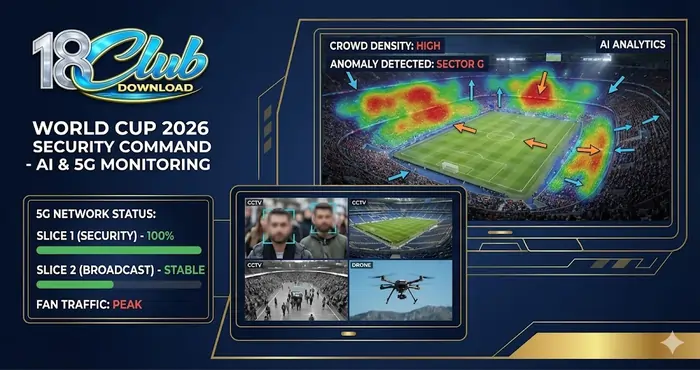
The World Cup 2026 security and technology strategy represents a monumental shift in global event management. As of February 2026, with the opening whistle just months away, organizers have finalized a technology-first safety model designed to protect an unprecedented 48 teams and millions of visitors across North America. This is not merely a sports tournament; it is a multi-billion-dollar infrastructure project that serves as a high-pressure laboratory for the next era of urban safety and digital integration.
At 18clubdownload.com, we provide structured intelligence into how advanced surveillance, cybersecurity protection, and AI-driven crowd monitoring will redefine the fan experience at the FIFA World Cup 2026. This expanded guide dives deep into the systems, software, and hardware that will make the 2026 edition the most secure—and technologically advanced—event in human history.
Overview: The 2026 Security & Tech Knowledge Graph
| Category | Technology & Systems | Strategic Impact |
| Command & Control | Integrated Security System (ISS) | Real-time monitoring across 16 venues. |
| Airspace Defense | Fortem DroneHunter | Autonomous interception of hostile drones. |
| Crowd Intelligence | Dataminr AI Intel Agents | Predictive triage of emerging safety risks. |
| Network Security | Netscout DDoS Scrubbers | Protects 8K broadcasts and digital ticketing. |
| Medical Response | Hyperlocal Heat Sensors | Automated alerts for spectator heat stress. |
1. The “Digital Nerve Center”: Integrated Security Systems (ISS)
On January 27, 2026, officials formally unveiled the Integrated Security System (ISS)—the digital backbone of the tournament. Unlike previous versions, which operated in silos for each stadium, this system connects every one of the 16 venues across Canada, Mexico, and the USA to a central command portal.
The ISS is more than just a collection of camera feeds. It is an active AI participant in stadium safety. Utilizing edge computing, the system can autonomously analyze patterns of movement to detect anomalies. For instance, if a specific gate at MetLife Stadium begins to experience a surge in crowd density that matches “crush” conditions, the ISS can automatically redirect digital signage and alert on-ground staff to open additional overflow valves.
This system provides a level of transparency never seen before. Local law enforcement, federal agencies (like the DHS and FBI), and FIFA’s private security detail can access synchronized data feeds, ensuring that the response to a localized incident in Vancouver is just as efficient as one in Mexico City.
2. Smart Stadium Technology: The IoT Revolution
Modern venues like the World Cup 2026 final host have been transformed into “Intelligent Entertainment Hubs.” These smart stadiums use a grid of thousands of IoT (Internet of Things) sensors to track everything from crowd flow to restroom hygiene and environmental temperature.
The Role of 5G and Network Slicing
Because 80,000+ fans will be checking stats, posting to social media, and utilizing Augmented Reality (AR) apps simultaneously, standard cellular networks are insufficient. Carriers have deployed 5G Network Slicing for the tournament. This technology allows the physical network to be divided into virtual “slices.”
- The Security Slice: Reserved exclusively for law enforcement and emergency responders, ensuring they always have 100% bandwidth, even if the fans’ network is congested.
- The Broadcast Slice: Dedicated to ensuring that World Cup 2026 opening match 8K broadcasts are transmitted with zero latency.
- The Fan Slice: Optimized for high-speed social sharing and AR experiences.
This ensures that the massive data consumption of modern fans never compromises the critical communication lines needed to keep people safe.
3. AI Surveillance and the “Referee View”
Artificial Intelligence is the “all-seeing eye” of the World Cup 2026 security and technology plan. FIFA and Lenovo have recently unveiled “Football AI Pro”, which introduces innovations that impact both safety and the game itself.
3D Player Avatars and Offside Technology
Players are now digitally scanned in real-time, creating precise 3D models. This allows the Semi-Automated Offside Technology (SAOT) to be more accurate than ever, even when players are bunched together during a corner kick. For the fans, this translates to “Referee View”—a stabilized first-person perspective from the referee’s body-cam, rendered in real-time by AI to remove the natural shaking of the official’s movements.
Behavioral Analytics for Crowd Safety
In the concourses and perimeters, AI-powered cameras are programmed to recognize specific “threat behaviors.” These include:
- Identification of Abandoned Objects: Detecting a package left unattended for more than 120 seconds.
- Aggression Detection: Flagging physical altercations in a crowd before a human operator notices the commotion.
- Perimeter Breaches: Using thermal imaging and AI to detect unauthorized entry attempts in low-light conditions.
4. Drone Sovereignty: Defending the Airspace
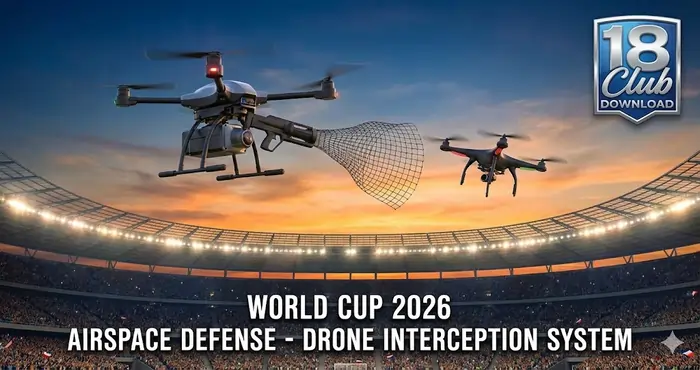
Airspace security is a top priority for the U.S. Department of Homeland Security (DHS) as the threat of unauthorized or hostile drones (UAS) has become a primary concern since the last World Cup cycle. This makes World Cup 2026 security and technology a critical area of focus, leading the DHS to tap Fortem Technologies to deploy AI-enabled DroneHunter interceptors at 11 U.S. venues. These autonomous systems act as a “physical firewall,” utilizing specialized radar to track intruders and firing nets to capture them mid-air, which prevents rogue drones from falling uncontrollably into a crowd.
This World Cup 2026 security and technology investment, totaling approximately $115 million, creates a “Golden Dome” of airspace defense designed to protect millions of fans. Beyond physical interception, the strategy includes sophisticated radar detection and potential signal jamming to ensure comprehensive airspace protection. By prioritizing World Cup 2026 security and technology, organizers are setting a new global standard for how massive sporting events manage the growing complexity of modern UAS threats, ensuring a safe environment for the historic 48-team tournament.
The Fortem DroneHunter System
DHS has tapped Fortem Technologies to deploy AI-enabled DroneHunter interceptors at 11 of the U.S. venues. These autonomous drones act as a “physical firewall.” When an unauthorized drone enters the restricted airspace, the DroneHunter is launched. It uses its own radar to track the intruder and fires a net to capture it mid-air. This method is preferred over signal jamming because it prevents the rogue drone from falling uncontrollably into a crowd of fans.
This $115 Million Investment creates a “Golden Dome” of airspace defense, making it nearly impossible for rogue actors to disrupt a match from the sky.
5. Cybersecurity: Defending the Digital Stadium
In 2026, a World Cup is just as much a digital target as it is a physical one. From ticketing systems to the Video Assistant Referee (VAR) fiber lines, every bit of data must be protected.
DDoS Mitigation and the “Scrubbing” Center
Using Netscout’s scrubbing centers, FIFA can divert massive “denial of service” attacks away from their primary servers. This technology “scrubs” the malicious traffic and allows only legitimate fan data to pass through. This is vital for maintaining the integrity of the World Cup 2026 final broadcast, which will be the most-watched digital event in history.
Biometric Identity and Data Privacy
Mobile-first ticketing is mandatory for 2026, linked to the fan’s verified digital ID. While this virtually eliminates ticket scalping and fraud, it raises concerns about data privacy. FIFA and the host nations have implemented “Data Sovereignty” protocols, ensuring that fan biometric data is encrypted and deleted shortly after the tournament concludes, following the strict privacy laws of Mexico, Canada, and the USA.
6. Emergency Preparedness: AI-Assisted Triage
Fan safety also encompasses health. In cities like Miami, Houston, and Monterrey, heat stress is a primary concern for the June/July schedule. Stadiums are being equipped with Hyperlocal Climate Hazard Sensors.
These AI-powered tools deliver real-time alerts to medical teams, enabling them to:
- Predict Heat-Stroke Clusters: Using crowd density and temperature data to move water-misting stations to areas of high risk.
- Automated Triage: Using wearable tracking for first responders, allowing the central command to route the nearest medic to an unconscious fan via the most efficient path through the crowd.
7. The Legacy of 2026: A Blueprint for the Future
The innovations introduced in the World Cup 2026 security and technology plan will not disappear after the trophy is lifted. This tournament is serving as the blueprint for:
- Smart Cities: Using the crowd-monitoring AI to improve daily transportation in host cities like New York and Dallas.
- Future Olympics: Providing a tested framework for the 2028 Los Angeles Games.
- Public Transit Safety: Implementing the biometric and IoT sensors into major airport and rail hubs across North America.
Conclusion: A Safer, Smarter World Cup
The World Cup 2026 security and technology framework is a masterclass in modern risk management. By integrating autonomous drones, 5G slicing, and predictive AI, FIFA is setting a new standard for global safety. For fans, this means faster entry, better crowd management, and the peace of mind to focus on the legendary action on the pitch.
Beyond the field, the technologies tested in 2026 will redefine how we protect large-scale public gatherings for decades to come. As kickoff approaches, one thing is certain: the world will be watching, and thanks to this technology, the world will be safe.
For the latest World Cup 2026 debut nations and tournament updates, continue following our coverage at 18clubdownload.com.