
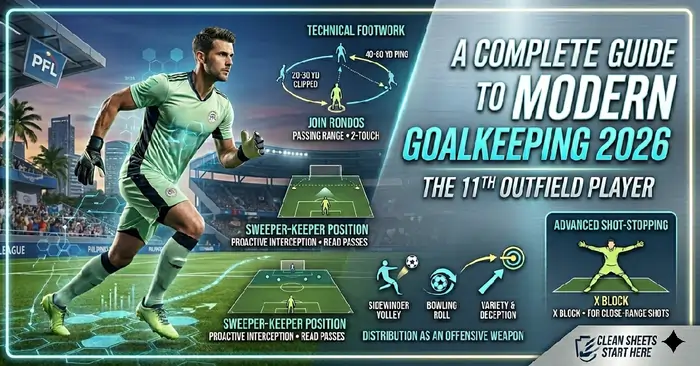
The guide to modern goalkeeping in 2026 is more than a specialist in gloves—they are the 11th outfield player, a playmaker, a sweeper, and a leader who shapes every phase of the game. This guide walks through how we got here, what skills you need, how to train, and how to adapt all of this to the realities of football in the Philippines.
The Evolution: From Shot-Stopper to Playmaker
For decades, goalkeepers were treated like a separate species on the pitch. They wore different kits, trained in separate groups, and were judged almost entirely on how well they could dive and catch. Their job description was simple: stay on the line, react to shots, and clear danger when it got too close. Today, in 2026, that job description is outdated.
From Isolation to Integration
The modern game is obsessed with one idea: numerical superiority. If you can create a free player somewhere on the pitch, you can progress the ball, break a press, and eventually create chances. Traditionally, teams played “10 vs 10” in open play because the goalkeeper was not involved. Now, coaches have realized that if the keeper can genuinely play with their feet, the team essentially has an extra outfield player in build-up.
This is why you now see goalkeepers stepping high, splitting center-backs, and joining passing triangles. When a keeper is calm in possession, opponents must decide: press the goalkeeper and leave someone free, or sit back and let the keeper dictate the tempo.
The Death of the Aimless Long Clearance
In older eras, the classic escape option was the long, hopeful clearance. Under pressure? Launch it. While there are still moments where a long ball is necessary, blindly “hoofing” the ball upfield is increasingly seen as throwing away possession.
Modern coaches expect the goalkeeper to:
- Scan the field before receiving the ball.
- Control even difficult back-passes calmly.
- Find a teammate’s feet or chest instead of kicking and praying.
In this new landscape, losing the ball from an easy pass is treated almost like conceding a soft goal. The keeper is now judged for their passing decisions the same way a central midfielder is.
The Goalkeeper as Quarterback
Think of the modern goalkeeper as the “quarterback” of the pitch. Players like Kevin Ray Mendoza and Neil Etheridge at club and international level embody this evolution. They do not just look for the nearest defender to relieve pressure; they actively search for line-breaking options.
That might mean:
- Slipping a pass through the first pressing line into a defensive midfielder.
- Clipping the ball over an aggressive winger into the full-back’s path.
- Driving a low, accurate 40–60 yard ball into an advancing winger’s run.
These passes don’t just avoid danger; they turn defense into attack in one action. A modern goalkeeper who can consistently find these passes becomes as much a playmaker as a number 6 or 8.
The Core Pillars of Modern Goalkeeping
To truly become the 11th outfield player, you need to master four main pillars: technical footwork, sweeper positioning, offensive distribution, and advanced shot-stopping. You cannot rely on just one; the modern role demands all four working together.
Pillar I: Technical Proficient Footwork
You are a footballer first, a goalkeeper second. That mindset changes everything.
Key components:
- Receiving under pressure
You must be comfortable taking a back-pass on either foot, even when a striker is sprinting at you. That means opening your body to the field, angling your first touch away from pressure, and never panicking when you see a forward closing in. Your “weak” foot cannot be truly weak anymore—it has to be reliable. - Passing range
Think of your passes like clubs in a golf bag:- The short 5–10 yard pass into a center-back or pivot.
- The 20–30 yard clipped ball over an onrushing winger into your full-back.
- The 40–60 yard “ping” to a winger or target forward.
Each pass has its moment. The more options you have, the harder you are to press.
- First touch
A poor first touch for a goalkeeper is not just a turnover; it can be a direct goal. In a crowded penalty area, a heavy touch gives the pressing forward half a second to slide in and poke the ball past you. Your first touch should always set up the next action—either a pass or a clearance. That requires repetition, but also composure.
Pillar II: The “Sweeper” Positioning
Modern teams love the high defensive line because it compresses space and helps them press. But a high line leaves a huge gap behind the defenders. That space is your responsibility.
- Starting position
When your team is settled in possession in the opponent’s half, you should not be on your six-yard line. Instead, you move up toward the edge of the 18-yard box or even a few steps beyond it, depending on your speed and comfort level. From here, you can react faster to through-balls and long passes over the top. - Proactive interception
You are not waiting for shots; you are reading passes. You watch body language, scanning for opponents shaping to play balls in behind. When you see it, you accelerate off your line to clear, intercept, or even control the ball and restart play. At your best, you feel less like a traditional keeper and more like an extra center-back sweeping behind the line.
Pillar III: Distribution as an Offensive Weapon
Distribution is no longer about safety first. It is about damage.
- The sidewinder volley
This is a low, driven kick, usually struck with the instep or laces with your body slightly sideways. The ball travels fast and flat, ideal for hitting wide players on the counter before the opponent can regroup. Done well, it feels like a long pass from a midfielder, not a panicked clearance. - The bowling roll
Rolling the ball out, almost like a bowler in cricket, allows you to hit a teammate’s stride with precision. A quick roll into a sprinting midfielder can ignite a counter-attack, especially when the opposition has committed numbers forward on a corner or set-piece. - Variety and deception
A truly modern goalkeeper can disguise their intentions: shaping like they will play short, then whipping a longer ball; or looking wide before threading a pass centrally. This keeps pressing forwards off balance and gives your teammates time to get free.
Pillar IV: Advanced Shot-Stopping (The “X” Block)
Shot-stopping is still non-negotiable. You can be a genius with the ball at your feet, but if you cannot save shots, you will not last long. The modern twist is the way keepers deal with close-range finishes.
- The traditional dive vs the “X Block”
In tight 1v1s or close-range shots inside the box, there is often no time or space for a full dive. The “X Block,” borrowed from futsal, involves exploding forward and spreading your arms and legs wide, forming an “X” shape. By staying more upright but big, you cover more area and force the attacker to find a tiny gap. - When to use it
Use the X Block when:- The attacker is close (a few meters).
- The shot is likely to be low or mid-height.
- You are closing the striker down rather than reacting from your line.
This technique can look messy, but it turns many “certain goals” into blocks.
Mental Resilience: The Loneliest Role
The more involved you are in play, the more chances you have to make mistakes. The 11th outfield player role gives you more touches, more passes, and more decisions—but also more ways to get punished.
Living with Risk
If a midfielder misplaces a pass, often nothing catastrophic happens immediately. Another defender might clean up. If you misplace a pass as a goalkeeper, the ball might be in your net within seconds. That is a huge mental burden.
This means:
- You must accept that occasional high-profile errors are part of the job.
- You cannot allow fear of mistakes to push you back into old habits (constant long clearances, panicked decisions).
The “Short Memory” Protocol
The only way to handle this pressure is to develop what many call a “short memory.”
- You concede a soft goal from a bad pass.
- The crowd groans, teammates are frustrated, social media clips the moment.
- Two minutes later, you receive another pressured back-pass.
The modern keeper’s test is this: do you still have the courage to play the right pass again? Or do you default into smashing the ball away?
A short memory does not mean you ignore your mistake. You still analyze and learn from it later. But in the moment, you have to flush it and stay committed to the style and responsibilities your team depends on.
Training Like a Modern Keeper
Training for the 2026 keeper cannot just be about shot-stopping drills and diving over cones. Your sessions must mirror your expanded role: outfield play, positional awareness, and under-pressure decision-making.
Join Outfield Rondo Drills
Rondos—small passing circles where a group keeps the ball away from 1–2 pressers—are perfect for developing composure and quick thinking.
- Join in as a regular player, not standing outside the circle.
- Practice one- and two-touch passing.
- Learn to open your body and always receive facing as much of the field as possible.
If you can handle rondos with defenders and midfielders, you will feel much calmer when a striker presses you in a match.
Angle Support Drills
You must learn to “show” for the ball like a defender.
- When your center-back is pressed into a corner, you move into a passing lane that gives them a safe escape.
- In training, simulate this by having a defender dribble near the touchline while a coach or attacker presses them. Your job is to continuously adjust your angle and distance to make the passing lane clear.
This teaches you to think like a passing option, not just a last resort.
Simulation Pressing Drills
You need to feel what real match pressure is like in training, not just in games.
Try this:
- Two strikers or attackers press you aggressively inside your box.
- You receive passes from defenders and must find a designated target player 30–40 yards away with controlled passes.
- Limit yourself to 2–3 touches to force quick decisions.
At first, this will feel stressful. Over time, it builds the “ice in your veins” you need on match day.
The Philippine Context: Adapting to the Environment
Playing as an 11th outfield player in the Philippines carries unique practical challenges: pitch types, climate, and local football culture all affect how you interpret your role.
The “Turf” Factor
Artificial turf pitches—seen in places like Biñan, Cebu, or urban complexes—change how the ball behaves.
- The ball moves faster and skids more on turf.
- Short passes can zip past teammates if you hit them too hard.
- Long ground passes stay low and quick, making them harder for defenders to react to.
For a modern keeper, this means adjusting your passing weight. On turf, a pass that would be perfect on dry grass might speed out of play. You must develop a feel for:
- How much power to use on side-foot passes.
- How quickly your long driven balls travel and bounce.
- How the ball behaves in wet vs dry turf conditions.
The Weather: The “Wet Game”
Rainy conditions, especially during monsoon months, change your risk calculation.
- Wet grass pitches can become heavy, uneven, and slippery.
- Charging out to sweep a through-ball can cause you to slide past the ball or misjudge your timing.
- Short passes across puddled or muddy zones can die unexpectedly and be intercepted.
In these conditions, a safety-first approach is smart:
- Use more clipped passes in the air over the worst parts of the pitch instead of delicate short ground passes through puddles.
- Time your sweeper runs more conservatively; better to stay slightly deeper than to slide out of position.
- Communicate with your defenders about playing slightly safer back-passes if the ball is sticking underfoot.
The modern keeper adapts style to context. The philosophy—being the 11th outfield player—remains, but the execution changes with the environment.
Essential Gear for the Modern Keeper (2026)
Your gear should support your new demands: more running, more passing, more rapid direction changes.
- Hybrid cut gloves
These gloves often combine elements of roll-finger and negative cuts, offering both grip and a close feel on the ball. That improved “touch” helps with accurate throws and quick distribution. - Lightweight boots
Heavy, old-style boots are a disadvantage when you are constantly sweeping and joining play. You need boots that feel closer to what wingers or midfielders wear: light, responsive, with good traction on the surfaces you play on (grass or turf). - Grip socks
Sudden changes of direction are constant when you play higher up and have to recover quickly. Grip socks reduce sliding inside the boot, giving you more stability when you push off to sprint or dive.
Small gear upgrades will not turn you into a pro overnight, but they make it easier to perform modern actions consistently.
The Future: Where Is Goalkeeping Going? – Guide to Modern Goalkeeping
We are already seeing glimpses of the next step in goalkeeping evolution.
- Inverted keepers
Some teams experiment with keepers who step into midfield during goal kicks and structured build-up. By forming part of the first line in a 3- or 4-man build-up, they create extra passing options and overloads against high presses. - Youth development
As Philippine academies and grassroots programs adopt modern methods, young keepers are now trained to use both feet from an early age, to join rondos, and to understand basic tactical structures. The next generation will grow up treating goalkeeper passing ability as normal, not special.
In other words, the line between “goalkeeper” and “outfield player” will likely blur even further. The role is becoming a hybrid position that demands full-field understanding.
Conclusion: Are You Ready to Lead?
The modern goalkeeper is not just a specialist in saving shots; they are a leader, a strategist, and a technician. You are the only player who constantly sees the entire pitch in front of you. That vantage point is a responsibility.
By embracing the role of the 11th outfield player, you:
- Give your team an extra passing option in every phase.
- Control the space behind the defense as a proactive sweeper.
- Launch attacks with smart, ambitious distribution.
- Anchor your side mentally by staying brave, even after mistakes.
In the 2026 landscape of World Cup football—whether in the PFL, collegiate leagues, or weekend games at Turf BGC—teams do not just need shot-stoppers anymore. They need generals in gloves. They need keepers who can thread a 60-yard pass in the 90th minute, who can read the press like a midfielder, and who can still pull off that crucial X Block when everything is on the line.
The goal starts with you. The attack starts with you. The victory, more often than you realize, starts with you.