
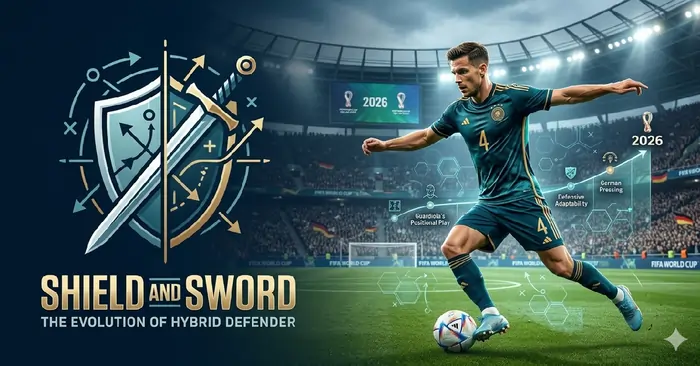
As the 2026 FIFA World Cup approaches, one thing is clear: the lines separating football positions have nearly disappeared. The once simple instruction for defenders — “clear your lines and stay back” — no longer applies at the elite level. The modern defender is as much an attacker as a protector.
Today’s tactical evolution revolves around one key philosophy: Hybrid Defender in Modern Football.
In this fluid approach, defenders act as both Shield and Sword — the first line of resistance when possession is lost, and the first dagger thrust when it’s regained. This dual identity is transforming world football into a high-speed game of intelligent, synchronized motion.
What Is a Hybrid Defender in Modern Football?
A hybrid defender is a player capable of performing multiple tactical roles depending on whether their team is in or out of possession. These defenders don’t occupy fixed zones — they slide, pivot, and advance across layers of the pitch in real time. Systems built around them look like shape-shifting formations: a 4-4-2 becomes a 3-2-5 in a heartbeat, depending on where a full-back or center-back moves.
For example, a right-back may start the match as part of a flat back four, but when their team begins the buildup, that same player drifts into midfield — becoming a temporary defensive midfielder who supports ball circulation. This constant spatial morphing forms what coaches call a “Liquid System.”
It’s a tactical nightmare for opponents: press triggers become unpredictable, man-marking fails, and pressing traps collapse because defenders no longer behave like static anchors.
This hybrid philosophy draws from three tactical revolutions: Pep Guardiola’s positional play, Italy’s tradition of defensive adaptability, and the high-pressing intensity brought by German football. The convergence of these ideas has produced defenders who are cerebral, technical, and relentlessly mobile.
The “Inverted” Revolution: From Wide to Wild
Perhaps the most noticeable shift leading into 2026 is the wide adoption of Inverted Full-Backs (IFB) and Inverted Wing-Backs (IWB). In simpler terms, these are full-backs who abandon the flanks during possession and move into the midfield.
The Midfield Overload Advantage
When a right-back or left-back inverts, they step into the central midfield space near the holding midfielder. This transforms a typical three-man midfield into a “box” or “diamond” structure, depending on how the play develops.
For example, Spain and the Netherlands often deploy this tactic, inviting their full-backs to form part of a compact central square during buildup. This additional midfielder creates a numerical overload, letting the team dominate possession and compress the field vertically.
When the full-back inverts:
- The team gains an extra passer in central areas.
- Ball circulation becomes smoother between the defensive and attacking thirds.
- There’s built-in protection if possession is lost, closing down counterattacks before they develop.
The Sword: Space Creation for Wingers
By moving centrally, the full-back vacates the wing. This opens lanes for attacking wingers to stay wide, isolate their matchup, and drive inward 1v1.
We’ve seen this repeatedly from teams like England and Portugal — where Trent Alexander-Arnold or João Cancelo step into midfield, releasing the winger ahead of them into expanses of undefended grass.
The full-back acts as an interior pivot, while the winger becomes a solo duelist — a deliberate spacing tactic designed to stretch opponents horizontally.
The Shield: Security Against Counters
The hidden bonus of inversion is defensive insurance. When the ball is lost, the inverted full-back is already central, close enough to intercept or counter-press. By shortening distances between defenders and midfielders, teams reduce exposure to direct counter-attacks — a necessity in tournaments where transitions decide matches.
The Return of the Libero: The Stone-Cold Evolution
Perhaps the most symbolic comeback of the tactical age is the modern Libero — a reimagined version of the 1970s sweeper, reborn for 2026. But this is not Franz Beckenbauer’s Libero who sat behind the line; the modern incarnation steps forward.
The Step-In Center-Back
In 2026’s tactics, a center-back will advance into midfield when their team has the ball. This hybrid behavior gives birth to what analysts describe as the “step-in defender” or “auxiliary pivot.”
John Stones of England epitomizes this approach. During buildup phases, he steps beside Declan Rice, forming a double pivot. When England loses the ball, Stones instantly drops back into defense, regaining his traditional position.
Dual Role
- The Shield: In defense, the Libero is a physical stopper — winning duels, reading through balls, and organizing the line.
- The Sword: In possession, he becomes a deep-lying playmaker, dictating tempo, progressing the ball through vertical passes, and stabilizing shape.
By stepping into midfield, Stones (and others like him — Josko Gvardiol for Croatia, Nico Schlotterbeck for Germany) allow the attacking midfielders to push higher. This creates structural freedom: midfielders can invade final-third spaces with confidence, knowing their hybrid defender controls the rhythm from deep.
Tactical Impact
This mechanism turns formations like a 4-2-3-1 into a 3-2-5 organically. The Libero bridges lines; he isn’t just a defensive figure, but an architect of team geometry.
The “Inside Full-Back”: The Structural Anchor
Not all hybrid defenders invert inward diagonally — some slide horizontally to enhance structural stability. This variation, popular with France, Italy, and Argentina, is the Inside Full-Back System.
The 4-to-3 Shift
Here’s how it works:
- In Defense: The team looks like a standard 4-3-3 or 4-4-2 shape.
- In Possession: The left-back (for instance) stays back and drifts inside, morphing the line into a Back 3.
This tweak allows the opposite full-back to advance freely, practically playing as a winger. The retained inside full-back becomes an anchor — part defender, part controller.
Example:
In France’s tactical setup, Jules Koundé often tucks in on the right, while Theo Hernandez rockets up the left flank. The shift creates rest defense: a compact three-man security shield that absorbs counterthrusts instantly when possession is lost.
Why It Works
- Positional Balance: Keeps the defensive equilibrium even during attacks.
- Transition Proofing: If the ball is turned over, there are always three defenders staggered.
- Freedom for Creativity: The opposite full-back or winger can attack with minimal risk.
This inside movement is subtle but vital—it’s how proactive defenses maintain numerical superiority without sacrificing width at the other end.
The Overlapping and Underlapping Center-Back
Hybrid defending has even extended to the central positions, particularly in back-three formations used by teams such as Germany, Morocco, and Croatia.
In a back three, the Wide Center-Backs (WCBs) often move forward into the half-spaces, overlapping or underlapping the wing-backs. This role merges classic defending with controlled attacking incursions.
Ben White (England) and Josko Gvardiol (Croatia) are prime practitioners. They step beyond the halfway line, link plays on the flanks, and deliver diagonal crosses into the box.
When the WCB surges forward:
- It forces opposing wingers to track back, disrupting the opponent’s shape.
- It adds an extra man in attack without changing the rest of the formation.
This expansion of the center-back role gives tactical diversity—since now defenders manipulate overload zones, not just occupy them.
Why 2026 Is the Year of the Hybrid
The 2026 World Cup, with its expanded 48-team format and global tactical convergence, is poised to become the tournament of versatility. Here’s why hybrid defending is no longer a luxury — it’s pure survival.
1. Press Resistance Under Fire
High-paced pressing systems, popularized by Germany, Argentina, and Japan, demand defenders who can evade pressure, not just clear it. When goalkeepers like Mike Maignan or Alisson start play short, hybrid defenders step into midfield spaces to present safe outlets.
Without these flexible passing lanes, teams risk self-destruction during buildup sequences. The hybrid defender acts as the “get-out-of-jail” pass — absorbing chaos through composure.
2. Squad Flexibility
Tournament football stretches squads to the limit: travel, fatigue, injuries, and tactical surprises. Managers rely on multi-functional players to sustain consistency.
A hybrid defender can cover multiple tactical shapes across rounds.
For instance, Argentina’s Lisandro Martínez can play:
- as a central defender in a back four,
- as a left-center-back in a back three,
- or as a holding midfielder in certain matchups.
That flexibility keeps tactical identity intact even when lineups rotate or game states shift.
3. The “Quarterback” Expectation
In the modern game, defenders are expected to act like quarterbacks, sending line-breaking passes to unlock compact midfields.
Coaches like Lionel Scaloni (Argentina) or Luis de la Fuente (Spain) instruct defenders to thread verticals through pressing lines — a skill once reserved for midfield playmakers.
Hybrid positioning gives defenders better passing angles, and once they step higher into midfield, they find clearer sightlines toward creative attackers operating in the half-spaces.
Tactical Blueprint: The Hybrid Defender Cheat Sheet
| Role | Movement | Defensive Duty | Offensive Duty |
| Inverted Wing-Back | Diagonal (into midfield) | Wide defense | Overload central zones, control possession |
| Modern Libero | Vertical (into pivot) | Central defense | Deep playmaking, tempo control |
| Inside Full-Back | Horizontal (tucks inside) | Wide defense | Back 3 creation, rest-defense anchor |
| Overlapping CB | Vertical (to wing) | Central defense | Support in wide overloads, secondary crossing |
This table highlights how movement defines modern defending. The same player might perform multiple of these functions in a single match depending on match control and opponent pressure.
Hybrid Defending in 2026: Case Studies by Nation
England:
John Stones steps into midfield beside Declan Rice while Alexander-Arnold inverts into passing lanes. This creates a box-shaped midfield that fuels England’s controlled tempo.
Argentina:
Lisandro Martínez often pushes slightly into midfield, allowing Enzo Fernández and Mac Allister to operate higher. Their structure alternates between a 4-3-3 and a 3-2-5 mid-phase.
Germany:
Joshua Kimmich and Robin Gosens flex roles interchangeably, switching between inside and overlapping movements to sustain both width and pressing strength.
Portugal:
João Cancelo’s tactical freedom gives Portugal the ability to transition between formation systems seamlessly — his hybrid role transforms the team’s identity from patient buildup to direct counterplay.
Morocco & Japan:
Both nations embrace pressing mechanisms that depend on fluid defensive support. Morocco’s Hakimi acts as both an aggressive wing-back and a recovering full-back, while Japan’s overlapping center-backs form a fluid zone coverage system.
The Psychology Behind Hybrid Defending
Hybrid defenders are not just athletes; they are decision-makers operating under constant information load. Their tactical intelligence is measured by micro-decisions per minute — choosing when to stay, step, or slide in relation to teammates’ positioning.
Psychologically, hybrid defenders must:
- Trust teammates implicitly, knowing when others cover.
- Maintain composure under pressure.
- Recalibrate positioning instinctively within new shapes.
This demands a rare blend of mental automation and anticipatory vision. What separates elite hybrid defenders from the rest is their ability to read potential rather than actual danger — defending with foresight instead of reaction.
The Death of the Specialist
If the 20th-century footballer was defined by narrow mastery — the no-nonsense center-half, the stay-wide full-back — the 21st century’s elite defender embodies universalism.
In modern football, the specialist is giving way to the multitool.
The hybrid defender’s value stems from elasticity — their skill in bridging phases, covering gaps, and defying positional stereotypes. They carry the shield of the anchor and the sword of the conductor.
This has profound tactical implications:
- Systems are no longer dictated by fixed formation labels.
- Defenders are playmakers; midfielders become first defenders.
- Every phase of play becomes fluid, interconnected, and reactive.
Watching the Hybrid Masters: What to Observe in 2026
When the World Cup kicks off, try to watch the defenders away from the ball for a few seconds — that’s where tactics truly unfold. You’ll notice the quiet orchestration:
- A full-back tucking into midfield while the winger stays wide.
- A center-back stepping forward while the holding midfielder slides back.
- A line of three forming when one full-back commits to attack.
Every subtle movement you observe is part of an intricate puzzle that redefines possession and protection as two sides of the same principle.
The Final Word: In Football, the Shield Is Now the Sword
In the grand chessboard of modern football, the defenders of 2026 stand as knights — capable of diagonal advances, backward retreats, and surprising leaps across the board.
The age of the pure stopper is over. The defender of today is a strategist, a playmaker, a rhythm controller — a hybrid warrior.
So when the knockout rounds begin, take your eyes off the striker for a moment. Focus instead on the defenders — watch how they switch lanes, trade positions, and dictate the geometry of play.
In the age of hybrid defending, the ones who guard the goal are also the ones who make victory possible. They are the Shield and the Sword — the future of modern football in one complete form.