
As the 2026 FIFA World Cup approaches, football’s tactical landscape has entered a new era of innovation. If you’ve tuned into recent matches from tactical masterminds like England, Portugal, or Spain, you might have noticed something unusual — the right-back or left-back, traditionally stationed near the touchline, suddenly appears at the center of the pitch, orchestrating attacks like an experienced midfield playmaker.
Welcome to the age of the Inverted Full-Back (IFB).
Inverted Full-Backs Explained. By 2026, this concept isn’t just a niche experiment or managerial fancy — it’s a tactical revolution reshaping elite football. Across continents, managers are using the inverted full-back concept as their “cheat code” — a strategic shortcut to dictate possession, compress defensive transitions, and create midfield superiority against opponents who were once masters of space.
What Exactly Is an Inverted Full-Back?
To understand the inverted full-back, you have to first unlearn what you know about traditional defending. For decades, a full-back’s role was simple and predictable:
- Stay wide on the flank.
- Defend the opposing winger.
- Overlap occasionally and deliver crosses.
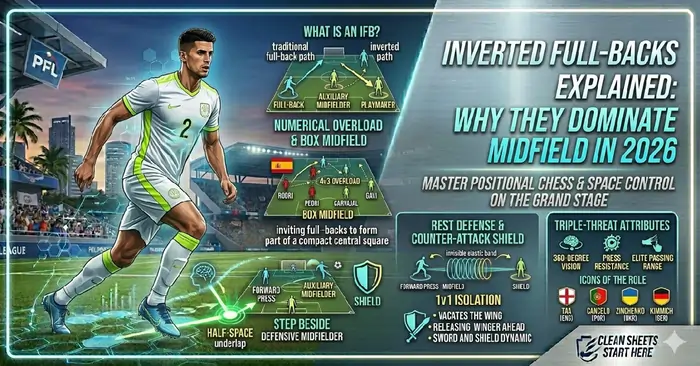
The inverted full-back, however, flips this blueprint entirely. When their team has the ball, they move diagonally inward instead of running toward the sideline. They “underlap” — sliding into central areas known as the “half-spaces” or stepping beside the defensive midfielder to help construct play from deeper zones.
This single adjustment changes the entire geometry of modern formations. A team starting in a classic 4-3-3 can, within seconds, morph into a 3-2-5 or 3-2-2-3 structure. One full-back becomes an auxiliary midfielder, while the other stays wide, balancing the shape into a dynamic attacking system.
A perfect modern example of this transition is England under Gareth Southgate and his technical staff. When England’s goalkeeper begins buildup play, Trent Alexander-Arnold often drifts into midfield beside Declan Rice, transforming England from four defenders into a three-man back line with dual pivots controlling the rhythm of possession.
The Power of the Numerical Overload
The fundamental reason managers love the inverted full-back system is simple — it wins the numbers game in the middle of the pitch.
Most international teams defend using compact structures like a 4-4-2 or 4-5-1. These shapes form a defensive midfield triangle consisting of three natural pressers. But by moving one full-back into the midfield zone, the attacking side instantly creates a 4v3 overload, often forming what coaches call a “Box Midfield.”
How the Numbers Work
Imagine this scenario: Spain faces an opponent using a 4-4-2. When Dani Carvajal drifts inside next to Rodri, Spain suddenly has four central options — Rodri, Carvajal, Pedri, and Gavi — working against three defenders.
The immediate effect?
The opponent’s midfield line fractures. One defending midfielder must choose whether to close down Carvajal or stay on Pedri. Either choice opens a gap somewhere else.
The Results
- If they press the inverted full-back:
Spaces open between lines, inviting quick vertical passes toward forward runners. - If they hold position:
Spain retains the ball comfortably, recycling possession until the opposition’s structure collapses under constant movement.
This positional superiority defines modern elite football. It turns defenders into facilitators of control — subtly shifting formations to make the midfield unplayable for opponents trying to press.
The philosophy echoes Pep Guardiola’s “Juego de Posición,” a framework rooted in numerical dominance and spatial occupation. Guardiola’s Manchester City teams influenced many national setups preparing for 2026, where full-backs operate as midfield controllers disguised as defenders.
Rest Defense: The Secret to Stopping Counter-Attacks
In high-pressure tournaments such as the World Cup, every manager fears the counter-attack. Possession-oriented teams often dominate play but risk vulnerability when caught out of shape. This is where the inverted full-back becomes the ultimate Shield.
Closing the Center
In traditional setups, full-backs who charge forward down the flanks leave gaping holes in the wide defensive channels. When the ball is lost, opponents can play long diagonals behind those spaces, instantly triggering breakaway transitions.
The inverted system corrects that weakness.
Since inverted full-backs sit centrally during attacks, they’re perfectly placed to intercept turnovers and intercept passes toward strikers. They act as a “guardrail” around the central axis of the pitch, keeping opponents trapped in their half.
The Hidden Safety Net
This design forms the basis of modern rest defense — a concept describing how a team remains balanced while attacking. Instead of leaving two defenders alone to handle counters, the inverted full-back adds another defensive layer behind the midfielders, creating a triangle of protection.
This allows forwards like Phil Foden, Ousmane Dembélé, or Vinícius Júnior to stay high upfield without sprinting 60 yards back every time possession changes. The shape absorbs transitions gracefully, protecting rhythm and energy levels simultaneously.
Rest defense is one reason teams such as Portugal and Germany refine positional rotation — it’s not only about creating attacks but preventing chaos the moment attacks collapse.
Liberating the World-Class Wingers
The inverted full-back doesn’t just improve possession play; it amplifies winger effectiveness by clearing space where it matters most.
In previous football generations, full-backs were encouraged to overlap their wingers — running outside them to offer wide support. While helpful for creating crossing angles, this also invited extra defenders, crowding the area and reducing dribbling spaces.
The Modern Vacuum Effect
When a full-back moves inside, the wide zone empties. Opponents shift inward to follow them, leaving the winger isolated against a single defender — a tactical situation called 1v1 isolation.
For elite wingers like Bukayo Saka, Vinícius Júnior, or Khvicha Kvaratskhelia, isolation is a gift. In these moments, they can combine speed, creativity, and unpredictability against defenders stranded in open space.
The Sword and Shield Dynamic
- Sword: Inverted movement frees the winger for devastating solo runs.
- Shield: Simultaneously, the IFB provides defensive cover to recycle possession if the attack breaks down.
This symbiosis transforms the left and right flanks from simple passageways into strategic battlegrounds. Teams enjoy vertical dynamism without sacrificing defensive safety — a dual gain essential for tournament knockout matches.
England exemplified this blend during qualifiers: Alexander-Arnold inverts into midfield while Saka stays wide, turning the right side into a conduit for creativity balanced by structural protection.
The Skill Set: Who Can Play This Role?
The inverted full-back role is not for everyone. While physically part of the defense, mentally, it’s a midfielder’s position. It demands players capable of performing three vital skills with equal mastery — collectively known as the Triple-Threat Attributes.
1. 360-Degree Vision
Traditional full-backs have the comfort of the touchline behind them, limiting where attacks approach. The inverted full-back operates in congested central areas, where pressure can arrive from any angle. Constant scanning and awareness are non-negotiable.
2. Press Resistance
When defenders step into midfield, they enter zones where pressing intensity is highest. Receiving under pressure, maneuvering in tight spaces, and shielding the ball like a playmaker require composure more typical of midfield specialists.
3. Elite Passing Range
Once central, the inverted full-back becomes a distribution hub. They must execute line-breaking passes, switch flanks accurately, and possess creativity to find teammates between defensive lines.
Icons of the Role
- Trent Alexander-Arnold (England): Orchestrates play from right-back, acting as a deep-lying conductor.
- João Cancelo (Portugal): Fluid, two-footed, and tactically adaptive — arguably the role’s archetype.
- Oleksandr Zinchenko (Ukraine/Arsenal): Proven at club level as the perfect blend of control and intuition.
- Joshua Kimmich (Germany): Though primarily a midfielder, his ability to toggle roles defines the IFB’s spirit.
These players symbolize a hybrid continuum where defensive discipline meets creative artistry. Their adaptability mirrors the meta-strategy every elite team will rely on in 2026.
Tactical Breakdown: Traditional vs. Inverted
| Feature | Traditional Full-Back | Inverted Full-Back |
| Primary Movement | Vertical (up and down the line) | Diagonal (into central half-space) |
| Offensive Goal | Deliver crosses from wide areas | Control possession, dictate play from midfield |
| Defensive Shape | Remains as part of a back four | Drops into back three during transitions |
| Primary Link Player | The winger (for overlaps) | The pivot midfielder (for circulatory play) |
| Spatial Focus | Width, touchline dynamics | Compactness, centrality, overloads |
This comparison illustrates how radically different the responsibilities are. The inverted approach turns defenders into architects of rhythm instead of carriers of width.
How to Beat the Inverted Full-Backs Explained
No tactic is invincible. The inverted full-back creates dominance but leaves vulnerabilities waiting for sharp opponents.
The Direct Counterattacking Threat
When full-backs vacate their flanks, the immediate danger area becomes the wide channel. If the ball is lost during buildup or midfield congestion, the opponent’s winger has a ready-made highway toward goal.
For instance, if Portugal’s Cancelo misplaces a pass while drifting inside, a wide forward like Alphonso Davies (Canada) can exploit the open lane for instant acceleration and cut inside unopposed.
The High Press Trap
Aggressive pressing nations may specifically target the inverted full-back during initial buildup. The moment the defender receives the ball in midfield, attackers swarm, trying to force errors near the penalty area.
Germany and Japan mastered this press-and-pounce technique during qualifying matches, reminding everyone that precision and quick decision-making define survival for inverted systems.
Tactical Responses
Managers counter these threats through:
- Rotating formations (3-2-5 to 4-2-4 mid-possession).
- Ensuring goalkeepers act as sweeper-passers for emergency exits.
- Pre-planned rotations where midfielders drop briefly into the vacated zone to provide coverage.
Adaptability is everything. Inverted full-backs function best within dynamic systems that adjust not only to possession but also opponent triggers.
Case Studies: Nations Leading the Inverted Revolution
England:
Southgate’s squad employs Alexander-Arnold and Rice as dual conductors, allowing England to dominate midfield tempo and keep attackers free for combination play.
Result: Predictable pressing schemes from opponents collapse under rotational movement.
Portugal:
Cancelo performs diagonal transitions between the defensive line and midfield pivot, while Nuno Mendes retains standard width. This hybrid control issues equal threats along both sides.
Spain:
Under Luis de la Fuente, Spain leverages Dani Carvajal’s interior positioning beside Rodri, creating endless passing triangles. Possession remains a defensive weapon.
Germany:
Kimmich’s dual midfield/full-back identity gives Germany unmatched balance. When stationed as an IFB, he controls the counter-press more effectively than a static center-half ever could.
Argentina:
Scaloni’s opting for fluid shapes where Lisandro Martínez tucks in while Molina rotates wide — Argentina’s version of the inverted concept grounded in defensive synergy.
Together, these examples demonstrate how inverted logic transformed international football into a multidimensional matrix of role changes — tactical puzzles solved through positional intelligence.
Tactical Philosophy Behind the Inversion
At its heart, the inverted full-back represents more than a positional tweak. It expresses a deeper philosophical idea — control through centralization.
By pulling defenders into midfield, managers anchor their team’s tempo to compact spaces. Possession becomes protection. Dominating the center allows every attack, press, and rotation to emanate from stability rather than chaos.
This synthesis of defense and attack revives football’s oldest dream: Total Football, reborn through tactical geometry. Every player shifts fluidly between zones, erasing boundaries between defender, midfielder, and creator.
Conclusion: The Future of the Global Game
As the 2026 FIFA World Cup kicks off, expect every tactical analyst, commentator, and coach to examine the inverted full-back phenomenon. It’s not just a trend — it’s a philosophy redefining the global game’s DNA.
By drifting into midfield, full-backs are no longer “helpers” of possession. They are possession itself. They are responsible for tempo, counter-control, creativity, and cohesion. They blend structure and flow — the shield against counters and the sword for creation.
Inverted full-backs crystallize football’s modern truth: the best way to defend is to keep the ball, and the best way to attack is through the defender who refuses to stay behind.
So the next time you watch a match from England, Spain, or Portugal, don’t chase the ball with your eyes. Follow the full-backs instead. Watch how they slide inward, how their presence transforms geometry, how they dictate from zones usually reserved for midfield maestros.
When they step toward the center, know this: the tactical chess match has begun — and in 2026, it’s the Inverted Full-Back who carries the queen’s power on football’s grandest stage.