
In the high-stakes tactical theater of the 2026 FIFA World Cup, no defensive strategy is as polarizing—or as influential—as the Holding the High Line. To many casual fans, it looks like tactical suicide: a back four standing close to the halfway line, leaving forty yards of open grass behind them with world-class sprinters lurking. But to the elite coaching minds guiding nations like Germany, Argentina, and Japan, the high line is a sophisticated tool designed to suffocate the opposition, win the ball back early, and control the rhythm of the match.
Executing a high line requires far more than bravery. It demands flawless synchronization, elite physical conditioning, and a level of psychological calm that very few defenders possess. When it works, the high line turns the match into a game played almost entirely in the opponent’s half. When it fails, it creates instant one‑on‑one situations against the goalkeeper.
This guide breaks down how the high defensive line actually functions, why the offside trap remains its deadliest weapon, and how 2026’s technology and pressing trends have pushed this strategy to center stage.
What Is Holding the High Line?
A high defensive line is a positioning strategy in which the back four (or back three) defend far away from their own goal, usually between the edge of the center circle and the halfway line.
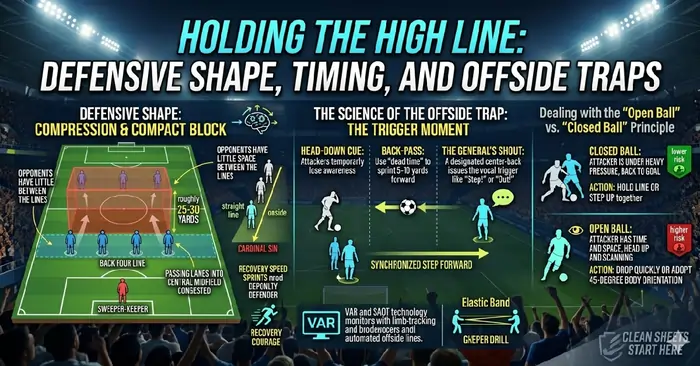
The key objective is compression. By pushing the line up, the team reduces the vertical distance between its defenders, midfielders, and forwards to roughly 25–30 yards. This forms a compact block where:
- Opponents have very little space between the lines.
- Passing lanes into central midfield are heavily congested.
- Any attempted buildup through the middle is quickly closed down.
When rivals cannot play through you, they are forced to play over you—launching longer balls that are easier to read, intercept, or sweep up with the right personnel.
In 2026, this approach is inseparable from high pressing: teams that spend most of their defensive time in a high press also rank among those with the highest defensive line height. The two ideas are mutually reinforcing—an advanced line enables aggressive pressing, and the pressing, in turn, justifies that advanced line.
The Anatomy of Defensive Shape
A high defensive line is only as strong as its weakest positional link. In modern tactical theory, the back line is treated as a single moving organism rather than four individuals.
The “Straight Line” Rule
The golden rule is simple: all defenders must hold the same height.
If even one defender “drops”—moving closer to their own goal while others stay high—that player can play an attacker onside, destroying the trap and exposing the space behind. This is the cardinal sin of high-line defending.
The Pendulum Movement
The back four should move like a pendulum:
- When the ball is played to the left, the entire line slides left.
- When the ball travels right, the line slides right.
- When the opponent plays a back-pass, the line steps up together, shrinking the space the opponent has to breathe.
Every step, slide, and drop must be mirrored almost simultaneously, often guided by visual cues and constant communication. Top-level teams drill this repeatedly so that movement becomes automatic.
The Sweeper-Keeper Connection
The high defensive line cannot function without a Sweeper-Keeper—a goalkeeper who acts as an 11th outfield player.
Instead of camping on the goal line, the sweeper-keeper positions themselves near or even outside the edge of the penalty area to:
- Intercept through-balls and long passes that escape the back line.
- Provide a passing outlet during buildup under pressure.
- Allow the defenders to hold a higher starting position with confidence.
Teams that adopt possession and high pressing structures benefit enormously from this kind of keeper, as their advanced position compensates for the space left behind the high line.
The Science of the Offside Trap
The offside trap is the signature move of any team using a high line. It’s the coordinated act of defenders stepping forward just before a pass is played, leaving attacking players beyond them and thus in an offside position.
Executed correctly, it doesn’t just stop attacks—it frustrates and mentally wears down opponents who repeatedly see promising runs halted by the assistant’s flag or VAR.
The Trigger Moment
Timing is everything. The line must move at the exact moment the ball is about to be played. Too early, and attackers adjust. Too late, and they’re clean through on goal.
Defenders rely on visual “triggers”:
- The Head-Down Cue: When the ball-carrier looks down to strike the ball, they temporarily lose awareness of the line’s movement. This is when defenders surge forward as one.
- The Back-Pass: A pass played backward to a defender or goalkeeper removes the immediate threat of a through-ball. High-line teams use this “dead time” to sprint 5–10 yards forward, locking their opponents into their own half.
The “General’s” Shout
Typically, one center-back is designated the on-field “general.”
They issue the vocal trigger—shouts like “Step!” or “Out!”—that tell the entire line when to push up. This leader must:
- Track the ball-carrier’s body language.
- Maintain awareness of all attacking runners.
- Command confidently so teammates commit without hesitation.
Without a clear voice, defenders may step inconsistently, resulting in broken lines and easy passes in behind.
Dealing with the “Open Ball” vs. “Closed Ball”
To balance aggression and safety, defenders in 2026 are trained to apply the Open/Closed Ball Principle.
Closed Ball Situations
A ball is considered “closed” when:
- The ball-carrier is under heavy pressure.
- They have their back to goal.
- Their head is down or body orientation limits forward passing.
Action: The defense can hold the line or even step up, because the risk of an accurate long ball is low.
Open Ball Situations
A ball is “open” when:
- The opponent has time and space.
- Their head is up and scanning.
- Their body is set to strike a long, vertical pass.
Action: The defensive line must drop quickly or at least adopt a 45-degree body orientation, ready to turn and sprint.
Reading this open/closed status in real time is what separates elite high-line defenses from those repeatedly caught out.
The Physical and Mental Demands
Holding a high line for 90 minutes under World Cup pressure is brutally demanding. It requires both elite physical tools and psychological resilience.
Recovery Speed
If the offside trap fails or the timing is slightly off, defenders must race world-class forwards in open grass. That means:
- Top acceleration over the first 5–10 meters.
- High-end speed over 30–40 meters.
- The ability to turn from backpedaling to sprinting in an instant.
This is why players like Kyle Walker or Micky van de Ven are so prized—their recovery pace acts as the insurance policy behind an aggressive line.
Mental Courage
Standing on the halfway line while Kylian Mbappé or Vinícius Júnior hovers on your shoulder is not for the faint-hearted.
Defenders must:
- Trust teammates and the game model completely.
- Avoid “panic dropping” when they sense runs in behind.
- Stay calm even after a narrow offside or a close scare.
One defender’s instinctive retreat can destroy structure and invite exactly the danger the system is designed to prevent.
Why Top Nations Use the High Line in 2026
If the high line is so risky, why are so many top nations leaning into it? The answer lies in territory, tempo, and technology.
Sustained Pressure and Territory Control
By defending closer to the halfway line, high-line teams keep the ball and the opponent locked into the opponent’s half. This has several advantages:
- Opponents struggle to fully clear their lines.
- Second balls tend to fall to the pressing team’s midfielders.
- The constant pressure creates mental fatigue and eventual errors.
FIFA’s analysis of recent tournaments, including the Club World Cup, shows that teams who spend the most time in a high press also keep their defensive line higher and often dominate matches territorially.
Rest Defense and Counter-Pressing
Another major benefit is rest defense: the structure a team maintains while attacking to be ready for instant transition.
With a high line:
- Defenders are already near midfield when possession is lost.
- They can launch a counter-press within 3–5 seconds, aiming to regain the ball before the opponent can launch a counter-attack.
This suits teams like Germany, Argentina, and Japan, whose tactical models rely on quick recovery of possession and sustained attacking waves.
VAR and Semi-Automated Offside Technology
Technology has quietly tipped the scales in favor of disciplined high lines.
Semi-automated offside technology (SAOT) uses multiple cameras and limb-tracking data to generate quick, accurate alerts for offside calls. It:
- Tracks 29 data points per player and the match ball dozens of times per second.
- Automatically draws offside lines and identifies the kick point of passes.
- Helps VARs make faster and more precise decisions on tight offsides.
Knowing that a “stray toe” or shoulder will be flagged by technology gives high-line defenses more confidence that well-executed traps will be rewarded.
High Block vs. Low Block: A Practical Comparison
| Feature | High Defensive Line (High Block) | Low Defensive Line (“Parked Bus”) |
| Pitch Position | Near halfway line | Near 18-yard box |
| Primary Goal | Interceptions & pressing high | Shot-blocking & last-ditch clearances |
| Main Risk | Through-balls and pace in behind | Sustained pressure, long shots, second balls |
| Goalkeeper Role | Sweeper-keeper, high starting position | Traditional shot-stopper |
| Best Against | Slow, methodical build-up teams | Fast, direct counter-attacking teams |
| Transition Threat | Immediate counter-press, quick regains | Long counters from deep, transitional breaks |
Both systems have their place, but the high line has become the preferred weapon for teams wanting to control matches, not merely survive them.
Training the High Line: The “Elastic Band” Drill
Because synchronization is everything, international sides use specific drills to engrain collective movement. One of the most effective is the “Elastic Band” Drill.
How the Drill Works
- Four defenders (two center-backs and two full-backs) line up as a back four.
- They are literally connected with resistance bands in some training setups, or mentally “tied” through strict spacing rules.
- Coaches move the ball side to side, backward, and forward.
The defenders must:
- Move collectively without the “band” stretching or sagging—meaning distances between them remain constant.
- Step together on back-passes.
- Slide laterally as a unit when the ball is switched.
Focus Points
- Peripheral Vision: Players must learn to react to teammates’ movements without constantly looking across the line.
- Communication: Calls like “Step,” “Hold,” and “Shift” must be clear and instantaneous.
- Body Orientation: Defenders are trained to stand half-turned, ready both to step up and to pivot into recovery runs.
Over time, this builds the muscle memory that allows high-line movements to remain coordinated even under match pressure.
The Role of Coaching and Match Analysis
Modern coaches use video, tracking data, and post-match analytics to refine their high-line structures.
- Line Height Metrics: Analysts measure how far from goal the line defends on average and in different phases.
- Compactness: Vertical and horizontal distances between lines are tracked to ensure compression targets are met.
- Trap Timing: Video frames of offside traps are reviewed to check if one defender stepped late or early, leading to corrections in training.
Articles and tactical case studies highlight how clubs and national teams with disciplined high lines—like Manchester City, Bayern, and PSG at club level—successfully combine aggressive pressing with advanced positioning.
Conclusion: The Ultimate Test of Unity
Holding the high line is the ultimate expression of collective trust in football. It’s a declaration of dominance: a signal that your team is willing to defend as far from its own goal as possible to win territory, tempo, and initiative.
In the 2026 FIFA World Cup, when you watch a back four standing near the halfway line with a sweeper-keeper stationed 20 yards outside the box, you’re not witnessing recklessness—you’re seeing a finely tuned tactical machine at work.
Pay attention to the invisible line between defenders. Watch for the synchronized “Step” when the ball is played backward. Notice how often attackers are flagged offside by a fraction, thanks to perfectly drilled traps and precision technology.
In those moments, Shape, Timing, and Nerve intersect. And in 2026, that is where World Cups can be won or lost.