
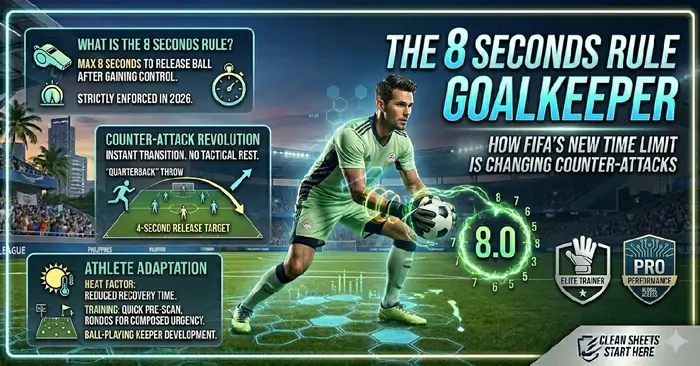
The 8 seconds rule goalkeeper has turned every goalkeeper into a ticking time-bomb of potential—forced to think faster, play smarter, and become a true weapon in transition. This guide unpacks what the rule actually is, why it has changed counter-attacks, and how Filipino keepers can adapt and thrive in 2026.
What Exactly Is the 8 Seconds Rule Goalkeeper?
The 8-second rule is simple in writing but brutal in execution: once the goalkeeper has clear control of the ball with their hands, they have a maximum of eight seconds to release it back into play. That short window has changed everything about rhythm, tempo, and transition.
When Does the Clock Start?
The countdown begins the moment the goalkeeper gains total control of the ball:
- Catching a cross cleanly.
- Smothering a low shot and securing it.
- Picking up a loose ball or back-pass with their hands inside the box.
In 2026, referees are instructed to treat this strictly. They often:
- Start a visible internal count as soon as the keeper stands up or stabilizes with the ball.
- Use subtle signals (like hand gestures or verbal cues) to indicate that the time is running.
- Enforce the rule consistently, especially in higher-level competitions where FIFA World Cup directives are closely followed.
The key detail: the law does not care how exhausted your defenders are, how intense the previous attack was, or whether your team needs a breather. Once the ball is in your hands and under control, the eight-second clock is ticking.
What Happens If the Keeper Fails to Release?
In the past, breaking the old 6-second guideline rarely brought punishment. It was treated as a “soft” rule: only the most obvious time-wasting drew an indirect free kick. Now, under the modern goalkeeping interpretation, repeated or deliberate violations bring real consequences.
Common sanctions in 2026 competition formats include:
- A booking (yellow card) for time-wasting if the keeper clearly ignores the count.
- In some competitions and experimental tournaments, sanctions like:
- An indirect free kick inside the area from where the keeper held the ball.
- Or a more severe reset, such as awarding a corner or restarting play with possession to the opponent.
The precise penalty can vary by competition rules, but the message is universal: you cannot hold the ball in your hands and kill time anymore. Those eight seconds are not a suggestion—they are a hard limit.
The Death of the “Tactical Rest”
For decades, goalkeepers were unofficial “oxygen tanks” for tired defenders. After a long spell of pressure, a keeper would:
- Gather the ball.
- Fall to the ground, sometimes dramatically.
- Lie there for several seconds.
- Slowly get up, adjust socks, reposition the ball, and then finally release it.
This was the classic tactical rest. It allowed:
- Defenders to jog up the pitch and reset shape.
- Midfielders to catch breath and glance at the bench.
- The entire team to mentally and physically reset.
The 8-second rule has effectively killed this tactic.
Fatigue and Constant Flow
Now:
- Defenders must reset their shape while the ball is already on its way back into play.
- Teams no longer get those hidden 15–20 second mini-breaks after every cross or long shot.
- The overall intensity and “effective playing time” have increased, with fewer long pauses.
Instead of using the goalkeeper as a pause button, teams are forced into a more continuous style. For players, that means:
- Higher cardiovascular demands.
- Fewer chances to “switch off.”
- More frequent end-to-end sequences.
For coaches, it changes conditioning plans. For goalkeepers, it transforms their mentality: your job is no longer “calm the game down at all costs”; now, you must read the game and either spring a counter or restart quickly without drifting into time-wasting territory.
The Counter-Attack Revolution
While defending teams have lost their safety net, attacking teams have gained a massive weapon. The 8-second rule is unintentionally a gift for fast, vertical football.
Why Attacking Teams Benefit Most
Look at what happens when a goalkeeper catches a corner or long cross:
- The opponent’s tallest defenders (center-backs) are often stuck high up in your penalty area.
- Their midfield is stretched and disorganized as they move forward to support the attack.
- Their full-backs may be advanced, leaving space behind them.
In this moment, they are structurally at their weakest. Under the old “take your time” approach, they had 10–15 seconds to jog back, reorganize, and drop into shape. Under the 8-second rule, your keeper is encouraged to exploit that vulnerability instantly.
The 4-Second Release
Elite modern keepers are now aiming for something even more aggressive: a 4-second release.
- Within four seconds of catching the ball, they are already:
- On their feet.
- Scanning for options.
- Releasing the ball to a wide runner or central outlet.
By doing this, they attack the opposition before they can “transition into defense.” The other team is still mentally attacking when the ball is already flying toward their half.
The “Quarterback” Throw
One of the visible trends of this era is the rise of the powerful, precise overhead throw:
- A long, American-football-style launch from the keeper’s hands.
- Targeting a winger or attacking full-back sprinting into space near the halfway line.
- Bypassing the entire midfield in a single action.
Imagine a keeper grabbing a high cross, spotting a winger already breaking upfield, and unleashing a 40-meter throw into their stride. Under the 8-second rule, this is not just a flashy option—it’s a core weapon.
Pre-Designed “8-Second Patterns”
Teams are now choreographing their counter-attacks around this rule. These patterns might include:
- As soon as the keeper catches the ball, full-backs immediately sprint toward wide channels.
- The number 10 (attacking midfielder) drops quickly into a central pocket to receive on the half-turn.
- One winger makes a wide, diagonal run into space; the other tucks inside to attract defenders.
Instead of random movement, these are planned 8-second patterns, drilled in training so that everyone knows where to go the moment the keeper secures the ball. The goalkeeper, in turn, is trained to recognize which “pattern” is on based on where their teammates are moving.
The Goalkeeper’s Dilemma: Speed vs Accuracy
The 8-second rule sounds great for attacking football, but it also creates a huge psychological test for keepers. Eight seconds is not much time to:
- Mentally reset after a shot or cross.
- Get up, stabilize, and scan the field.
- Choose the best option.
- Execute an accurate throw, roll, or kick.
The Panic Problem
Inexperienced goalkeepers often feel the rule as pressure, not opportunity:
- They hear the referee’s count in their head, even if it’s not audible.
- They see pressing attackers shadowing them, cutting off easy passes.
- As the mental “count” hits six or seven, they rush.
This leads to:
- Poorly judged throws straight into opponents.
- Overhit kicks that fly out of play.
- Hesitation—starting to release one way, then changing their mind too late.
Suddenly, the weapon becomes a liability.
Composed Urgency
The modern solution is training the ability to be urgent but composed. That means:
- Moving very quickly through the first actions (getting up, securing grip, arranging the ball).
- But slowing the mind—breathing, scanning, and choosing calmly.
- Accepting that you have time for one clear look and one decisive action, not three or four.
A good way to think of it: the 8-second rule gives you time for one good decision, not many small indecisions. The aim is to turn the count into a rhythm cue, not a source of panic.
Adaptation in the Philippines: Local Realities
In the Philippines, the 8-second rule hits differently because of climate, playing style, and infrastructure.
The Heat Factor
Playing in Cebu, Manila, or other hot, humid areas, teams used to lean on natural game slowdowns:
- Goalkeeper pauses.
- Longer set-up times for free kicks.
- Goal kicks taken slowly.
With keepers forced to restart quickly, the effective ball-in-play time rises, which increases physical strain:
- Players have less time to cool down during matches.
- Defenders must backtrack and reset quicker after attacking set-pieces.
- Coaches must rotate more, hydrate better, and plan conditioning around a faster tempo.
The tactical rest is gone, so physical preparation has to improve.
The Rise of the Ball-Playing Filipino Keeper
On the positive side, this rule is accelerating the development of more technically skilled local keepers.
In many modern training environments in the Philippines, young keepers are now:
- Included in rondo drills with outfield players.
- Coached to use both feet under pressure.
- Practicing quick-release actions from throws, rolls, and low kicks.
Instead of being told to “boot it long,” they’re being asked:
- “Who can you find in three seconds?”
- “Where is the free player before you even catch the ball?”
- “Can you hit the winger in stride instead of just into space?”
The result is a new generation of keepers who see the ball not as a burden, but as a chance to attack.
How to Master the 8-Second Window (Practical Tips for Keepers)
If you are a goalkeeper playing under these standards, you need to rewire your habits. Here are key principles to own the 8-second window.
The Pre-Scan
Do not wait until you have the ball in your hands to look around. Start scanning before the shot or cross:
- If your team might win the ball, know already where your wingers and full-backs are.
- Track runners in your peripheral vision as the ball comes in.
- Have a mental “map” of where your safest and most dangerous options are.
When you finally catch the ball, your decision should feel like confirmation, not discovery.
Instant Recovery to Your Feet
The moment you secure the ball:
- Get up as quickly and safely as possible.
- Avoid staying on the ground longer than necessary.
- If you fall while catching, roll or shift your body in a way that lets you bounce back onto your feet efficiently.
Every extra second spent on the grass reduces your decision time.
Communication Trigger
Your teammates must feel the urgency too. Create a verbal trigger—like “GO!” or “OUT!”—that everyone understands:
- When they hear it, full-backs sprint wide.
- Wingers begin their runs.
- Midfielders show for short options.
This turns your release into a coordinated team habit rather than a solo improvisation.
Use the Full 8 Seconds Wisely
Fast does not always mean instant. Sometimes the quick counter is not on. In those moments:
- Use the first 3–5 seconds to see if a forward pass is viable.
- If not, signal your defenders to create safer angles.
- Aim to release by second seven, not second three.
You are allowed to be patient within the rule. The key is purposeful use of time, not blind speed.
The Spectator’s Perspective: A More Thrilling Game
From the stands or in front of the TV, the difference is clear. Games feel:
- More continuous, with fewer long pauses where nothing happens.
- More unpredictable, because any catch or save can trigger a counter.
- More intense, as there is less time for teams to slow the tempo artificially.
Every time a keeper grabs the ball now, the crowd knows something must happen soon. The stadium holds its breath, waiting to see:
- Will the keeper launch a quick break?
- Will they calm things down with a smart short pass?
- Or will pressure force a mistake?
This extra mini-drama plays out multiple times per match, turning the goalkeeper’s decisions into a focal point rather than a dead moment.
Conclusion: The Clock Is Ticking
The 2026 8-second rule is far more than a cosmetic tweak to an old guideline. It has:
- Removed the goalkeeper’s ability to act as a built-in time-waster.
- Increased the physical and mental demands on all players.
- Supercharged the power of fast counter-attacks.
- Raised the technical and tactical bar for modern goalkeepers.
For today’s keeper, your hands are not just tools for saving shots—they’re the start button for your team’s next attack. If you can read the game early, move quickly, and stay composed under the countdown, you turn a potential weakness into your biggest strength.
Master the 8-second window, and you’re not just protecting your goal—you’re architecting the goals your team scores at the other end.