
In the tactical laboratory of the 2026 FIFA World Cup, a quiet revolution has reached its zenith. For decades, the center-back was the “heavy” of the team — a figure prized for brute strength, last-ditch tackles, and the ability to send the ball 60 meters into the stands. But football’s tactical ecosystem has evolved, and so have its demands.
As the world’s elite national teams adopt hyper-aggressive high-pressing systems, a new type of defender has risen from the back line — one whose greatest weapon isn’t a sliding tackle, but a controlled dribble through chaos.
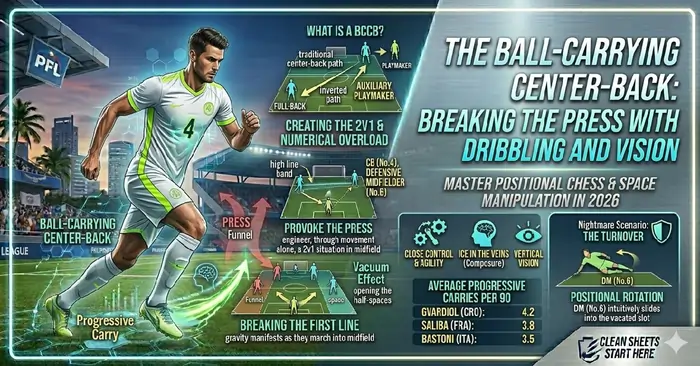
Enter the Ball-Carrying Center-Back (BCCB): a player who breaks lines with movement, not just passes. In 2026, defenders like William Saliba (France), Alessandro Bastoni (Italy), and Josko Gvardiol (Croatia) are redefining what it means to defend and attack in the same breath. Instead of recycling possession, they’re marching directly into midfield, turning pressing traps into opportunities.
In a tournament where microseconds determine success, the ball-carrying center-back is football’s newest superweapon — the tactician’s gamble and the modern game’s embodiment of courage through control.
What Is a Ball-Carrying Center-Back?
Simply put, a ball-carrying center-back is a defender who uses dribbling and vertical movement to progress play from the defensive third into more advanced areas of the pitch.
Traditionally, center-backs relied on passing to advance play — short exchanges between themselves, full-backs, and pivot midfielders. The problem? Predictability. Elite opponents learned to trap these patterns through zonal pressing schemes.
The ball-carrying center-back, however, bypasses that issue through motion. Instead of waiting for an outlet, they create one. Using body feints, acceleration, and composure, they dribble through the first line of pressure, demanding a reaction that reshapes the entire opposition structure.
Think of them as a chess piece that steps off the back row. They don’t just move the ball — they move opponents.
The Science of “Provoking the Press”
On paper, it seems counterintuitive. Why risk dribbling 30 yards from your own goal when a simple side pass would suffice? The answer lies in an advanced tactical concept: numerical superiority.
In high-level football, positioning isn’t just about spacing — it’s about luring opponents out of equilibrium. When the opposition presses in a zonal system, each attacker covers a lane or passing option. The goal is to suffocate outlets, not necessarily to tackle. This works well against static defenders but collapses the moment someone breaks structure.
Creating the 2v1
When a center-back carries the ball forward, they “provoke” an opponent into an uncomfortable choice.
- Do they stay in their zone, allowing the defender to advance freely?
- Or do they abandon their mark, stepping forward to challenge the ball?
Whichever choice they make, the defense loses its shape. The instant the pressing player commits, a free man emerges. The ball-carrying center-back has engineered, through movement alone, a 2v1 situation in midfield.
Forcing Tactical Disarray
This controlled chaos is precisely what top defenders like Gvardiol exploit. Their dribbles are calculated risks — choreographed disruptions designed to bend pressing lines and manipulate spacing.
By daring opponents to commit, ball-carrying defenders weaponize their first steps as psychological bait, turning the risk of losing possession into the reward of strategic domination.
Breaking the “First Line” of Defense
In most modern pressing structures — such as the 4-4-2 block or 4-2-3-1 press — the first line of defense consists of two strikers whose job is to “funnel” play wide. This tactic forces build-ups toward the sidelines, where teams can trap opponents using the touchline as an extra defender.
The ball-carrying center-back obliterates that funnel.
By dribbling directly through the central corridor, the defender disrupts an opponent’s pressing triggers. The two forwards, expecting lateral passes, are bypassed completely. Suddenly, the entire pressing plan collapses — the midfield, not the front line, becomes the first point of engagement.
However, this shift creates a domino effect. Once the midfield collapses inward to confront the advancing defender, positional fractures appear elsewhere, typically on the wings. Space emerges on the flanks — the “release valves” for attackers waiting in wide or half-space zones.
In 2026, breaking the first line isn’t just about advancing possession — it’s about reprogramming the opponent’s press mid-game.
The Gravity Effect: Opening the Half-Spaces
No concept defines modern football geometry better than “tactical gravity.”
This is the invisible force that elite players generate — not by touching the ball, but by drawing defenders toward them. For ball-carrying center-backs, that gravity manifests as they march into midfield.
When they do, entire defensive blocks contract inward. The midfield narrows. The opposition’s shape tightens. All attention funnels toward the unexpected invader charging from below.
The Vacuum Effect
This gravitational pull leaves behind vacancies along the wings and half-spaces — prime real estate for creative midfielders and wide forwards.
Attackers like Kevin De Bruyne, Jamal Musiala, or Phil Foden thrive in these moments. Once a center-back carries the ball far enough to draw pressure, a simple slip pass into those zones gives playmakers 10 to 15 yards of open room to operate — time to turn, scan, and strike.
The Point of No Return
Every ball-carrying run has a decisive moment — the split-second when defenders overcommit and space becomes exploitable. Elite center-backs, like Bastoni or Saliba, intuitively feel that “Point of No Return.” They release the pass exactly as the press peaks. The opponent is caught between collapse and exposure, unable to recover its shape in time.
It’s tactical artistry disguised as bravery.
A simple dribble creates what 20 clever passes could not.
The Anatomy of an Elite Ball-Carrier
Being a ball-carrying center-back isn’t about showmanship — it’s about engineering. The mechanics of dribbling at the professional level combine body control, psychological calm, and advanced field vision. Let’s break down the blueprint.
Close Control & Agility
The best ball-carriers don’t dazzle with step-overs. Their magic lies in control so clean it’s almost silent. Small, measured touches seal the ball within a two-foot radius, allowing micro-adjustments through dense traffic.
This agility lets them glide past pressing forwards, forcing constant recalibration from opponents who misjudge distance or direction.
“Ice in the Veins” — Composure Under Pressure
At elite speed, pressing situations unfold in milliseconds. Most defenders clear the ball when cornered. The ball-carrying center-back? They keep their nerve.
Armed with deceptive body feints, they exploit attackers’ momentum — letting opponents commit first, then pivoting away at the last heartbeat. It’s the football equivalent of aikido: using force against its wielder.
Vertical Vision
Dribbling is only half the story. What separates competent carriers from transformational ones is vertical passing vision.
A good ball-carrying run breaks the press. A great one ends with a line-breaking pass — often into a striker’s stride or the run of an interior midfielder. Elite defenders read not one line ahead, but two. They anticipate attacking lanes before they even open, converting risk into orchestration.
The Data Behind the Dribble: Progressive Carries
Modern analytics now quantify what eyes have long admired: defenders who carry the ball alter football’s geometry.
The Stat
A “Progressive Carry” measures any dribble that moves possession at least 10 yards closer to the opponent’s goal (or into the final third). In high-performance analysis, this metric differentiates passive possession from forward momentum.
| Player | Nation | Average Progressive Carries per 90 | Tactical Profile |
| Josko Gvardiol | Croatia | 4.2 | Power & Overlap |
| William Saliba | France | 3.8 | Calmness & Precision |
| Alessandro Bastoni | Italy | 3.5 | Creative Playmaking |
| Pau Torres | Spain | 4.0 | Line-Breaking Vision |
The numbers tell a pattern — elite teams depend on defenders willing to advance the game physically, not just theoretically.
For example, Gvardiol’s average carries often lead to positional overloads, allowing Croatia’s midfielders to push forward early. Similarly, Bastoni’s left-footed dribbles collapse space for Italy’s wing-backs, creating natural crossing zones.
These sequences underline a modern principle: control the ball, control the opponent. And few players demonstrate control better than a defender who dictates rhythm by movement.
The Risk: When the Sword Cuts Its Wielder
Every tactical sword can wound its master, and no role embodies that thin line better than the ball-carrying center-back.
The Nightmare Scenario: The Turnover
A misplaced dribble or mistimed step can be catastrophic. If possession is lost during a carry, the team’s formation immediately disintegrates — full-backs remain wide, midfielders are advanced, and recovery lanes are open. The result? A clean runway toward goal for opposition counterattacks.
The Safety Valve
Modern managers address this by structuring rotation systems.
As the center-back begins their forward run, the defensive midfielder (the “6”) instinctively slides into the vacated slot between the remaining defenders. This automated “positional rotation” maintains the team’s integrity even during forward ventures.
In Argentina’s system, for example, Enzo Fernández performs this role flawlessly, locking into the center-back space whenever Lisandro Martínez drives forward. France performs similar adjustments with Aurélien Tchouaméni dropping deep while Saliba advances.
The balance between risk and structure is the hallmark of coaching sophistication — a silent understanding that allows the sword to strike without leaving the shield unguarded.
Training the Ball-Carrying Instinct
For younger defenders drawn to this modern style, the skill isn’t instinctive — it’s disciplined artistry. Developing the confidence to carry the ball from defense requires repetition, scenario drills, and mental recalibration.
The “Commit” Drill
Design 1v1 training scenarios starting from a defensive position. The objective is to dribble past the pressing attacker before making a pass to a target upfield. This teaches acceleration into press-resistant zones and composure under pursuit.
Peripheral Vision Training
Use color or number recognition drills while dribbling. For example, have assistants flash colored signs or call out numbers behind the player. The defender must identify them mid-dribble, reinforcing scanning and awareness under stress.
Heavy Touch Recovery
Encourage defenders to accept slightly heavier touches, teaching them to use their body to shield and recover. The ability to protect the ball after imperfect control transforms technical mistakes into survival mechanisms.
Positional Conditioning
Simulate pressing triggers in small-sided games where defenders are forced to dribble or risk conceding points. This introduces the psychological pressure of real match tempo without elevating failure into punishment.
The goal of these exercises is not flashiness — it’s fluidity, recognition, and nerve. A ball-carrying defender must learn to see movement itself as possession.
Tactical Case Studies: Carriers of the 2026 Revolution
William Saliba – France
Saliba epitomizes “calm command.” His carries aren’t flamboyant; they’re surgical. During buildup, he advances five or ten yards only when pressing lines loosen, preserving structure while inviting minimal risk.
Alessandro Bastoni – Italy
Left-footed creativity defines Bastoni’s approach. He dribbles into midfield to break Italian opponents’ compactness, using his passing angles to feed wing-backs or midfield progressors like Barella.
Josko Gvardiol – Croatia
Perhaps the most daring of the new wave, Gvardiol often merges brute force with technique, bulldozing through pressing forwards. His runs are offensive plays unto themselves, setting Croatia’s rhythm through sheer initiative.
Pau Torres – Spain
Torres brings elegance and adaptability. Rather than driving vertically, he glides diagonally, shifting defenders laterally to craft crossing or switching windows.
Across these profiles, the distinction between defender and playmaker fades — replaced by a hybrid craft that prioritizes control of time, space, and pressure.
Why the 2026 World Cup Is the Perfect Stage
The conditions in modern international football make 2026 the ideal moment for the ball-carrying center-back to flourish.
- Pressing Intensity: Opponents deploy high blocks and coordinated presses, leaving huge rewards for those who can bypass them.
- Referee Protection: Increased emphasis on preventing tactical fouls after turnovers gives risk-takers more freedom.
- Spatial Compression: Stadium pitches and match tempos encourage teams to exploit compact central zones — dribbling lines provide immediate release points.
- Analytics Evolution: Coaches can now measure progressions and success zones, empowering defenders to act with data-backed confidence.
Amid these conditions, the center-back is no longer a backdrop figure. They are the pivot on which every tactical rotation spins.
Conclusion: The Most Dangerous Man on the Pitch
In 2026, football has rediscovered a forgotten truth — that courage and control are not opposites but allies. The Ball-Carrying Center-Back stands as a symbol of this reconciliation. A player who blends serenity and adventure, science and instinct.
By breaking the press not with a long ball but with a deliberate dribble, they collapse entire defensive structures into moments of vulnerability. Their advances ripple upward: freeing midfielders, stretching shape, and rewriting opponents’ blueprints in real time.
They are defenders reborn as architects. The quiet conductors of chaos.
When a center-back dares to stride forward — commanding, calm, and fearless — they don’t just bypass pressure; they rewrite the rules of football’s balance.
At the 2026 World Cup, the most dangerous player might not be the striker or the number ten.
It might be the man starting the attack from forty yards behind them.