
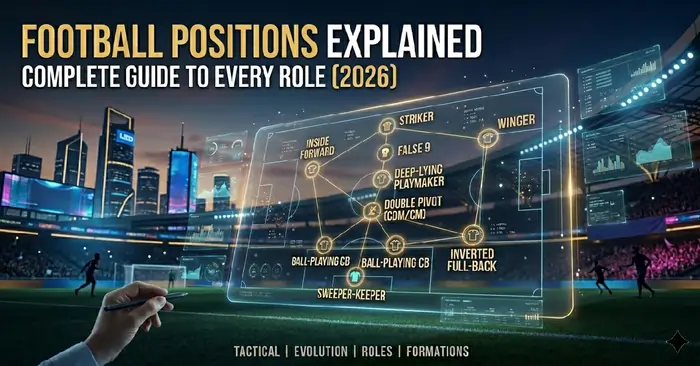
Football has always been called the beautiful game — a perfect mix of skill, intelligence, and emotion. But Football Positions Explained in 2026, that beauty lies not just in goals or skill moves, but in tactical evolution. Coaches and players now view the pitch as a living chessboard, where every move has strategic intent. Every role, from goalkeeper to striker, contributes to a grand tactical design aimed at controlling space, tempo, and transitions.
If you’re a fan from the Philippines following the growing PFL scene or playing in a local liga weekend match, understanding football positions isn’t just trivia — it’s the key to reading the game. This guide breaks down how traditional roles have transformed into dynamic, multi-functional responsibilities. Modern football no longer defines players by where they stand, but by what they do.
What Are Football Positions?
At its most basic level, a football position defines a player’s responsibilities and general area of operation on the pitch. A team fields 11 players, traditionally divided into four main lines:
- Goalkeeper (GK)
- Defenders
- Midfielders
- Forwards
But the modern game of 2026 has blurred the boundaries between these categories. No position is static. Today, players rotate fluidly — a striker may drop deep to become an auxiliary midfielder, and a defender might advance into attacking zones. The positional “map” is flexible, shaped by team tactics, opposition movement, and game context.
A modern position represents a function rather than a fixed spot. It provides structure to a team’s shape and allows smooth transitions from defensive blocks to attacking waves — maintaining organization even in moments of chaos. This concept of “functional positioning” is what defines elite teams worldwide, from PFL champions Kaya FC–Iloilo to footballing giants like Manchester City and Bayern Munich.
Defenders: Builders from the Back
Defenders were once seen purely as protectors — players whose job was to kick the ball away and shut down attacks. Not anymore. In 2026, defenders are architects of the game. They initiate offensive moves, control possession tempo, and determine the shape of their team’s buildup.
The Modern Center-Back (CB)
Modern center-backs combine strength with intelligence. Players like Jefferson Tabinas, a mainstay for the Philippine national team, epitomize the role — aggressive in duels yet skilled in distribution.
Role:
- Guard the central zones of the defense.
- Win aerial battles and intercept through passes.
- Start attacks by passing between defensive and midfield lines.
Tactical Evolution:
Center-backs are no longer static stoppers. In the age of “ball progression,” they carry the ball forward, provoking the opponent’s press and creating space for teammates. Many teams use one “aggressive” center-back who advances upfield, turning a basic line into a flexible structure.
Football analysts often refer to them as Ball-Playing Defenders, a breed that values technical ability and composure just as much as physical strength.
The Full-Back (LB/RB) and Wing-Back
The full-back position has become one of the most demanding in modern football. These players operate up and down the touchline, defending wingers while acting as auxiliary attackers.
Role:
- Protect their flank against opposition wingers.
- Overlap their own wingers to deliver crosses.
- Provide width during attacking phases.
The Inverted Full-Back (2026 Trend):
Instead of hugging the sideline, modern full-backs — such as Santi Rublico for the Azkals — tuck into midfield during possession. This creates a “box midfield,” allowing teams to dominate central zones and maintain passing triangles.
Top European managers like Pep Guardiola and Julian Nagelsmann popularized this tactic, enabling full-backs to play as deep playmakers while still fulfilling defensive duties. Filipino clubs, inspired by global strategies, increasingly adopt this method to improve possession control and transitional stability.
Goalkeepers: The Sweeper Revolution
Though often overlooked, goalkeepers have undergone the biggest transformation of all. The modern Sweeper-Keeper has evolved into an eleventh outfield player — crucial in initiating attacks and maintaining positional balance.
Role:
- Protect the goal, but also act as a passing outlet.
- Advance outside the penalty box to clear through balls and cover space behind defenders.
- Distribute accurately to start counterattacks.
Examples like Ederson (Manchester City) or Manuel Neuer (Bayern Munich) demonstrate this mindset. Locally, watch how PFL keepers increasingly attempt long diagonal passes to launch transitions. Mastering footwork and vision has become just as important as reflexes.
In short, the goalkeeper is now a playmaking anchor — a tactical initiator as well as a shot-stopper.
Midfielders: The Engine Room
The midfield remains the strategic heart of football. It’s where the rhythm of play is controlled, where possession fights occur, and where creativity meets grit. In 2026, midfielders don’t just pass and tackle — they interpret space, link phases, and dictate tempo.
The Defensive Midfielder (CDM) – The “6”
The “number 6” shields the defense. They are the pivot between the backline and the attack.
Role:
- Break up opposition plays.
- Maintain positional discipline.
- Support defenders when possession is lost.
Modern Twist:
The archetype is now the Deep-Lying Playmaker — press-resistant, visionary, calm under pressure. Think of Rodri (Manchester City) or Joshua Kimmich (Germany). These players maintain ball circulation even under intense press, commanding control through technique and intelligence.
In Philippine football, the emergence of adaptive CDMs who double as playmakers signals a growing tactical maturity within the domestic game.
The Central Midfielder (CM) – The “8”
This is the box-to-box runner — high-energy and dynamic.
Role:
- Connect defense and attack.
- Carry the ball vertically.
- Support both ends of the pitch with stamina and spatial awareness.
The modern “8” is often the team’s balance keeper. They move continuously, serve as outlets for passes, and close down opponents in transition. Their versatility is essential for maintaining rhythm during high-paced matches.
The Attacking Midfielder (CAM) – The “10”
The creative soul of the team. The “10” operates in pockets between midfield and defense, crafting opportunities.
Role:
- Deliver key passes (“killer balls”).
- Link the forwards and midfield.
- Serve as tactical catalysts who unlock defenses.
Players like Sandro Reyes showcase how agility and vision combine in this role. Modern “10s” exploit half-spaces rather than staying central, constantly searching for gaps to create overloads.
In contemporary tactics, however, the CAM is often redeployed as a “False Winger” or “Inside Forward” to stretch space and confuse markers — another example of positional fluidity in 2026.
Forwards: Pressing Machines and Clinical Finishers
The goal of a forward remains simple — score — but their means have changed drastically. In 2026, forwards symbolize modern football’s balance: attacking threat combined with defensive pressure.
The Striker (ST) – The “9”
The centerpiece of the attack.
Role:
- Lead the offensive line and finish chances.
- Hold up the ball to allow midfield support.
- Press defenders aggressively when out of possession.
The Modern 9 blends physicality with intelligence — think Erling Haaland or Harry Kane. Many teams now utilize the False 9, a tactical innovation where the striker drops deep, dragging defenders out of position. It opens channels for wingers to exploit and makes attack more unpredictable.
Locally, emerging talents in the PFL who mimic this movement style are learning the importance of spacing and timing over raw speed.
The Wingers (LW/RW) – The “7” and “11”
Traditionally known as “wide dribblers,” wingers have evolved into goal-oriented inside forwards.
Role:
- Provide pace, width, and attacking thrust.
- Cut inside to shoot or create link-ups with full-backs.
- Apply high pressing during defensive transitions.
The Inverted Winger (Modern Standard):
A right-footed player on the left side (and vice versa) to enhance shooting and inside combination play. Players like Mohamed Salah or Vinicius Jr. have redefined this role, turning wingers into major scoring threats.
Filipino clubs in Asia increasingly embrace this tactic, favoring skilled inverted wingers who can attack diagonally rather than just cross traditionally.
How Positions Work Together
Football is not about individuals standing in separate zones. It’s about interaction — how units move together. Successful teams synchronize player movement like gears in a machine.
The Defensive Unit:
Comprises the goalkeeper and back four. They must shift cohesively; when one defender steps up for offside traps, others follow in sync. Misalignment leads to danger, so communication and timing are vital.
The Double Pivot:
A trademark of modern football. The system uses two CDMs — one defensive anchor, one progressive passer. It ensures composure in transitions and support during pressing phases. Many Filipino teams integrate this concept to stabilize midfield control.
The Front Three:
Typically the striker and two wingers. Coordinated motion is key. If the center-forward drops deep, wingers invert inward to occupy scoring zones. These relationships form attacking triangles — essential for fluid passing and positional rotation.
Modern Football in 2026: Positional Fluidity
Perhaps the biggest shift in 2026 is Positional Fluidity — the idea that shape constantly changes depending on ball possession.
- Defensive Phase: Teams may form a compact 4-4-2, prioritizing shape and space control.
- Attacking Phase: The same team might morph into a 3-2-5, maximizing offensive width and overloads.
In these patterns, center-backs step into midfield roles; defensive midfielders drop between defenders; full-backs transform into inverted creators. This fluidity requires high football IQ — players must know multiple positional duties simultaneously.
A striking visual example: during buildup, the left-back moves midfield, forming a triangle with the CM and CDM. Once possession advances, the left winger widens, the striker shifts between center-backs, and the attacking midfielder finds interior space. Every movement triggers another — like dominoes creating dynamic geometry across the pitch.
This “Total Football” concept, first introduced by the Dutch, now reappears globally at a higher physiological and tactical level, shaping the future of the sport.
Why Understanding Positions Matters
So why should everyday fans — especially in the Philippines — care about this tactical complexity?
- Appreciation for Unsung Heroes:
You begin noticing the defensive midfielder who intercepts ten passes but never scores, realizing they shaped the match. Recognizing these nuances deepens appreciation for team balance and strategy. - Predicting the Game’s Flow:
If you see full-backs pushing high, you can anticipate vulnerability to counterattacks. If the winger’s positioning tightens inward, expect an overload in central zones. Understanding positioning makes watching football intellectually engaging. - Improving Your Own Play:
Whether you play amateur football or weekend futsal, knowing your role helps conserve energy, improve coordination, and elevate teamwork. - Supporting Tactical Growth in Local Football:
As clubs in the Philippines develop academies and training systems, tactical literacy among players and fans accelerates. Knowing positional dynamics helps nurture smarter footballers and analytical spectators.
Final Thoughts – Football Positions Explained
By 2026, football positions have transcended labels — becoming dynamic, role-based systems that require precision, intelligence, and adaptability. From the Sweeper-Keeper initiating attacks to the Inverted Winger leading intense presses, players embody both artistry and discipline.
In this modern era, tactical understanding enriches every facet of the game. For fans, it transforms watching football into reading live strategy. For players, it defines efficiency, awareness, and leadership. And for Filipino football’s growing landscape, it lays the groundwork for globally competitive teams grounded in modern methodology.
Football is not just motion — it’s orchestration. The pitch is a canvas, and every position is a brushstroke that contributes to the masterpiece of “the beautiful game.”