
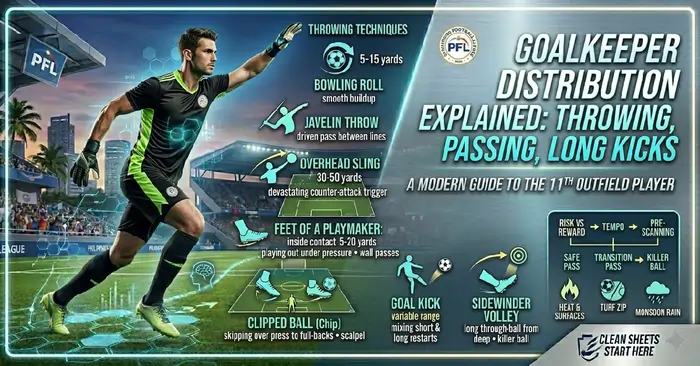
Goalkeeper distribution explained in 2026 is as important as shot‑stopping. This expanded guide unpacks how you use your hands, feet, and long kicks to control tempo, launch counters, and play as a true 11th outfield player—whether you are in the PFL or at a local 7‑a‑side.
Why Distribution Defines Modern Goalkeepers
In today’s game, most attacks either start or break down at the goalkeeper. A clean save is only half the job; what you do in the next three to eight seconds decides whether your team rests, resets, or punishes the opponent.
Modern keepers are judged on:
- How quickly they turn defense into attack.
- How safely they can play out under pressure.
- How accurately they can hit teammates at different ranges.
Think of yourself as a deep‑lying playmaker with gloves on. Every distribution choice—throw, pass, or long kick—should be guided by what your team needs in that exact moment: safety, progression, or a killer blow.
The Power of the Hand: Throwing Techniques
Throws are usually your most accurate and controllable form of distribution. Because the ball never leaves your hand spinning wildly, your teammate receives a cleaner, easier ball than from many kicks.
The Bowling Roll (Underarm)
Range: 5–15 yards
Best target: Center‑backs, full‑backs, deep midfielders who are free.
Technique
- Stand low, knees bent, body slightly leaning forward.
- Hold the ball with your palm underneath and fingers spread.
- Step toward your target with your opposite foot.
- Roll the ball smoothly along the ground, with enough pace that it arrives quickly but doesn’t bounce.
When to use
- When you want to build from the back under control.
- When the opposition is sitting deeper and not pressing high.
- After a save, if you see your nearest defender free and facing forward.
The goal with the bowling roll is zero drama: no bobbles, no awkward chest‑height deliveries—just a clean ball that lets your teammate’s first touch go forward.
The Javelin Throw (Overarm / Sidearm)
Range: 15–30 yards
Best target: Pivot / CDM in space, full‑back stepping inside, attacking midfielder dropping deep.
Technique
- Hold the ball near the side of your head, elbow bent.
- Step forward with your opposite leg to generate momentum.
- Use a whipping arm motion, releasing the ball just in front of your head.
- Aim for a flat, driven trajectory that reaches the target quickly.
When to use
- When your midfielder has peeled into a pocket between the opponent’s forwards and midfielders.
- When you want to beat the first line of pressing players without going long.
- Right after catching a cross, to punch a hole through the middle of the pitch.
Think of the javelin throw as a pass that replaces two or three short passes your team would otherwise need to escape pressure.
The Overhead Launch (The Sling)
Range: 30–50 yards
Best target: Winger on the touchline, full‑back overlapping, forward making a diagonal run.
Technique
- Hold the ball with your arm extended back behind your head or slightly to the side.
- Take a few steps or a run‑up if you have space.
- Rotate your torso and shoulder, using your whole body to generate power.
- Keep your arm mostly straight and “sling” the ball high and long.
- Aim so your receiver can run onto it without breaking stride.
When to use
- After claiming a corner or deep cross, when the opposition is scattered and their defenders are still upfield.
- When a fast winger has already started a counter run toward halfway.
- Any moment you see 1v1 or 2v2 opportunities higher up the pitch.
A well‑timed sling is one of the most devastating counter‑attack triggers. Your aim is to hit your runner early enough that they’re sprinting into space while the opponent is still turning around.
The Feet of a Playmaker: Short and Medium Passing
Being comfortable with the ball at your feet is non‑negotiable in 2026. Teams expect their keeper to join the passing network, not stand outside of it.
The Side‑Foot Wall Pass
Range: 5–20 yards
Best target: Center‑backs, full‑backs, defensive midfielders.
Technique
- Open your body so you can see as much of the pitch as possible.
- Use the inside of your foot for maximum contact and accuracy.
- Keep your ankle locked and your head steady as you pass.
- Strike through the middle of the ball with controlled pace.
Tactical use
- When a pressed center‑back plays back to you, you act as the “wall.”
- You receive, then immediately pass out to the opposite side to escape the press.
- You can also play first‑time, using your touch as a redirection rather than controlling then passing.
Imagine you’re the wall in a simple bounce pass: the defender passes to you under pressure, you bounce it out to the free side of the pitch.
The “Clipped” Ball (Chip Pass)
Range: 15–35 yards
Best target: Full‑back near the touchline, winger dropping wide, advanced midfielder pulling into half‑spaces.
Technique
- Approach the ball slightly from the side.
- Strike the lower half of the ball with your laces or inside‑toe area.
- Lean slightly back and “lift” the ball with your foot, creating backspin.
- Aim for a high arc that drops softly onto your teammate.
When to use
- When a striker or winger is pressing you, cutting off ground passes.
- When a full‑back is free near the line beyond the pressing opponent.
- To skip over two or three opponents while still keeping the ball within your team’s control.
The clipped pass is your scalpel. It’s riskier than a short pass but much cleaner and more controlled than a wild long clearance.
Launching the Attack: Long Kicks and Volleys
Sometimes the game demands distance: your team is under heavy pressure, or the space is clearly behind the opponent’s back line. That’s when your long range matters.
The Goal Kick (Dead Ball Restarts)
Range: Variable (short inside the box to long 60+ yards)
Targets: Center‑backs in the box, pivot dropping deep, or forwards in advanced zones.
Technique for long goal kicks
- Place the ball so that the valve or logo faces you if you like a consistent feel.
- Approach at a slight angle, not dead straight.
- Plant your non‑kicking foot about 5–10 cm beside and slightly behind the ball.
- Strike through the middle‑lower section with your laces, following through for height and distance.
- Keep your head over the ball enough to avoid slicing or ballooning it.
2026 tactical context
With rules allowing defenders to receive the ball inside the penalty area, teams often:
- Play short when they want to build carefully.
- Go long when they see the opponent push too many players into the press, leaving space behind.
As a keeper, you must be ready to execute both, sometimes alternating within the same game to stay unpredictable.
The Sidewinder Volley
Range: 40–60 yards
Target: Wide forwards, strikers on the shoulder of the last defender, attacking full‑backs.
Technique
- Hold the ball in your hands and drop it slightly to your side rather than straight down.
- As it falls, swing your leg horizontally, like a golf club, striking the ball around its center.
- Your body leans slightly sideways; your hip opens to allow a sweeping motion.
- Aim for a flat, driven trajectory that skims through the air rather than looping high.
Why it’s dangerous
- It reaches teammates faster than a traditional high punt.
- It’s easier to control because the ball arrives on a more predictable, flatter path.
- It punishes high defensive lines: a well‑hit sidewinder can send a runner through on goal in seconds.
Think of the sidewinder as your long, cutting through‑ball from deep.
Decision‑Making: Where and When to Distribute
Technique is one half of distribution. The other half is choosing the right option at the right time. You’re constantly weighing risk vs reward in a few seconds.
The Three Main Options
Before you release, ask yourself: what does the team need?
- The Safe Pass
- Usually a short roll or side‑foot pass to an open defender.
- Best when:
- Your team is winning or needs to calm the game.
- The opposition is pressing but you can easily out‑number them nearby.
- There’s no clear, high‑value counter opportunity.
- The Transition Pass
- Medium throw or pass into midfield.
- Best when:
- There’s space between the opponent’s lines.
- Your midfielders are facing forward and calling for the ball.
- You want to move the game 20–30 yards upfield in one action, but not go long.
- The Killer Ball
- Long sidewinder, sling throw, or driven goal kick.
- Best when:
- You spot a winger or striker already making a run.
- The opposition is disorganized after a set piece or chance.
- The risk of losing the ball in their half is acceptable compared to the chance of creating a 1v1.
The 8‑Second Rule Effect
In 2026, strict enforcement of the goalkeeper time limit means:
- You cannot stand holding the ball and debate endlessly.
- Your decision needs to be made almost before you catch it.
This is where pre‑scanning becomes crucial:
- While the ball is still in the air (cross, shot, or through‑ball), glance up quickly.
- Note where your full‑backs, wingers, and midfielders are moving.
- Decide: if I catch this, is there a counter on? Or do we reset?
When the ball hits your gloves, you should already be leaning toward one of the three options, not starting your thought process from zero.
Distribution in the Philippine Climate and Surfaces
Local conditions change how your distribution behaves. Smart keepers adjust their power, trajectory, and choices.
Artificial Turf: “Zipping” Ground Passes
On turf pitches like those in BGC or Biñan:
- Ground passes travel faster and skid more.
- A side‑foot pass hit with typical grass power may overrun your teammate.
- Mis‑controls can turn into counters if the ball zips away.
Adjustments:
- Take 5–10% power off your short and medium ground passes.
- Focus on clean contact and correct weighting more than raw speed.
- Consider using slightly more lifted passes (mini‑clips) when the turf is very slick.
Monsoon Rain and Wet Conditions
In heavy rain:
- The ball can become slippery in your hands.
- Long throws risk slipping out early or off‑target.
- Puddles on natural grass can slow ground passes unexpectedly.
Adjustments:
- For long distribution, trust your kicks and volleys more than very long throws—they give you a more secure strike.
- For short rolls and passes, aim slightly ahead of your teammate to compensate for potential sticking in puddles.
- Dry your gloves on your kit before each major throw or goal kick when possible.
The principle: same decisions, but slightly tweaked technique and weighting for safety and accuracy.
Training Drills to Sharpen Distribution
You improve what you train deliberately. Instead of just repeatedly punting downfield, structure your distribution practice.
The Trash Can (Target) Challenge
Purpose: Refine throwing accuracy and feel.
- Place three targets (cones, small goals, or bins) at roughly:
- 10 yards (for rolls),
- 20–25 yards (for javelin throws),
- 35–40 yards (for sling throws).
- Set a number of hits you must achieve with each technique before moving on.
- Vary the side (left/right) and type of target (midfielder zone vs wide channel).
This develops touch and trajectory control, not just arm strength.
The Pressure Rondo for Keepers
Purpose: Improve passing under pressure.
- Stand in a 5×5 yard square.
- Two teammates act as pressing forwards who must stay outside your box but can close the angles.
- One or two target players stand 25–30 yards away.
- Your job: Receive passes back from defenders and find a “clipped” or driven pass to a target player within two or three touches.
As you get better, reduce your allowed touches or bring the pressers closer to narrow your angles.
The Counter‑Attack Sprint Drill
Purpose: Train quick transition into long distribution.
- Start in your goal area.
- A coach or teammate serves a cross or shot that you must claim.
- As soon as you catch it:
- Sprint to the edge of your 18.
- Within 3–4 seconds, execute a sidewinder volley toward a designated wide runner or target area.
This builds the habit of moving quickly from save to distribution, mirroring real match situations.
The Mental Game: Confidence, Risk, and Coach Trust
The biggest barrier to good distribution is often fear: fear of mistakes, interceptions, and criticism.
Footballing Courage
To play short when you’re being pressed, or to clip a ball over an onrushing forward, you need:
- Trust in your technique.
- Trust that your coach values the right idea, even if execution occasionally fails.
- Confidence to keep playing your style after a mistake.
In modern systems, a turnover from a brave but sensible pass is often seen as a learning moment, not a reason to stop trying. The bigger mistake is retreating into panic long balls every time, because that hands momentum to the opponent.
Building Trust with Your Team
Your teammates must believe:
- That when they show for the ball, you will find them with good weight and timing.
- That you won’t panic and smash it out when a safe pass is available.
- That you also know when to clear long instead of forcing a risky short option.
This trust comes from repetition in training and consistency in games. Over time, your team will start to see you as a true playmaker, not just a safety valve.
Summary Table: Choosing Your Distribution Tool
| Distribution Type | Typical Range | Best For |
| Bowling Roll | 5–10 yards | Safe buildup, retaining possession |
| Javelin Throw | 15–25 yards | Finding midfielders between lines |
| Overhead Sling | 30–50 yards | Rapid counters to wide runners |
| Side‑Foot Pass | 5–20 yards | Playing out under pressure, wall passes |
| Clipped Pass | 15–35 yards | Bypassing press to full‑backs or wingers |
| Sidewinder Volley | 40–60 yards | “Killer” balls to strikers and wide runs |
| Goal Kick | Variable | Structured restarts, mixing short and long |
Use this mentally during games: what distance, what risk level, what tactical goal—then pick the tool that matches.
Conclusion: Goalkeeper Distribution Explained
In 2026, a goalkeeper’s value is measured as much by what they create as by what they prevent. When you master your throws, passes, and long kicks—and when you learn to choose the right one at the right moment—you transform from the last line of defense into the first line of attack.
The next time you catch the ball, don’t think, “Job done.” Think, “What can I build from this?” Because in the modern game of FIFA World Cup, the move that wins the match might start in your hands—or at your feet.