
Master the ultimate FIFA World Cup format: inside look at 12‑team groups, 32‑team knockout rounds, tie‑breakers, qualification rules, and the 48‑nation 2026 edition.
Table of Contents
FIFA World Cup Format & Rules Explained
The FIFA World Cup is the most prestigious tournament in association football. Every four years, national teams from around the globe compete for the coveted World Cup trophy, captivating billions of fans worldwide. Understanding the official rules and tournament format is key to appreciating how teams progress from qualification to the final match.
This guide explains everything you need to know about the FIFA World Cup format, including group stages, knockout rounds, tie‑breakers, and qualification rules.
Overview of the FIFA World Cup Format
The FIFA World Cup format is divided into two main phases:
- Qualification Stage
- Final Tournament
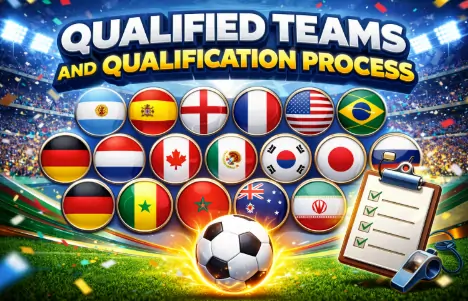
The qualification stage involves teams from FIFA’s six continental confederations:
- AFC (Asia)
- CAF (Africa)
- CONCACAF (North & Central America and Caribbean)
- CONMEBOL (South America)
- OFC (Oceania)
- UEFA (Europe)
Each confederation runs its own qualification system, but they all feed into the final tournament.
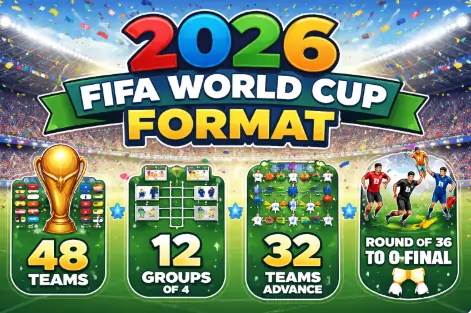
As of 2026, the final tournament expands to 48 teams, up from 32 in past editions. This change affects the number of groups, group‑size, and the path to the knockout stages.
Tournament Format: 48‑Team Structure (2026 Onwards)
Under the new FIFA World Cup format, 48 teams will compete in the final tournament:
- 48 teams divided into 12 groups of 4 teams each
- Each team plays 3 group matches
- Top 2 teams from each group advance to the knockout stage
- 8 best third‑placed teams also qualify for the Round of 32
This means the first knockout round is a Round of 32, followed by:
- Round of 16
- Quarter‑finals
- Semi‑finals
- Third‑place match
- Final
The 48‑team format increases the number of matches and offers more opportunities for under‑represented confederations to participate.
Group Stage Rules
The group stage is the heart of the initial phase of the FIFA World Cup format. Its structure and rules are designed to test consistency, scoring power, and resilience.
Match Format
Each group consists of 4 teams, and every team plays the other 3 teams once. This is known as a round‑robin format.
- 3 points for a win
- 1 point for a draw
- 0 points for a loss
The total points determine rankings within the group.
Tie‑Breaker Rules in Groups
If two or more teams finish on the same number of points, FIFA uses a series of tie‑breakers, in order:
- Goal difference in group matches
- Goals scored in group matches
- Points obtained in head‑to‑head matches between tied teams
- Goal difference in head‑to‑head matches between tied teams
- Goals scored in head‑to‑head matches
- Fair play points (yellow and red cards)
- Drawing of lots (used very rarely)
Goal difference is the most important tie‑breaker and is calculated as:Goal Difference=Goals Scored−Goals Conceded
For example, if Team A has:
- 4 goals scored, 1 conceded → goal difference +3
- Team B has: 3 scored, 0 conceded → goal difference +3
They share the same goal difference, so goals scored would be the next criterion.
Number of Teams Advancing
Under the 48‑team format:
- Top 2 teams from each of the 12 groups (24 teams)
- 8 best third‑placed teams (based on points, goal difference, etc.)
- Total: 32 teams qualify for the Round of 32
This system rewards both group winners and strong third‑place teams, reducing the impact of a single poor result.
Knockout Stage Format
Once the group stage concludes, the knockout phase begins. Unlike the group stage, knockout ties are single‑match eliminators.
Round of 32
The 32 teams enter the Round of 32, paired according to:
- Group winners vs. runners‑up or third‑place teams, depending on the seeding and bracket rules
- Third‑place teams are seeded according to their performance in the group stage
The winners progress to the Round of 16.
Round of 16, Quarter‑Finals, and Semi‑Finals
Each round reduces the number of teams by half:
- Round of 32 → 16 teams remain
- Round of 16 → 8 teams remain
- Quarter‑finals → 4 teams remain
- Semi‑finals → 2 teams remain
There are no replays in knockout matches. If a match is tied after 90 minutes, it goes to:
- Extra time: 2 additional periods of 15 minutes each
- If still tied after extra time, the match is decided by penalty shootouts
Third‑Place Match
Before the final, the two losing semi‑finalists play a third‑place match. This game is optional but has traditionally been scheduled to:
- Determine the bronze‑medal winner
- Give teams one more competitive match
Only the winning team in the final is crowned World Cup champion.
Rules of Play in a FIFA World Cup Match
The FIFA Laws of the Game govern how matches are played during the World Cup. Here are the key rules that apply:
Duration of a Match
- 90 minutes divided into two halves of 45 minutes
- A half‑time break of up to 15 minutes
- Stoppage time is added at the end of each half at the referee’s discretion to compensate for delays
In knockout matches, if the score is level after 90 minutes:
- Extra time: two 15‑minute periods
- If the score remains tied after extra time, penalties decide the winner
Substitutions
The number of substitutions allowed has increased in recent years:
- Teams can name up to 26 players on the matchday squad
- A maximum of 5 substitutions per team in a match (with warm‑up protocols)
- Substitutions can be made during 3 substitution windows plus half‑time
This rule helps manage player fatigue, especially during tight schedules or hot climates.
Yellow and Red Cards
- A yellow card is a caution
- A direct red card means immediate dismissal
- A player who receives two yellow cards in the same match is also sent off
Disciplinary points are tracked across the tournament:
- Yellow card: 1 point
- Indirect red card (second yellow): 3 points
- Direct red card: 4 points
These points are used in fair play tie‑breakers in the group stage.
Penalty Shootouts
If a knockout match remains tied after extra time, the result is decided by penalty kicks:
- Each team takes 5 penalties alternately
- The team with more goals after 5 each wins
- If still tied, the shootout continues in sudden death (one round at a time until one team scores and the other doesn’t)
Only players on the field at the end of extra time can take penalties.
Qualification Rules for the FIFA World Cup
Qualification is the bridge between regional competitions and the final tournament. The FIFA World Cup format begins long before the opening ceremony.
Number of Slots
Each confederation is allocated a certain number of slots. Under the 48‑team format, the proposed allocation is:
- AFC (Asia): 8 full slots + 1 play‑off
- CAF (Africa): 9 full slots + 1 play‑off
- CONCACAF (North/Central America): 6 full slots + 2 play‑off
- CONMEBOL (South America): 6 full slots + 1 play‑off
- OFC (Oceania): 1 full slot + 1 play‑off
- UEFA (Europe): 16 full slots
Two additional teams may qualify via a global inter‑confederation play‑off tournament.
Confederation‑Specific Qualification Formats
Each confederation designs its own system, but common formats include:
- League‑style group stages (e.g., UEFA, CONMEBOL)
- Knockout tournaments for smaller confederations (e.g., OFC)
- Combined group and knockout phases (e.g., AFC, CONCACAF)
For example, in recent cycles:
- UEFA used a group stage with 10 groups, where group winners qualify directly and runners‑up enter play‑offs.
- CONMEBOL ran a single round‑robin league with 10 teams, where the top 6 teams qualify for the World Cup.
Host Nation Qualification
The host nation of the FIFA World Cup automatically qualifies for the final tournament. This means:
- The host does not need to participate in the qualification stage
- Their slot is counted within their confederation’s total allocation
This rule has been standard since the early years of the tournament and ensures the host appears in the World Cup.
Tie‑Breaker Rules in Detail
Tie‑breaker rules are crucial in both the group stage and, in some cases, qualification rounds.
Group Stage Tie‑Breakers
If two or more teams are level on points:
- Goal difference in all group matches
- Goals scored in all group matches
- Points from head‑to‑head matches between tied teams
- Goal difference from head‑to‑head matches
- Goals scored in head‑to‑head matches
- Fair play points (yellow/red cards)
- Drawing of lots (by FIFA)
Most teams are separated by points and goals, but fair play can matter in rare cases.
Qualification Tie‑Breakers
During qualification, similar rules apply:
- Goal difference, goals scored, and head‑to‑head records are primary criteria
- If teams remain tied, fair play and drawing of lots may be used
These rules ensure that even the tightest qualification tables can be resolved objectively.
Key Changes in the 2026 FIFA World Cup Format
The 2026 World Cup, co‑hosted by the United States, Canada, and Mexico, will be the first to feature the 48‑team format. This brings several important changes:
- More teams: 16 additional teams compared to the 32‑team format
- More matches: Over 80 matches in the final tournament
- Larger group stage: 12 groups instead of 8
- Expanded knockout stage: Round of 32 added before Round of 16
The aim is to:
- Increase global participation
- Afford more matches to fans
- Provide more opportunities for emerging football nations
However, critics argue that too many extra matches could increase player fatigue and affect the quality of knockout games.
Historical Evolution of the World Cup Format
The FIFA World Cup format has evolved significantly since the tournament’s inception in 1930.
Early Years
- 1930 (Uruguay): 13 teams, no preliminary qualification
- 1934 (Italy): First tournament with qualification rounds
- 1938 (France): 16 teams, all‑knockout format throughout
Modern Structure
- 1950 (Brazil): Group stage returns, with a final round among top teams
- 1954 (Switzerland): First use of 16‑team format
- 1982 (Spain): First 24‑team tournament
- 1998 (France): First 32‑team format
- 2026 (United States–Canada–Mexico): First 48‑team format
The growth in team numbers reflects the global expansion of football and FIFA’s desire to include more nations.
Seeding and Draw Rules
The draw for the World Cup is a carefully regulated process that ensures balance and fairness.
Group Draw Process
Before the tournament, teams are placed into pots based on rankings and continental representation:
- The top‑ranked teams (including hosts) are placed in Pot 1
- Remaining teams are distributed by FIFA ranking and confederation
The draw then assigns teams to groups, ensuring:
- No group contains more than one team from the same confederation
- Certain restrictions apply to teams from the same continent in the knockout stage
Seeding Implications
Seeding affects not only the group stage but also:
- The path to the final in the knockout rounds
- The perceived difficulty of each group
While seeded teams are often favored, upsets are common in the World Cup, underscoring the unpredictability of the tournament.
Disciplinary Rules and Fair Play
FIFA’s World Cup format includes strict disciplinary rules to ensure fair play and sportsmanship.
Yellow and Red Card Suspension Rules
- A player receiving one red card in a match is suspended for the next match
- Accumulating two yellow cards in different matches may also trigger a one‑match suspension, depending on tournament regulations
- In some cases, players can carry suspension risks into the knockout stage if they are close to the limit
Fair Play and Team Discipline
FIFA tracks:
- Yellow cards
- Indirect red cards
- Direct red cards
Teams are compared using fair play points in tie‑breakers. Poor discipline can therefore affect a team’s chances of advancing, even if match results are unchanged.
Travel, Scheduling, and Logistics
The FIFA World Cup format also considers the logistical challenges of hosting a global tournament.
Match Scheduling
- Matches are spread over about 30 days
- Teams are given minimum rest periods between games
- FIFA coordinates kick‑off times to suit different time zones and TV audiences
Travel Considerations
In 2026, co‑hosting across three countries adds complexity:
- Teams may travel between the United States, Canada, and Mexico
- FIFA aims to minimize travel strain and maximize competitive balance
Impact of the Format on Players and Fans
The FIFA World Cup format shapes the experience for both players and fans.
For Players
- Longer tournaments mean more matches and higher physical demands
- More participation opportunities for emerging nations
- Greater pressure in high‑stakes knockout matches
For Fans
- More matches and more nations mean broader global engagement
- Increased likelihood of surprise results and underdog stories
- More chances to watch favorite teams over several weeks
Conclusion
The FIFA World Cup format is a carefully calibrated system that balances competition, fairness, and spectacle. From the 48‑team group stage to the knockout rounds and tie‑breakers, every rule is designed to determine the best team in the world while keeping the tournament exciting for fans.
By understanding the rules, qualification process, and structure, you can appreciate the journey each team takes from local qualification to the final match on the world stage. Whether you follow the tournament for the drama, the football, or the global celebration of sport, the FIFA World Cup format lies at the heart of this unique experience.