
Table of Contents
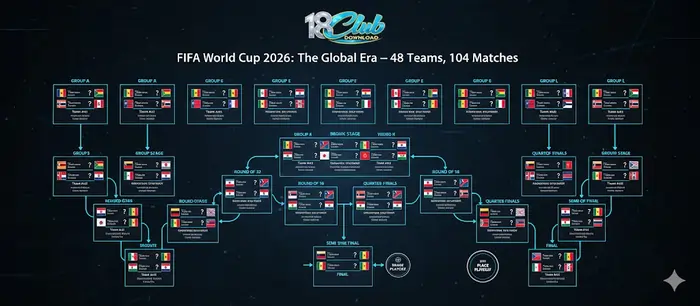
The 48 teams 104 matches World Cup marks the most dramatic evolution in international football history. Scheduled for the FIFA World Cup 2026, this expanded tournament introduces more nations, more fixtures, and a broader global footprint than any previous edition of the competition.
For decades, the World Cup followed a stable structure built around 32 teams and 64 matches. The upcoming shift to 48 participating countries and 104 total games is not simply a numerical increase. It represents a deep structural redesign that will influence qualification pathways, match scheduling, player workload, broadcasting economics, environmental planning, and the overall fan experience across continents.
Overview of the 48 Teams 104 Matches World Cup
The expansion to 48 national teams increases total fixtures from 64 to 104 matches, creating the longest and most inclusive tournament ever staged.
Quick Definition: The 48 teams 104 matches World Cup is the new international tournament structure beginning in 2026, featuring 12 groups of four teams, third-place qualification pathways, and an expanded knockout phase starting at the Round of 32.
Core Goals of Expansion
- Broaden Global Participation: By increasing the field, FIFA aims to give more nations a realistic path to the world’s biggest stage.
- Accelerate Development: Emerging football regions receive a massive boost in funding, infrastructure, and elite-level experience.
- Economic Windfall: FIFA anticipates the 2023-2026 cycle to generate over $11 billion in total revenue.
- Immersive Fan Experience: A longer tournament—running 39 days from June 11 to July 19—creates a “summer of football” like no other.
Rather than replacing tradition, the new format builds upon familiar competition principles while extending the journey toward the final.
Historical Evolution of World Cup Tournament Size
Understanding the importance of 48 teams and 104 matches requires historical comparison.
| Era | Teams | Matches | Structural Meaning |
| 1930–1978 | 13–16 | Up to 38 | Experimental global tournament; limited reach. |
| 1982–1994 | 24 | 52 | First modern expansion; growth in Africa/Asia. |
| 1998–2022 | 32 | 64 | Stable global format; established the 8-group standard. |
| 2026 onward | 48 | 104 | Full worldwide inclusion; the largest expansion in history. |
Every expansion reflected football’s growth. The official expansion announcement by the FIFA Council remains a landmark moment for the sport.
Full Tournament Structure Explained: The 12-Group Model
Group Stage Format
The 48 teams 104 matches World Cup begins with:
- 12 groups of four teams each.
- Round-robin matches inside each group (72 total group games).
- Advancement: The top two teams from each group plus the eight best third-placed teams advance.
This produces 32 knockout qualifiers, allowing for a perfectly balanced elimination bracket. For real-time updates on these group standings and team profiles, visit 18clubdownload.com.
Why Four-Team Groups Were Retained
FIFA initially considered three-team groups but rejected them due to:
- Collusion Risks: The “Disgrace of Gijón” scenario, where teams in the final match could play for a specific result to eliminate a third party.
- Competitive Integrity: Four-team groups ensure all final-day matches start simultaneously, maintaining high drama.
- Sustained Rest: This model allows for a more equitable rest schedule for players between fixtures.
Expanded Knockout Phase: The Round of 32
A defining innovation is the Round of 32, adding one more elimination stage before the Round of 16. This essentially doubles the amount of knockout football compared to the 32-team era.
Knockout Pathway:
Round of 32 (16 matches) → Round of 16 (8 matches) → Quarterfinals (4 matches) → Semifinals (2 matches) → Final (July 19, 2026).
Qualification Pathways: A More Equitable World
The 48 teams 104 matches World Cup significantly reshapes global qualification, rewarding the rapid growth of the sport in Asia, Africa, and North America.
Confederation Slot Distribution
- Europe (UEFA): 16 direct slots (+3 from 2022).
- Africa (CAF): 9 direct slots (+4). Debutants like Cabo Verde are now major contenders.
- Asia (AFC): 8 direct slots (+4). Nations like Uzbekistan and Jordan have leveraged this to secure their first-ever appearances.
- North/Central America (CONCACAF): 6 slots (3 Hosts: USA, Mexico, Canada + 3 Qualifiers).
- South America (CONMEBOL): 6 slots (+2).
- Oceania (OFC): 1 direct slot (A historic first for the region).
Intercontinental Playoffs
Two final spots are decided through an intercontinental playoff tournament, effectively extending the World Cup atmosphere months before the main event. For a deep dive into the odds and favorites, visit 18clubdownload.com.
Host Region, Cities, and Logistics: A Continental Mega-Event
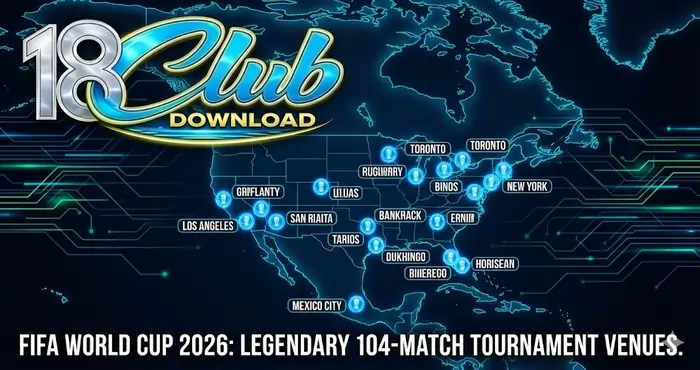
The 2026 edition is the first to be hosted by three nations: the United States, Canada, and Mexico.
16 Iconic Host Cities
Matches will be held in world-class stadiums, including:
- The Grand Opener: Estadio Azteca, Mexico City (June 11).
- The Final: New York New Jersey Stadium / MetLife Stadium (July 19).
- Regional Clusters: To reduce travel, cities are clustered into West (Vancouver, Seattle, LA), Central (Dallas, Kansas City, Mexico City), and East (Toronto, Miami, NY).
Logistics and Fan Experience
With distances exceeding 3,000 miles between some venues, fans and teams must manage unprecedented travel. Authorities recommend using the official host city guide to coordinate transport and border crossings.
Tactical Evolution and Squad Depth
Winning the 48 teams 104 matches World Cup requires playing eight matches to reach the final—one more than previous formats.
Championship Currency: Rotation
- B-Team Reliability: Managers will rely on deep 26-man squads to rotate key players during the 72 group-stage matches.
- Underdog Resilience: The new format allows more room for “Cinderella” stories. With 48 teams, the chance for a tactical upset from a debutant nation is at an all-time high. Stay updated on these underdog predictions at 18clubdownload.com.
The Role of Sports Science and Player Workload
Concerns regarding player fatigue are at the forefront of the 2026 discussion. The expanded format places extreme physical demands on elite athletes who are already coming off a grueling domestic club season.
Modern Recovery Technology
National teams are now using:
- Cryotherapy Chambers: For instant muscle recovery between the Round of 32 and Round of 16.
- GPS Biometric Tracking: Real-time data to monitor “red-zone” fatigue levels.
- Sleep Optimization: Specialized travel protocols to manage circadian rhythm disruption across four time zones.
Economic and Commercial Impact
The 48 teams 104 matches World Cup is projected to be the most lucrative sporting event in history.
Revenue Breakdown:
- Broadcasting Rights: Expected to reach $3.92 billion.
- Ticketing & Hospitality: Projected to generate $3.1 billion, fueled by massive NFL-capacity stadiums.
- Sponsorship: Marketing contracts are estimated between $2.5 billion and $3 billion.
Individual host cities are also expecting massive windfalls. For example, Seattle projects a $929 million injection into its local economy, while Los Angeles anticipates $594 million in total economic impact.
Environmental and Sustainability Considerations
The 2026 tournament faces scrutiny as the “most climate-challenging” due to the high volume of air travel. However, FIFA has committed to an Environmental & Sustainability Strategy focusing on:
- Green Stadiums: Utilizing LEED-certified venues.
- Renewable Energy: Powering fan zones with sustainable sources.
- Carbon Offsetting: Programs designed to mitigate the footprint of 104 matches and millions of traveling fans.
Conclusion: Redefining the Beautiful Game
The 48 teams 104 matches World Cup is more than a tournament; it is a historic turning point. By expanding participation and the competitive schedule, the 2026 edition signals a future of global inclusivity, cultural unity, and unprecedented commercial scale.
Beyond the stats, this transformation reflects football’s power to connect nations and inspire generations. For the latest World Cup updates and content, stay tuned to our ongoing coverage as we approach the legendary kickoff on June 11.