
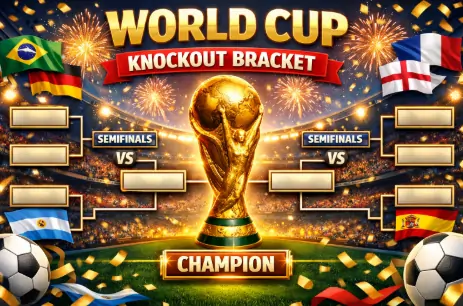
Unlock the 2026 World Cup knockout bracket: 32 teams, 8 high‑stakes rounds, and the exact path from group stage to the final. Discover how winners advance, strategic paths for favorites, and how upsets can reshape the tournament in a single match.
Table of Contents
World Cup Knockout Bracket Guide & Progression
The FIFA World Cup is the most prestigious tournament in international football, and the 2026 edition—co‑hosted by the United States, Canada, and Mexico—introduces a new, expanded format that changes how teams move from the group stage to the final. At the heart of this evolution is the World Cup knockout bracket, a single‑elimination tree that maps every possible path from the Round of 32 all the way to the World Cup Final on July 19, 2026.
This guide explains how the World Cup bracket works, how teams qualify for the knockout stage, how the bracket is structured, and how the draw ensures top‑seeded nations cannot meet too early. It is designed for fans, analysts, and sports‑betting players who want to understand not just the rules, but also the strategic implications of the new 48‑team format.
How Teams Reach the Knockout Stage
In the 2026 World Cup, 48 national teams are divided into 12 groups of four, with each side playing three round‑robin matches against its group opponents. The top two teams from each group (12 winners and 12 runners‑up) automatically progress to the knockout stage, filling 24 of the 32 spots.
The remaining eight knockout spots go to the best third‑placed teams across all 12 groups. FIFA ranks these third‑place finishers by points, goal difference, and other tie‑breakers; the top eight advance to the Round of 32. This new mechanism means that even a group ranked third can survive, turning the final group‑matchday into a dramatic “mini‑tournament” for outsiders.
From Group Stage to the Knockout Bracket
Once the group stage ends, the 32 qualified teams are slotted into a predetermined knockout bracket. Unlike some other tournaments, there is no separate knockout draw after the group stage; the structure is fixed in advance based on group positions and the third‑place table.
The Round of 32 is the first knockout round and features the following types of matchups:
- Group winners face either a runner‑up from another group or one of the best third‑place teams.
- Some runners‑up meet other runners‑up, depending on which groups the third‑place qualifiers come from.
- Teams from the same group cannot meet again before the final under the current bracket rules.
This structure ensures that the top‑seeded group winners are generally paired with lower‑ranked opponents in the early knockout rounds, rewarding strong performances in the group stage.
Anatomy of the 2026 World Cup Knockout Bracket
The 2026 bracket is the largest in World Cup history, with 32 knockout matches across five rounds: the Round of 32, Round of 16, Quarterfinals, Semifinals, Third‑Place Match, and Final. Because the tournament now begins its knockout phase with 32 teams, any nation reaching the final must play eight matches in total (three group games plus five knockout ties).
Key Rounds and Scheduling
- Round of 32: June 28 – July 3
- Round of 16: July 4 – 7
- Quarterfinals: July 9 – 11
- Semifinals: July 14 – 15
- Third‑Place Match: July 18
- Final: July 19 at MetLife Stadium, East Rutherford, New Jersey.
This extended schedule means the knockout stage spans nearly three weeks, giving fans more high‑stakes fixtures and giving teams extra time to recover between matches.
How the Bracket Is Structured
The 2026 knockout bracket is split into two main halves, each with its own “path” to the final. FIFA uses a Wimbledon‑style seeding system that places the four top‑seeded teams—Spain (1), Argentina (2), France (3), and England (4)—into separate quadrants of the bracket.
This design guarantees that:
- Spain and Argentina occupy opposite sides of the bracket and cannot meet before the final.
- Neither Spain nor Argentina can face France or England until at least the semifinals, assuming all four reach that stage.
Such seeding preserves competitive balance and prevents the highest‑ranked nations from clashing in the early knockout rounds, which increases the likelihood of marquee matchups in the latter stages.
How the Bracket Relates to the Group Draw
Before the tournament begins, FIFA conducts a group‑stage draw using four pots, with co‑hosts Mexico, Canada, and the United States seeded among the top 12. Each group contains one team from each pot, and continental restrictions limit how many teams from the same confederation can appear in a single group.
Although the group draw determines which teams face whom in the group stage, the knockout bracket path is already fixed. For example:
- The winner of Group F is scheduled to face the runner‑up of Group C in the Round of 32.
- The winner of Group H is set to meet the runner‑up of Group J, and vice versa.
Because the bracket is predetermined, fans and analysts can look ahead and ask questions like: “If England wins Group A, who will they face in the Round of 32?”—and answer that question well before the first group match kicks off.
How Third‑Place Teams Are Slotted Into the Bracket
The inclusion of eight best third‑place teams is a major change from the 32‑team format. FIFA ranks all third‑place finishers by:
- Points earned in the group stage
- Goal difference
- Goals scored
- Other tie‑breakers such as head‑to‑head, fair‑play points, and the FIFA World Ranking
The top eight third‑place teams are then slotted into specific slots in the Round of 32 bracket.
For example, the bracket may specify that the best third‑place team overall will face the winner of Group A, while another third‑place qualifier will take on the runner‑up of Group E. This means the exact path of a third‑place team depends on both its own performance and the results of other groups, adding a layer of complexity to predictions and bracket‑picker games.
How Knockout Matches Are Decided
Starting with the Round of 32, every match is single‑elimination. There are no two‑leg ties, and the loser is eliminated immediately.
If a knockout match is level after 90 minutes, the following procedure applies:
- Extra time: Two 15‑minute halves (30 minutes total) are played, regardless of whether goals are scored.
- Penalty shootout: If the score remains tied after 120 minutes, the winner is decided by spot‑kicks.
- Each team takes five penalties in an initial “best‑of‑five” round.
- If the shootout remains tied after five kicks, the process continues to sudden‑death rounds until one team scores and the other does not.
This format places a premium on fitness, mental resilience, and penalty‑shooting technique, especially in the latter stages of the bracket where teams may be fatigued after three group‑stage games and multiple knockout ties.
Strategic Implications for Coaches and Punters
The fixed bracket structure and the expanded format create several strategic considerations for both managers and fans.
For Coaches
- Avoiding top seeds early: Teams often aim to win their group, because group winners are generally paired with lower‑ranked opponents in the Round of 32.
- Resting and managing fatigue: With up to eight matches for a finalist, managers must decide when to rotate squads and how to handle injuries without risking early elimination.
- Third‑place qualification planning: Sides that cannot finish in the top two may still target enough points to rank among the best third‑place teams, giving them a second chance in the knockout stage.
For Fans and Bettors
- Bracket‑picker games: Many fans fill out their own World Cup brackets, trying to predict which teams will advance from each group and which knockout matchups they will face.
- Live‑betting opportunities: The structure of the bracket—especially the seeding of top‑ranked teams—creates rich markets for match‑winner, over/under, and handicap bets at each knockout stage.
- Scenario‑based analysis: Analysts can simulate how third‑place qualifiers would affect the bracket and project which paths are “easier” or “tougher” for favorites.
How the 2026 Format Changes the Path to Glory
Before 2026, World Cup champions played seven matches: three in the group stage and four in the knockout rounds (Round of 16, Quarterfinals, Semifinals, Final). Under the new 48‑team format, a champion must now win eight matches, including the Round of 32, which adds both risk and excitement.
With more teams, more knockout matches, and a more complex third‑place qualification process, the 2026 World Cup offers a richer narrative from group‑stage tactical battles all the way to the final at MetLife Stadium.
World Cup Knockout Bracket in Practice: A Simple Example
To illustrate how the bracket works, imagine the following simplified scenario:
- Group A: Winner: Spain; Runner‑up: South Korea
- Group B: Winner: Netherlands; Runner‑up: Ecuador
- One of the best third‑place teams comes from Group C and is slotted into the bracket to face the winner of Group A.
Under the predetermined structure:
- Match X: Spain (Group A winner) vs Best third‑place team (Group C)
- Match Y: Netherlands (Group B winner) vs Ecuador (Group B runner‑up)
If Spain and Netherlands win their Round of 32 ties, they would meet the winners of adjacent matchups in the Round of 16, and the bracket continues to narrow until only two teams remain for the final.
Why the Knockout Bracket Matters for Fans
The World Cup knockout bracket is not just a diagram; it is a roadmap of potential storylines. It shows where favorites must navigate difficult paths, where underdogs might face manageable opponents, and where historic clashes could unfold.
By understanding how the bracket is built—from the group draw through the third‑place qualifiers and into the semifinals—fans gain a deeper appreciation for the tournament’s drama and the stakes of every group‑stage result.
Final Thoughts: Mastering the World Cup Knockout Bracket
The 2026 FIFA World Cup marks a turning point in the tournament’s history, with 48 teams, a Round of 32, and a predetermined, seeded knockout bracket that keeps the top seeds apart until the latter stages.
Whether you follow the competition as a casual viewer, a fantasy‑bracket player, or a sports‑betting enthusiast, knowing how the World Cup bracket works—from group qualification to third‑place rules and final‑path structure—gives you a clearer picture of which teams are on an “easy” route and which must battle through the toughest possible sides to lift the trophy.
As the tournament unfolds, the knockout bracket will evolve round by round, but the underlying logic remains the same: win or go home, through single‑elimination fixtures that test every side’s skill, resilience, and nerves—until only one champion emerges on July 19, 2026.