
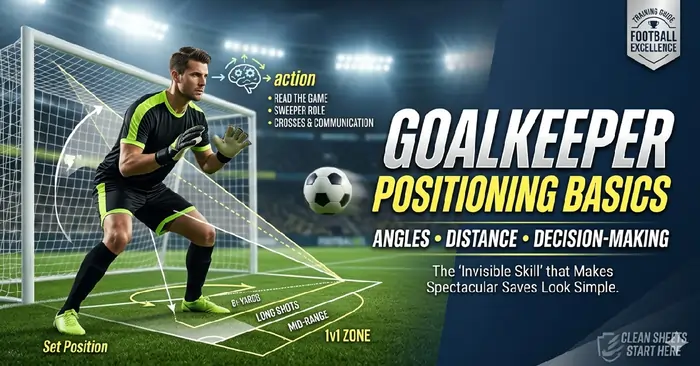
In the high-stakes World Cup of football, a Goalkeeper Positioning Basics is often judged by their spectacular, flying saves the fingertip stop to the top corner, the full-stretch dive that makes the highlight reel, or the last-second 1v1 block that saves a match.
But the world’s elite keepers from the trailblazing Filipino star Neil Etheridge to global icons like Alisson Becker know a secret that most beginners overlook: the best saves are often the ones that look simple because the goalkeeper was already standing in the perfect place.
Positioning is the “invisible skill” of goalkeeping. It rarely makes viral clips, but it is the foundation that every great save is built on. Good positioning is basically applied geometry on a grass pitch. If your position is correct, you do not always need outrageous athleticism; you need to be prepared, balanced, and in the right spot before the ball is struck.
For beginners in the Philippines who want to dominate their local 7-a-side leagues, impress in school tournaments, or one day aim for the PFL, mastering the trinity of Angles, Distance, and Decision-Making is the fastest path to more clean sheets.
This guide breaks those three concepts down into practical, easy-to-understand ideas you can apply in your very next game or training session.
The Geometry of the Goal: Understanding Angles
The most fundamental concept in goalkeeping is “narrowing the angle.” If you learn only one advanced idea as a beginner, make it this one. Angles decide whether a shot is unsavable or routine.
The Triangle Picture
Imagine two invisible ropes tied from the ball to the inside of each goalpost. Those two ropes and the goal line form a triangle. The bigger the triangle’s “mouth” facing the shooter, the more of the goal they can see and hit. Your job as the goalkeeper is to move in a way that makes that triangle smaller and more uncomfortable for the attacker.
Now imagine a line that cuts that triangle in half—this is the line that runs from the ball to the center of your goal. Your ideal position is almost always somewhere along this line. If you stand correctly on that line, the distance from you to each post is balanced. The striker sees less open space, and their finishing options shrink.
The “String” Theory
To make this even easier, use the “string” visualization. Picture a string tied from the exact center of your goal line to the ball. Your body should be standing on that string, with your feet, hips, and shoulders facing the ball.
- If the ball moves right: You shuffle right to stay on the string.
- If the ball moves left: You shuffle left in sync with it.
- If the ball moves forward or backward: You adjust your distance (more on that in the next section), but always stay aligned with that line.
This is not about big, dramatic movements. It is about constant, small, controlled shuffles that keep you centered on the ball–goal “string.” If someone took a top-down photo of the pitch, the line from ball to goal center should always go through your chest.
The Arc Movement
A big mistake beginners make is moving in straight, flat lines across the goal. In reality, a smart goalkeeper moves along a curved path—an arc—in front of the goal.
Think of it like this:
- When the ball is central (in front of the goal), you are at the top of the arc, a few steps off your goal line, facing the ball.
- As the ball moves toward the left or right side (toward the touchline or dead-ball line), you do not just slide sideways. You move diagonally back toward your near post, staying on the ball–goal line while slightly retreating toward the goal.
This curved movement keeps your angles correct. If you simply slide straight sideways and end up glued to your near post, you actually open up more space at the far post, giving the attacker a big target to aim at.
Why You Should Not “Live” on the Goal Line
A natural instinct for beginners—especially in pressure moments—is to retreat and stand right on the goal line. It feels safer. But too deep a position actually gives the attacker more time and space to pick their spot. Standing 2–3 steps off your line when the ball is in the box usually gives you:
- A better angle to block shots.
- More ability to move forward and attack the ball.
- A larger presence, making you look “bigger” to the shooter.
By holding this slightly advanced position, you make the goal feel smaller to the attacker and reduce the amount of goal they can see. Over time, you will feel the difference: shots that used to beat you into the corners become comfortable saves because you’ve already narrowed the angle.
Managing Distance: When to Stay and When to Go
If angles are the “side-to-side” component of positioning, distance is the “front-to-back” part. Managing distance is all about how far you stand from your line relative to where the ball and attacker are. It answers a critical question: Do I step forward to close space or stay back to gain reaction time?
The Six-Yard Rule
For beginners, a simple rule is to see the six-yard box as your primary reference zone.
- Long shots (20+ yards out): When the attacker is far from goal, especially outside the penalty area, you should stay close to your goal line. This gives you maximum time to react to the ball’s flight. If you play in windy coastal areas or on bumpy pitches common in many Philippine cities, staying slightly deeper can also help you adjust to unpredictable swerves and bounces.
- Mid-range attacks (inside the box but not too close): When the attacker enters the penalty area and looks ready to shoot, you should move forward to the edge of the six-yard box. By stepping out, you “grow” in the attacker’s vision, covering more of the goal with your body.
Imagine a triangle again: as you move forward, the distance between you and each post changes. Done correctly, stepping out reduces the visible target area for the striker.
The 1-on-1 “Charging” Technique
One of the most stressful situations for any goalkeeper is the breakaway—an attacker racing toward goal with defenders chasing behind them. Here, distance management becomes a game of controlled aggression.
Break it into three stages:
- Shorten the Distance
As soon as you recognize a true 1v1 (no defender close enough to block), start moving forward. Do not charge blindly; watch the attacker’s touches. When they take a heavier touch to push the ball ahead, that is your green light to sprint forward and close space. - The Breakdown Phase
As you get closer, you cannot keep sprinting. Slow down, lower your center of gravity, and enter your “Set Position”: knees bent, weight on the balls of your feet, hands in front and ready. This gives you balance to react to a shot, fake, or dribble. If you arrive at full sprint and the attacker taps the ball sideways, you will not be able to change direction. - The Stalk
Once you are in your set position, you do not dive immediately unless the ball is exposed and within reach. You “stalk” the attacker by taking small, controlled steps forward, staying as big as possible. The longer you stay on your feet, the more pressure you put on them. Many attackers panic and shoot early, making your save easier. If you dive too soon, they can dribble around you or chip the ball over you into an empty net.
Think of 1v1s as a battle of patience: your goal is to bring the attacker into a situation where they must try something difficult to score.
Decision-Making: The Goalkeeper’s IQ
In modern football, positioning is not just about mechanics; it is about reading the game. In 2026, the “sweeper keeper” concept is not only for professionals. Even in amateur and youth football, keepers are expected to help defend space behind the backline and join in build-up play.
Decision-making is the brain behind your positioning. It is the mental process of choosing where to stand, when to move, and when to hold your position, based on what is happening in front of you.
Defending a High Line: The Sweeper Role
When your team is attacking and pushes up into the opponent’s half, your defenders may hold a higher line near the halfway line. If you stay rooted on your goal line in these situations, you leave a huge empty gap between your defenders and your box, which opponents can exploit with long balls.
Instead, think of yourself as the last outfield player:
- Step up toward the edge of your penalty area or even a few steps outside it, depending on your speed and comfort.
- Stay slightly off the center line of your goal so you can quickly move left or right to intercept through balls.
- Constantly scan: check both the ball and the position of the opposing forwards.
Your goal in this higher starting position is to intercept “over-the-top” passes before the striker can control them. If you are already high, you can meet the ball early and clear it with your feet. This transforms many dangerous situations into routine clearances.
Balancing Risk: Beware the Long Lob
Playing high brings risk. If you are too far out and the opponent spots it, they may attempt a long-range chip or lob. To manage this:
- Watch the ball-carrier’s body language. When they look up, set their body, and seem to prepare for a long kick, be ready to drop quickly toward your goal.
- Learn to move backward using side steps or small cross-over steps, not turning your back completely. You must always keep your eyes on the ball.
- Accept that sometimes the safest choice is to stay a bit deeper if you are not confident in your speed or reading of the game yet.
Good sweeper-keepers constantly adjust: a few steps up when their team has solid possession, a few steps back when the ball is loose or a long shot seems possible.
Dealing with Crosses and Corners
Crosses are mentally demanding because they force you to decide quickly: come out or stay home? For beginners, this is often the hardest part of decision-making.
Start with a simple positioning guideline:
- Cross starting position: Stand roughly in the middle of the goal, 2–3 steps off your line. Angle your body slightly toward the ball so you can see both the delivery and the runs of attackers and defenders.
- Track the ball’s flight early. As soon as you see where it might land, ask yourself: “Can I get there first and reach the ball at its highest point?”
Then apply the golden rule:
Only come out if you are 100% sure you will get there.
If you misjudge and start to come but then hesitate, you create chaos:
- Your defenders expect you to claim the ball and may stop jumping.
- You are stuck in “no-man’s land”—too far off your line to react to a header, but not close enough to punch or catch.
If you are unsure, stay closer to your line, keep your feet alive, and prepare for the header or shot. It is better to face a tough shot from a header than to leave the goal completely empty by missing the cross.
Over time, you will develop a feel for which balls you can claim. In training, ask your teammates or coaches to serve crosses repeatedly so you learn how fast you must move and how high you can reach when leaping off one or two feet.
Communication: Positioning Your Teammates
Positioning is not only about where you stand. As a goalkeeper, you have the best view of the entire field. Part of your job is to use that view to position the ten players in front of you.
Setting the Wall on Free Kicks
On direct free kicks, you and your wall work together to cover the goal:
- Your wall should usually protect the near post side (the side closest to the ball).
- You take responsibility for the far post and the space above or around the wall.
- Make sure the wall is thick enough (number of players) and positioned correctly—often one small step one way or the other makes the difference.
A simple trick: line yourself up with the far post, then move the wall left or right until you can just see the ball over their shoulder. This ensures the wall is blocking enough of the goal while still allowing you a clear view of the strike.
Directing the Backline
During open play, your defenders do not always see what you see. You must guide them:
- Use clear, short commands like “Step up!”, “Drop!”, “Left shoulder!”, “Mark 9!”, or “Time!” (when they are under no pressure).
- Help your backline hold a good shape. If they are too deep, shout for them to step up together. If there is space behind them and a fast striker is lurking, warn them early.
Guarding the Blind Side
One of the most common ways teams concede goals is from runs on the “blind side”—the space behind the defender’s back where they cannot see the attacker. You, however, can see everything.
Make it a habit to:
- Call out “Shoulder!” or “Man on your back!” when you see a striker moving into that hidden space.
- Constantly talk to your center-backs and full-backs, especially when crosses are about to come in.
You may never touch the ball in some of these plays, but your voice will prevent shots from happening in the first place. That is elite positioning: removing danger before a save is even needed.
Practical Drills for Positioning
Knowing theory is one thing; turning it into automatic habits is another. Here are two simple drills you can use at your next session, whether on grass, turf, or even a small barangay court with makeshift goals.
Drill 1: The “Triangle Glide”
Purpose: Train angle awareness and arc movement.
- Stand in goal.
- Have a coach or friend dribble the ball slowly in an arc from one wing, across the front of the box, to the other wing.
- Your job is to stay on the “bisecting line” between the ball and the center of the goal at all times, moving in your curved arc—never in straight, flat lines.
- The server occasionally stops and holds the ball. Freeze in your position and check:
- Are you 2–3 steps off your line?
- Are you centered on the ball–goal line?
- Is your body facing the ball?
This builds a feel for how much you need to move as the ball shifts from one side to the other.
Drill 2: The “Red Light, Green Light” 1-on-1
Purpose: Train distance management and 1v1 timing.
- Place the ball at the halfway line with an attacker behind it.
- You start in goal in your normal position.
- The attacker dribbles toward goal. Your rules:
- Green Light: When they push the ball slightly ahead (a heavy touch), you sprint forward to close space.
- Red Light: When they have the ball under close control at their feet, you must stop, get into a set stance, and “stalk” them with small steps.
- The attacker chooses when to shoot, dribble, or try to fake you.
This drill teaches you to avoid rushing all the way or freezing on your line. Instead, you learn to arrive in control and balanced, ready for any finish.
Common Mistakes to Avoid
Even talented, athletic beginners often get caught by the same simple positioning errors. Being aware of them is the first step to fixing them.
- Hugging the Near Post
On angled shots, many new keepers stand too close to the near post because they are afraid of being beaten there. But if you overprotect it, you expose the far side with a huge gap the striker can easily pick out. Trust your angle and stay on the line between ball and goal center, not glued to the post. - Back-Pedaling into the Goal
Running straight backward is risky: it is easy to lose your balance, misjudge the crossbar, or misread the ball’s flight. Instead, move back using quick side or cross-over steps, always facing the ball. This keeps your body ready to jump or dive at any moment. - Getting Stuck in “No-Man’s Land”
No-man’s land is the worst of both worlds: you are too far from your line to react to a shot and too far from the attacker or cross to block or claim the ball. It usually happens when you start to come out but lose confidence halfway. The solution is mental: commit. Either attack the ball decisively or stay back and prepare to make the save—do not hesitate in between.
Conclusion: The Master of Space – Goalkeeper Positioning Basics
Goalkeeping is often described as a game of inches, but really, it is a game of space. A goalkeeper who understands positioning effectively “shrinks” the goal for the attacker. From the striker’s perspective, the open corners disappear, the angles tighten, and shots that used to feel easy suddenly look complicated.
By mastering your angles, managing your distance from both the ball and your goal line, and making clear, confident decisions, you quietly take power away from the attacker and give it back to your team. You may not always make the most dramatic dives, but your solid positioning will mean you are in the right place, at the right time, far more often.
In the Philippines, where football continues to grow—from school tournaments and weekend futsal to professional matches in stadiums like New Clark City—a technically sound goalkeeper is rare and highly valued. Whether you are playing under floodlights on pristine grass or under the sun on a concrete court in your barangay, the laws of geometry do not change.
Own your space. Position yourself well, and the saves—and the clean sheets—will follow.