
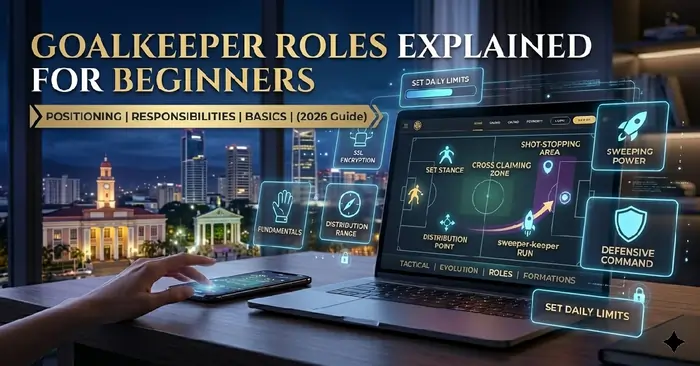
In 2026 football, the goalkeeper is no longer just the last defender; they are also the first playmaker. Modern keepers guard the goal, sweep up danger behind a high defensive line, and launch passing moves that start attacks. This Goalkeeper Roles Explained for Beginners guide explains goalkeeper positioning basics, core responsibilities, and modern trends like the sweeper-keeper so that complete beginners can finally see what is really happening between the posts.
Whether you are stepping into goal for the first time or you are a fan trying to understand modern football positions in 2026, this goalkeeper-focused breakdown will show you how keepers think, move, and influence every phase of the game.
Goalkeeper Fundamentals: The Foundation of Modern Keeping
The goalkeeper holds a unique place in any “football positions explained” guide because they are the only player allowed to use their hands inside the penalty area, yet they must also play with their feet like an outfield player. In modern 2026 soccer, this means a keeper acts as both the ultimate defender and the first point of attack. Many coaching resources now stress that the modern goalkeeper must be as comfortable with passing and decision-making as they are with shot-stopping.
In the traditional numbering system, the answer to “What are the 11 positions in football?” starts with the #1 goalkeeper. While outfield players often cover 10–12 km per match, keepers typically move shorter total distances but rely on explosive sprints, lateral shuffles, and quick reactions. In high lines and pressing systems, keepers may sprint 20–30 meters to clear through-balls, sometimes reaching very high speeds when sweeping behind defenders.
Beginners must first learn the basic set stance:
- Feet about shoulder-width apart.
- Knees slightly bent.
- Weight forward on the balls of the feet.
- Hands in front of the body at roughly a 45-degree angle, ready to move up or down.
Many coaching guides emphasize that a goalkeeper should always be “on their toes” with their body weight forward, so they can explode into a dive or step toward the ball. Think of your hands as “big gloves” with fingers spread to increase the surface area for catching; this makes it easier to control powerful shots and crosses.
The mental side is just as important as the physical. A huge portion of success in goal comes from decision-making: when to come out, when to stay, when to catch, and when to punch. Training material for keepers often focuses on building calm under pressure and clear thinking during chaotic moments in the box. Even at beginner level, you should see every situation as a decision puzzle, not just a physical reaction test.
Core Responsibilities: What Every Keeper Must Master
In 2026, the responsibilities of each football position place intense demands on goalkeepers across four main pillars: shot-stopping, organization, distribution, and sweeping. Possession-based systems and pressing styles mean that each pillar matters just as much as the others.
You can think of a simple responsibility matrix like this:
| Responsibility | Beginner Focus | Advanced Application |
| Shot-stopping | Get body behind the ball, hands set high and low | Reaction saves, smothering rebounds |
| Cross claiming | Jump at the right time, secure the ball safely | Directional punches, dominance in traffic |
| Distribution | Safe rolls and throws to nearby teammates | Driven 40–60 m passes with high accuracy |
| Defensive organization | Clear, loud communication to defenders | Managing zonal marking and set-piece structure |
| Sweeping | Basic clearances off the line | Aggressive interceptions 20–30 m from goal |
Shot-stopping
Shot-stopping begins with one key idea: attack the ball. Rather than waiting passively on the line, keepers step toward the shot, use their body mass to get behind the ball, and aim to control or smother rebounds. Many beginner drills use tennis balls or smaller balls to develop reaction speed and hand–eye coordination, helping keepers deal with close-range shots and deflections.
Common beginner mistake: standing flat-footed and reacting late. The fix is to always hold that active stance and move with the ball as it travels, instead of freezing in place.
Cross claiming
Crosses decide many matches, especially at youth and amateur level. Good cross claiming is about timing and bravery. You want to jump at the ball’s highest point and attack it with both hands, ideally above your eyebrows to protect it from challenges. Coaching articles on sweeper-keepers and command emphasize decision-making here: if you cannot catch cleanly, a firm, directional punch into a safe area is better than a weak attempt that drops in front of goal.
Rule of thumb: never punch back into the danger zone; angle your punch wide or toward the flanks so your team can recover shape.
Distribution
Quick, smart distribution has transformed goalkeeping. Modern drills often combine shot-stopping with immediate distribution, forcing keepers to make a save and then hit accurate passes within seconds. A simple training sequence for beginners might be:
- Save or catch a shot.
- Scan quickly for a free teammate.
- Roll or throw the ball out accurately within 2 seconds.
As keepers progress, they add driven passes along the ground or clipped balls to full-backs and midfielders to help build attacks under pressure.
Defensive organization
Goalkeepers see the whole field, so they must act as on-pitch coaches for the back line. Resources on modern keeping stress constant communication: organizing the wall on free-kicks, calling “away” or “keeper” on crosses, and instructing defenders when to push up or drop. Silent goalkeepers often concede avoidable goals because defenders do not react to danger as a unit.
Sweeping
Sweeping is the heart of the sweeper-keeper role. A sweeper-keeper aggressively leaves the goal line to intercept through-balls, clear long passes over the top, and even act as a spare defender behind a high back line. Good sweeping relies on reading the game early rather than trying to win foot races late.
A simple decision framework:
- If the forward is likely to receive the ball facing your goal within 20–25 yards, you should consider coming out quickly.
- If your defenders are goalside and close, you may hold and prepare for a 1v1 instead.
Mastering Goalkeeper Positioning: The Art of Angles
Soccer goalie position diagram
Goalkeeper positioning basics separate average keepers from reliable ones. Many coaches say that positioning accounts for most saves, because a well-placed keeper turns difficult shots into routine catches and forces strikers into poor angles.
Core positioning ideas:
- Central shot: Stand centrally between the posts, 2–4 yards off your line for most medium-range strikes.
- Wide angle: Shift toward the near post to narrow the angle when the ball is in a wide area.
- Diagonal threats: When attackers can both shoot and pass, position yourself between the ball and the most dangerous option.
- High press: When your team presses high, step 8–12 yards off your line to act as a passing outlet and sweeper.
Coaching diagrams for goalkeepers often show how stepping even one yard forward can significantly reduce the shooting angle. Simple partner drills, where a teammate dribbles toward goal while you adjust your position, help beginners understand how small movements change the striker’s options.
Set-piece positioning also matters. For corners, many coaches recommend starting nearer to the middle–near-post area, then adjusting based on the delivery and your team’s marking scheme. For wide free-kicks that may be crossed or shot, you usually start slightly toward the far post to anticipate a curling ball, while still being able to shift back across if the shot goes toward your near side.
During transitions—when possession changes quickly—keepers must constantly adjust: stepping higher when your team attacks to offer a passing option, then dropping quickly when the opponents break forward.
2026 Goalkeeping Revolution: Sweeper-Keeper Dominance
The modern sweeper-keeper role has evolved over the last decade, inspired by high-possession teams and pressing systems. Tactical analyses describe the sweeper-keeper as a goalkeeper who operates further from goal, contributes heavily in build-up play, and dominates space behind a high line.
Key traits of a modern sweeper-keeper include:
- Footwork and passing: Comfortable receiving back-passes and recycling possession, often attempting many short passes each game.
- Sweeping: Quick off the line to clear long balls and through-passes behind the defense.
- Command: Confident at claiming crosses and organizing defenders inside the box.
- Distribution: Able to play both safe passes in build-up and longer, riskier balls to launch counter-attacks.
Analysts often describe sweeper-keepers using three categories: sweeping (defending away from goal), command (controlling the penalty area), and distribution (passing impact and attacking threat). For beginners, it is enough to understand that sweeper-keepers are not just reacting inside the six-yard box; they are actively shaping the match 20–30 meters away from their line.
Press-resistant keepers must scan the field quickly under pressure and choose safe options instead of panicking. Coaches advise keepers to check wide full-backs, dropping central defenders, and nearby midfielders as options before the ball even reaches their feet, buying them extra decision time when a forward presses aggressively.
Training Framework: From Beginner to Competent Keeper
A structured training plan helps beginners move from basic shot-stopping to a more complete goalkeeper profile. Coaching sites lay out drills that blend reactions, footwork, and distribution into realistic scenarios.
Weeks 1–4: Fundamentals
Daily 45-minute sessions might include:
- 10–15 minutes of reaction saves using tennis balls or smaller balls to sharpen reflexes.
- 10–15 minutes of footwork ladders and short dives to each side.
- 10 minutes of basic distribution to stationary targets (rolls, throws, simple passes).
- 5–10 minutes of positioning games where a coach or partner moves the ball and the keeper adjusts stance and angle.
Many beginner drill guides emphasize staying light on your feet, keeping your stance consistent, and building muscle memory for simple actions like catching, collapsing to the side, and recovering quickly.
Weeks 5–8: Game Integration
As confidence grows:
- Practice claiming crosses from wingers serving balls into the box.
- Work on sweeping runs against through-balls, starting from a higher starting position.
- Add time pressure to distribution, giving yourself only 2–3 seconds to make a decision.
- Train 1v1 situations where you close down attackers, set your feet, and spread your body to block.
Several modern training resources combine shot-stopping and distribution in a single drill, mirroring realistic match situations where keepers must recover from a save and immediately start a counter-attack.
Weeks 9–12: Match Simulation
In the final phase:
- Play full 11v11 or small-sided games where you apply all skills under match pressure.
- Focus on set-piece routines, including how you position your wall and where you stand.
- Use basic video analysis—many apps now make this easy—to review your decisions and positioning.
- Practice advanced sweeping patterns, such as starting high when your team builds up, then retreating when possession is lost.
Coaches also highlight the value of mental training: visualization exercises where you picture yourself dealing with crosses or making crucial saves, and pressure simulations where you practice late-game situations with your team.
Equipment for this journey includes quality gloves (with better latex for matches and more durable foam for training), agility tools like ladders and cones, and reaction aids like bounce balls or multi-direction lights.
Common Beginner Errors and Fixes
Beginners often repeat the same few mistakes, which can be corrected with targeted drills.
Typical errors:
- Frozen positioning: Standing still as the ball moves, leading to poor angles and late reactions.
- Weak distribution: Inaccurate passes or panicked clearances.
- Silent organization: Failing to communicate with defenders.
- Hesitant sweeping: Arriving late to through-balls and conceding 1v1s.
Common fixes recommended in coaching resources include:
- “Move with the ball” drills, where the keeper shuffles in line with the ball’s position while a partner passes around the box.
- Cone and target drills for distribution, hitting cones at different distances with both feet for consistency.
- Vocal drills that force keepers to call out commands on every action—cross, back-pass, or defensive line movement.
- Races against forwards to reach a rolling ball first, teaching quick decision-making when sweeping.
Recording training and matches is a practical way to track progress; many platforms now allow goalkeepers and coaches to review clips, categorize errors, and measure improvement over time.
Goalkeeper Types: Discovering Your Style
Not every goalkeeper plays the same way. Personality and strengths often shape how a keeper approaches the game. Tactical analysis articles sometimes distinguish between pure shot-stoppers, vocal organizers, and sweeper-keepers in terms of command, distribution, and sweeping activity.
You can simplify this into a few broad styles:
- Vocal commander: Loud, authoritative, excellent at organizing defenders and dealing with crosses, but maybe less adventurous with the ball at their feet.
- Reflex athlete: Exceptional at close-range reaction saves and 1v1s, but may still be learning consistent sweeping or high starting positions.
- Distribution maestro: Calm under pressure with the ball, strong passing range and vision, but may need to work on aerial duels and physical presence.
- Sweeper supreme: Aggressive off the line, reads long balls early, acts almost like an extra centre-back, but must balance this with solid shot-stopping.
Different formations may suit different types. Teams playing a very high line with three central defenders often prefer a sweeper-keeper who covers space behind them, while deeper, more compact systems may tolerate a more conservative, shot-stopping specialist.
For young goalkeepers, the development path is usually:
- Ages 8–12: General fundamentals—catching, diving, basic positioning.
- Ages 13–16: More specialized keeper training, plus footwork and distribution under pressure.
- Ages 17+: Integration into full team tactics, with more emphasis on communication and reading complex match situations.
Integration with Team Tactics and Analytics
A goalkeeper does not act in isolation; they anchor the team’s defensive shape and influence how the side builds attacks. Tactical resources highlight how the keeper’s comfort with the ball allows teams to push their defensive line higher, compress space, and maintain possession under pressure.
Formation-specific duties might look like:
- 4-3-3: Very active in sweeping and build-up, offering an extra passing option as the team plays out from the back.
- 3-5-2: Supporting wing-backs with diagonal passes and covering wide spaces behind them.
- 4-2-3-1: Connecting with defensive midfielders and the central attacking midfielder, staying calm against coordinated presses.
Today, analytics play a growing role in goalkeeper evaluation. Modern analysis looks beyond simple save percentage and uses metrics such as:
- Goals prevented relative to expected goals (how many “extra” goals a keeper saves compared to an average one).
- Crosses stopped and aerial duel success.
- Passing and distribution stats, including short pass completion and long “launch” efficiency.
- Sweeping actions—how often and how successfully the goalkeeper leaves the line to clear danger.
Free or entry-level tools for video and data analysis are increasingly available, allowing ambitious beginners to compare their own tendencies with benchmarks and adjust training.
Equipment and Physical Preparation
Modern guides to goalkeeping stress that while size helps, athleticism and technique are just as important. Keepers benefit from:
- Explosive training like box jumps and sprints to improve take-off speed and vertical leap.
- Core stability exercises such as planks and rotational work to support powerful dives.
- Grip and forearm exercises to strengthen hands and fingers for firm catches.
Glove choice matters too. Many brands and coaching guides suggest:
- Softer latex palms for match gloves, offering better grip but wearing out faster.
- More durable foam palms for training gloves.
- Specialized wet-weather gloves or treatments to handle slippery conditions.
Injury prevention is also vital: warm-up routines for shoulders and hips, taping fingers if needed, and using ankle supports for players who have had previous sprains.
Start Mastering Goalkeeper Skills
By now, you can see that “goalkeeper roles explained for beginners” is about far more than just catching shots. Modern keepers must combine shot-stopping, sweeping, distribution, and organization into one complete profile. Coaching resources, tactical analyses, and training guides all agree that the position has evolved into a hybrid role that links defense, midfield, and attack.
If you are just starting out, focus first on a solid stance, basic handling, and clear communication. As you progress, add distribution, sweeping, and more advanced positioning. In 2026 football FIFA World Cup, the goalkeeper is a true game director from the back—if you embrace that responsibility, you can transform from passive shot-stopper into the modern, complete keeper your team builds around.