
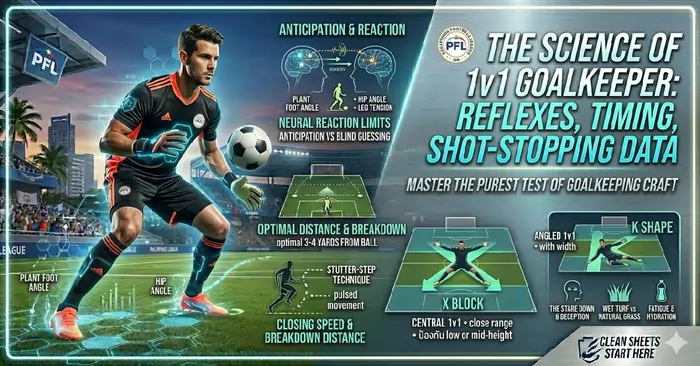
The 1v1 is the purest test of a goalkeeper’s craft. To fans, it looks like a coin flip; to a modern keeper, it is a battle of physics, biology, and probabilities that can be shaped and improved with training. This guide breaks down the science behind reaction time, distance, body shape, psychology, and environment so you can approach 1v1s with a clear, data-driven plan instead of guesswork.
The Physics of the Reaction Window
When a striker breaks free and is bearing down on goal, it feels like everything happens in a blur. That perception is accurate: the time window for a save is brutally small.
Human Reaction Limits
Elite goalkeepers in FIFA World Cup typically react to visual stimuli in roughly 200–250 milliseconds. That is the time needed for:
- The eyes to register movement.
- The brain to process what is happening.
- The nervous system to send a signal to the muscles.
- The muscles to begin moving in the chosen direction.
Now compare that to ball travel time:
- A ball struck from 10 yards at high speed can reach the goal in under 400 milliseconds.
- From even closer, that window shrinks further.
On paper, that sounds manageable—you have about half the ball’s flight time to react. In reality, if you start reacting only once the ball has left the striker’s foot, you are already in trouble. You need to cheat the clock.
Anticipation Over Pure Reaction
The key is anticipation, not blind guessing. Modern 1v1 goalkeeping focuses on reading “pre-impact cues” before the ball is struck:
- Plant foot:
Which foot is planted, and where? A plant foot pointing toward the far post often signals a shot across goal; a more closed plant may indicate a near-post or lifted shot. - Hip angle:
Open hips can suggest a shot across or a pass; hips closed toward goal often mean a driven shot straight ahead or to the keeper’s side. - Leg tension and swing:
A big backswing signals power; a short, stabbing motion could mean a quick toe-poke or dink.
By registering these cues, you can begin to load your movement fractionally before impact—maybe 100 milliseconds earlier. That small head start is often the difference between a clean goal and a fingertip save.
Practical Implications
In training and games, this means:
- Keep your eyes on the ball–hip–plant foot triangle as the striker sets up.
- Do not lock onto the ball alone; widen your visual field just enough to see body language.
- Use that information to pre-activate your push-off leg in the direction you’re most likely to need.
You are not guessing; you are using micro-signals to turn reaction into controlled anticipation.
Closing Speed and the Optimal Distance
In 1v1s, your best weapon is not your hands—it is where you stand.
Why Distance Matters
The closer you are to the ball, the smaller the shooting angle. As you step forward:
- The visible area of the goal shrinks from the striker’s perspective.
- Their margin for error decreases; they must be more precise.
- Your body covers a greater percentage of the goal.
However, sprinting all the way to the striker and sliding recklessly is not the answer. If you get too close too early, a quick dink or side-step leaves you stranded. The challenge is to find the sweet spot.
The “Sweet Spot” Distance
Many modern 1v1 coaching models point to an optimal “breakdown” distance of roughly 3–4 yards from the attacker. At this distance:
- You are close enough to make the goal feel small.
- You are far enough away that you can still react to a shot or a last-second touch.
- You have room to use a blocking shape (like an X or K block) without the ball being flicked over you instantly.
Think of your movement as having two phases:
- Closing the Gap
You sprint forward when the attacker’s touch pushes the ball away from their feet. Big touches are your green light—they cannot shoot while the ball is far from them. - The Breakdown
As the ball comes back within striking distance, you must stop your forward run, sink into your set stance, and be ready to react. This breakdown should happen around 3–4 yards from the ball.
The “Stutter-Step” Technique
Moving in pulses is more effective than one long, uncontrolled charge:
- Quick sprint forward on a heavy touch.
- Small stutter steps or controlled shuffle as the striker regains control.
- Stop completely (be “set”) at the exact moment their foot is about to strike.
Why being “set” matters:
- If you are still moving forward as they shoot, your body must fight its own momentum to change direction.
- That effectively slows your reaction by a noticeable margin.
- Being still at the moment of impact maximizes your ability to explode into a dive, block, or spread.
In simple terms: move fast between touches, be still at the touch.
The Anatomy of the Save: X Block vs K Shape
In true 1v1 situations, full-stretch diving saves are rare. The ball is usually struck from close range, leaving no time or distance for classic dives. That is why modern 1v1 goalkeeping relies on specific blocking shapes.
A. The X Block
The X Block, heavily influenced by futsal, is designed for close-range, central 1v1s—especially in and around the six-yard box.
Typical features:
- One knee drops toward the ground, often the side closest to the ball.
- The other leg is extended out, making you longer horizontally.
- Arms spread wide, with hands low and slightly forward.
- Torso stays relatively upright and leaning forward.
Why it works:
- Most close-range finishes are driven low or mid-height, not top corner.
- The X Block covers:
- The space between your legs (preventing nutmegs).
- Both low corners near your feet.
- A surprisingly large area of the goal just above the ground.
Used correctly, this shape turns your body into a big, ugly barrier that the ball has to find a tiny gap to get through.
B. The K Shape (Long Barrier)
The K Shape is more suited to angled 1v1s, where the attacker is coming in from the side rather than straight on.
Key points:
- You turn slightly toward the near post.
- The leg closer to goal remains more vertical, while the trailing leg drops and extends outward, forming a “K” shape with your body.
- Your near-side arm and hand protect the gap toward the post, while your far arm helps cover the mid-height zone.
Why it works from angles:
- It blocks the obvious near-post route.
- It stretches your body across the most likely shooting path.
- It forces the attacker into a very tight far-post attempt or a square pass.
Choosing between X and K:
- Central and very close: generally X Block.
- From an angle, with a bit more width: K Shape often gives better coverage.
In both shapes, your goal is to maximize surface area, not to look pretty.
Psychological Warfare: The Stare Down and Deception
1v1s are not just physical events; they are mental duels. The attacker expects you to panic or commit too early. If you control the psychological tempo, you can influence their decisions.
Reading Striker Focus
Strikers typically:
- Look at your position as they approach, to assess gaps and angles.
- Shift their gaze down to the ball shortly before striking, to time their contact.
The moment their eyes drop to the ball, they are no longer actively tracking your micro-movements.
Using Feints to Manipulate
You can use this shift of focus:
- Hold a stable, balanced position as they approach.
- Just as they look down to strike, introduce a subtle feint:
- A small dip to one side.
- A shoulder lean.
- A tiny step off-center.
If done well:
- The striker’s last conscious picture of you is slightly misaligned.
- They may aim for the area they believe you are leaving open.
- You then snap back into that space or maintain coverage with your block shape.
The key is subtlety. Wild, exaggerated movements will take you out of position. Small cues are enough to seed doubt.
Owning the Moment
Beyond feints, your body language matters:
- Staying tall and composed suggests confidence.
- Rushing in or flailing your arms signals panic and can calm the striker—because you look desperate.
Treat the 1v1 as your duel, not theirs. The more controlled and deliberate you appear, the more pressure shifts onto the attacker.
Decision-Making: The Point of No Return
Every 1v1 has a moment when you must commit. Diving too early or throwing yourself at the attacker from far away is often the biggest mistake.
Staying on Your Feet
A core principle in modern 1v1 coaching is: stay upright as long as possible.
Advantages:
- While standing, you can still:
- Adjust your angle.
- React to feints or last-moment touches.
- Transition into an X or K block.
- Diving early essentially turns you into a stationary obstacle. A calm striker can simply take one more touch and roll the ball around you.
Data and experience both show that keepers who remain on their feet until the last realistic moment tend to make more saves than those who “guess” and commit early.
When to Smother
There is one exception: the ball gets away from the striker.
- If the attacker’s touch pushes the ball further ahead than intended—about 30 cm (12 inches) or more beyond immediate control—that is your cue.
- In this window, they cannot shoot quickly; they must either stretch for the ball or slow down to recover it.
In that split second, a decisive smother often has a high chance of success:
- You dive forward, hands and leading knee protecting your head and torso.
- You aim to cover the ball with your hands and body before the attacker can poke it past you.
If, however, the ball is glued to their laces, diving at their feet becomes much higher risk. In that case, staying upright and using a block shape is usually safer.
Defining Your Point of No Return
Your personal “point of no return” might be:
- When your breakdown distance (3–4 yards) is reached.
- When the attacker starts their shooting action.
- When you commit to a smother.
Once you decide, do not second guess. Half-commitments cause accidents. Make your choice and execute it fully.
Environment Matters: Adapting to Climate and Surfaces
If you play in the Philippines—or any hot, humid, and often rainy environment—the science of 1v1s bends with the conditions.
Wet Turf vs Natural Grass
On artificial turf, especially when wet:
- The ball skids and maintains speed longer.
- Low shots zip quickly along the surface.
- Through-balls on the ground can accelerate after the bounce instead of slowing.
Implications for 1v1s:
- If you hold too high a line and expect the ball to slow, it may race under or past you.
- Staying a fraction deeper in 1v1 situations on slick turf gives you an extra reaction beat to track and block the ball’s path.
- Low spread shapes (like X Blocks) must be timed accurately to seal the ground quickly, as the ball will arrive faster.
On natural grass, especially heavier or uneven pitches:
- The ball slows more with each bounce.
- Unexpected bobbles can occur.
Here, you may:
- Be slightly more confident in coming out earlier.
- Focus extra on keeping your eyes locked on the ball’s path as it bounces.
Heat, Humidity, and Fatigue
In high humidity, especially late in halves:
- Your muscles tire more quickly.
- Your nervous system may transmit signals slightly slower when dehydrated or overheated.
- Mentally, you may start to switch off for tiny moments.
That’s dangerous in 1v1s, which often occur after transitions or late counter-attacks.
Practical adaptations:
- Use cooling and hydration breaks intelligently—drink, splash water on your face and neck, and use those seconds to reset mentally.
- Emphasize efficient, economical footwork to save energy earlier in the game.
- Build conditioning that mimics match intensity: sprints, rapid set–reset, and decision-making under fatigue.
The science is clear: if you want sharp 1v1 reflexes in minute 90, you must treat hydration and fitness as seriously as you treat technique.
Training 1v1s with Data in Mind
To turn this science into instinct, you need training that reflects real 1v1 chaos, not just static drills.
Drill 1: The Pressure Sprint
Goal: Improve closing speed and breakdown timing.
- Start on your goal line.
- A striker begins with the ball 18–20 yards away.
- On a signal, they drive toward goal.
- Your task:
- Sprint out aggressively when they take big touches.
- Break down and get set at roughly 3–4 yards from the ball before they shoot.
- Focus on:
- Getting from the line to the breakdown point quickly.
- Being completely still at the moment they strike.
This builds the habit of pulsed movement: fast, then set.
Drill 2: Blind-Side 1v1
Goal: Improve scanning, orientation, and rapid angle adjustment.
- Start facing away from the field or with your back turned.
- A coach or teammate plays a ball into the box and releases an attacker.
- On a call, you turn, locate the ball and striker, and rush to take up an optimal 1v1 position.
You learn to:
- Find your bearings quickly (where is my goal? where is the ball?).
- Rebuild your angle and distance under time pressure.
- Avoid panic rushes; instead, move intelligently into the breakdown space.
Drill 3: Shape Decision Game
Goal: Practice choosing between X and K shapes.
- Attackers approach from different angles, sometimes central, sometimes wide.
- You close to your breakdown distance and then must:
- Decide on X Block for central, close shots.
- Choose K Shape for angled attacks.
- Variants:
- Some attackers pass instead of shoot, forcing you to stay alert for cut-backs and rebounds.
Over time, you’ll start picking the right shape automatically based on angle and distance.
The Save Matrix: A Simple 1v1 Checklist
To keep all this science usable in real time, think in phases:
- Identification
- Spot the break immediately (through-ball, defender beaten).
- Switch into “high-alert” stance—slightly higher tempo, ready to move.
- Approach
- Close the distance quickly when the ball is free of the attacker’s feet.
- Avoid sprinting straight through them; you’re aiming for that 3–4 yard breakdown point.
- Breakdown
- Stutter your steps as the attacker regains close control.
- Get fully “set” just before they strike—balanced, weight slightly forward.
- Shape
- Central and close: X Block.
- Angled: K Shape or a modified barrier.
- Only smother if the touch is clearly loose and you can reach the ball first.
- Recovery
- If the ball rebounds, spring back to your feet quickly.
- Reposition for follow-up shots; many saves are made on the second attempt.
Think of this as your 1v1 flowchart, turning complex science into simple habits.
Conclusion: Becoming the Master of Probability
In 2026, 1v1 goalkeeping is no longer about hoping you guess the right side. It is a calculated game where you stack the odds in your favor:
- You understand that raw reaction time alone is not enough, so you learn to read pre-shot cues.
- You close distance intelligently, using geometry to shrink the goal without killing your ability to react.
- You choose body shapes like the X and K block to match the angle and distance.
- You control the psychological duel through body language, delayed commitment, and subtle feints.
- You adapt to climate, surface, and fatigue so your decisions stay sharp when it matters most.
The striker may control the ball, but you control the space, the timing, and the odds. Approach the 1v1 as a science, and you transform it from a dreaded situation into a scenario where you quietly believe: “I’m in charge here.”