
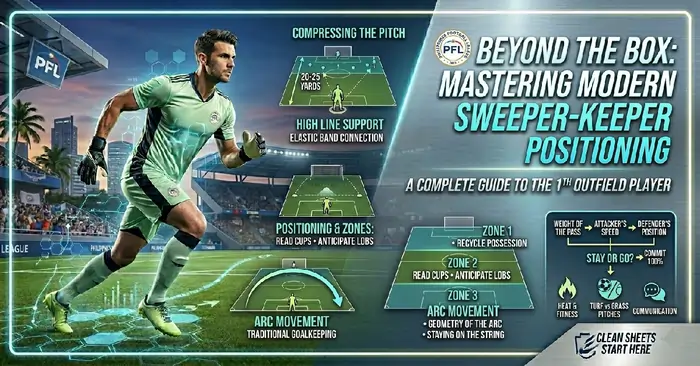
The Modern Sweeper-Keeper Positioning is a goalkeeper who controls everything that happens behind a high defensive line, not just shots inside the box. This guide breaks down the philosophy, positioning, decisions, skills, and FIFA World Cup specific realities you need to master if you want to play beyond the box in 2026.
The Core Philosophy: The 11th Outfield Player
The foundation of the Modern Sweeper-Keeper Positioning role is simple: you are not chained to your goal line. You are an active, mobile defender who compresses the pitch and removes the space that strikers want to attack.
Compressing the Pitch
When your team plays with a high line, your defenders step closer to the halfway line to squeeze the opposition into their own half. That only works if you, the keeper, move up with them. If you stay on your line while your backline pushes up, you create a huge empty zone between them and your goal. That “No-Man’s Land” is where through-balls become deadly.
A good sweeper-keeper closes that gap. By standing higher, you:
- Act as a safety net behind your defenders.
- Scare opponents away from simple long balls over the top.
- Make the field feel smaller for the attackers and bigger for your team.
The Connection Rule
Think of an invisible elastic band connecting you to your last defender. If they move five meters up, you should move up a few meters too. If they drop, you drop. You never want that elastic band to stretch too far.
A practical guideline for most situations:
- Try to keep a distance of about 20–25 yards between you and your deepest outfield defender when your team is in control of the ball.
- If your defenders are on the halfway line, you’ll often be around the edge of your penalty area or a little beyond.
- If they drop near your box, you move back accordingly.
You will adjust this distance based on your speed, the opponent’s pace, and the conditions, but the idea remains: you are tethered to your backline, not stuck on your goal line.
Positioning Based on the Three Zones
Your starting position should constantly change depending on where the ball is on the pitch. A simple way to think about it is in three zones.
Zone 1: Ball in the Opponent’s Final Third
This is when your team is attacking near the opposition’s penalty area.
- Position: At or just beyond the edge of your 18-yard box (around the “D”).
- Why so high?
If the opponent clears the ball without control, it will usually land somewhere between the halfway line and your defensive third. By being high, you can:- Step forward and claim loose balls with your feet or chest.
- Immediately send the ball back into midfield or wide areas.
- Prevent their striker from turning a hopeful clearance into a dangerous counter.
- Responsibility: Think like a holding midfielder. You are there to recycle possession, not wait for a shot. As soon as the ball pops out, you are ready to control and keep your team on the front foot.
Zone 2: Ball in the Midfield
Now the game is more balanced and dangerous balls over the top become a real threat.
- Position: Between the penalty spot and the edge of the 18-yard box.
- Responsibility: This is the zone of mixed danger:
- A clever playmaker can try a long-range lob if you’re too far out.
- A quick forward can spin in behind your defense if you’re too deep.
The key is reading cues:
- If the ball-carrier keeps their head down and shapes for a dribble or short pass, you can stay high and ready to sweep.
- If they look up and appear to set their body for a long pass or shot, you take two or three quick “drop-steps” back toward your goal to protect against a chip.
You are constantly making tiny adjustments: one step up, one step back, always keeping options covered.
Zone 3: Ball in Your Defensive Third
Once the opponent moves into your danger area—about 25–30 yards from goal and closer—your role starts to shift back toward traditional goalkeeping.
- Position: Roughly 2–4 yards off your goal line.
- Responsibility: Narrow the angle, protect your goal, and be ready for shots and crosses. In this zone, coming out too far can expose you to simple finishes if the ball is slipped behind you. You still may sweep on certain balls, but your main job is now shot-stopping and positioning inside the box.
A good Modern Sweeper-Keeper Positioning knows when to stop being a roaming defender and when to become a classic goalkeeper again.
The Geometry of the Arc
Movement is what separates a true Modern Sweeper-Keeper Positioning from a keeper who merely stands a bit higher. You never want to move in flat, straight horizontal lines in front of goal; you move in arcs.
The Arc Concept
Imagine a semi-circle (an arc) drawn in front of your goal. This arc is your “path” for side-to-side movement when you’re positioned high.
- When the ball is central, you stand near the peak of that arc—slightly in front of the middle of your box.
- As the ball moves toward the left wing, you don’t just shuffle straight left. You move diagonally along the arc: a little sideways, a little backward or forward according to the ball’s distance.
- The same happens if the ball goes to the right side.
This arcing movement:
- Keeps you aligned with the center of the goal and the ball.
- Maintains a consistent distance from the ball relative to your defenders.
- Ensures you are always in a good spot to cut out through-balls angled toward your box.
Staying on the String
You can also imagine a “string” from the center of your goal to the ball. You always want your body somewhere on that line, whether you are high outside the box or closer to your goal. The arc is simply that string, but curved to reflect the safe distances you can hold while still protecting your goal.
Decision Triggers: To Stay or To Go?
Being a sweeper-keeper is not about rushing out for every ball over the top. The real art lies in decision-making. You must decide in a split second whether to stay or to come out—and once you decide, you commit fully.
Here are the three main variables you evaluate:
1. The Weight of the Pass
Ask yourself: how fast is the ball traveling, and where will it stop?
- If the ball is hit hard and is skidding quickly on a wet or turf surface, it may carry all the way through to your box or beyond the striker. In that case, you sometimes do best to stay and let it come to you instead of charging too early.
- If the ball is more softly played, dying in the space behind your defenders, that’s your cue to attack it aggressively. You can arrive before the striker and clear or control.
The more you play, the better you’ll “feel” how a ball will behave based on the pace, spin, and surface.
2. The Attacker’s Speed
You must compare your speed and starting distance with that of the attacker.
- If the attacker is much faster and already close to the ball, a 50/50 becomes a 30/70 against you. Charging in that scenario may get you rounded or lobbed.
- If you are closer to the ball and have a clear run, you should come out with full commitment. A late hesitate-then-stop move is worse than not coming at all.
Learn to recognize when you can clearly get there first, when it is truly tight, and when you must stay.
3. The Defender’s Position
You are not alone. Always factor in where your nearest defender is:
- If your defender is shoulder-to-shoulder with the attacker, they may be in a great position to shield the ball or win the duel. In that case, staying a step deeper to cover the shot or loose ball might be best.
- If the attacker has clearly broken free and your defender is trailing, that’s when sweeping makes sense. You are now the last line, not them.
The Rule of Commitment
If you decide to come, go with 100% conviction.
Half-hearted actions are what get keepers chipped, rounded, or sent off. Once your brain says “I’m going,” your body must follow with full speed, strong body shape, and a clear plan: clear first; if you can keep it, even better.
Technical Skills for the Modern Sweeper-Keeper Positioning
Playing beyond the box requires more than courage. You need specific techniques that traditional keepers might rarely use.
Header Accuracy
Outside the penalty area, you cannot use your hands. Many long balls will arrive at head height.
You need to:
- Time your jumps well.
- Head the ball with purpose, not just anywhere.
- Direct your headers toward touchlines (for throw-ins) or toward a teammate if the situation allows.
A poor, weak header into the middle of the pitch can give opponents an even better chance to attack than the original long ball.
Chest Control and First Touch
Sometimes, a clearance or pass comes to you at chest height or slightly below. Instead of panicking and swinging wildly:
- Use your chest to cushion the ball into your path.
- Let it drop into a position where you can play an accurate pass.
- Keep your head up as it drops so you already know your next option.
This turns a clearance into the first pass of your team’s next attack.
The “Block Shape” Instead of Sliding
Sliding tackles look dramatic, but they are risky:
- If you mistime a slide outside the box and hit the attacker instead of the ball, it’s often a red card.
- Slides also make it harder to adjust mid-action if the attacker taps the ball around you.
A safer modern approach is to use a block shape:
- Get close quickly.
- Lower your center of gravity.
- Spread your body (arms and legs) to make yourself big, similar to an “X” block used in close-range saving.
- Use your feet or body to block the ball’s path rather than sliding through the attacker.
You still need to time your run, but you keep more control and reduce the risk of dangerous fouls.
Communication: Being the General Behind the Line
As a sweeper-keeper, you see all the space behind your defenders and much of the field in front of them. That perspective makes you a natural tactical leader.
Organizing Your Defensive Line
Your voice is as important as your feet:
- Shout “Push up!” when you see your defenders staying too deep. If they sit on the edge of the box while the ball is in midfield, the gap between them and your midfield grows. That forces you either to stay deep (killing your Modern Sweeper-Keeper Positioning role) or to cover an absurd amount of space.
- Call “Drop!” when you anticipate a long ball or see a dangerous runner preparing to sprint in behind. Your defenders need that early warning.
Claiming Your Space
When you decide to sweep or attack a ball outside your box, your defenders must know instantly.
- Use a loud, clear command like “Away!” or “Keeper!” as you sprint forward.
- They should then get out of your path, letting you handle the situation and providing cover behind or to the sides.
Good communication prevents collisions and confusion. In a loud stadium, you must project your voice enough to cut through the noise so your teammates react without hesitating.
Adaptation: The Philippine Environment
Playing as a Modern Sweeper-Keeper Positioning in the Philippines adds specific challenges that you must respect: heat, humidity, and varied pitches all affect how you should position and move.
The Heat and Fitness Demands
Sweeping behind a high line is physically taxing:
- You are constantly making small adjustments—two steps up, two steps back, side-to-side along your arc.
- You must sprint repeatedly to cover long balls, then recover quickly to your position.
Under the tropical sun, especially in afternoon matches, this demands:
- Strong conditioning and stamina training.
- Excellent hydration habits before and during games.
- Mental focus to keep reading the game clearly even when tired late in the match.
A tired Modern Sweeper-Keeper Positioning becomes hesitant, and hesitation leads to poor decisions.
Pitch Surface: Turf vs Natural Grass
In many Philippine venues, artificial turf is increasingly common. On turf:
- The ball tends to skid and travel faster along the ground.
- Long passes may reach your area more quickly than you expect.
- Bounces are more predictable but often higher and quicker.
On turf, you might:
- Start slightly deeper than you would on slow natural grass, because the ball will run to you more quickly.
- Be extra careful with your first touches and clearances; the ball can zip off your foot or chest faster.
On softer or uneven natural pitches:
- The ball slows down more and may hold up on the surface.
- You might need a slightly higher starting point because through-balls won’t skip all the way to your box as easily.
- You must read irregular bounces and adjust on the fly.
A true Modern Sweeper-Keeper Positioning adapts their starting positions and decisions to whatever surface they are playing on, not just to the tactics on paper.
Match-Day Checklist and Final Mindset
Before kick-off, it helps to run through a quick mental checklist to remind yourself of your responsibilities as a sweeper-keeper.
Match-Day Checklist
- Connection: Am I staying within roughly 20–25 yards of my last defender when we’re in possession?
- Scanning: Do I know where the opponent’s quickest forwards and wingers are at all times?
- Zone Awareness: Do I adjust my position as the ball moves from their third, to midfield, to our third?
- Decision Triggers: Do I have clear criteria for when I come out and when I stay?
- Commitment: If I leave my line, am I prepared to go at 100% speed and with a clear plan?
- Communication: Am I constantly talking—pushing the line up, calling drops, claiming balls?
Conclusion: Becoming the Backbone of Your Team
Mastering the Modern Sweeper-Keeper Positioning role is not just about charging out of your box or copying highlights from Manuel Neuer. It’s about understanding space, reading the game, and staying mentally sharp for 90 minutes.
When you:
- Stay connected to your backline,
- Adjust your position through the three zones,
- Move along your arc instead of in straight lines,
- Make clear, committed decisions on whether to come or stay,
- Use your technical skills to clear, control, and restart attacks,
- And lead your defense with your voice,
you evolve from a passive shot-stopper into an active defensive leader and an extra outfield player.
Beyond the box is where modern games are won or lost for goalkeepers. If you embrace that space with intelligence and bravery, you become the backbone of your team’s tactical success—controlling not just the goal line, but the entire territory behind your defense.