
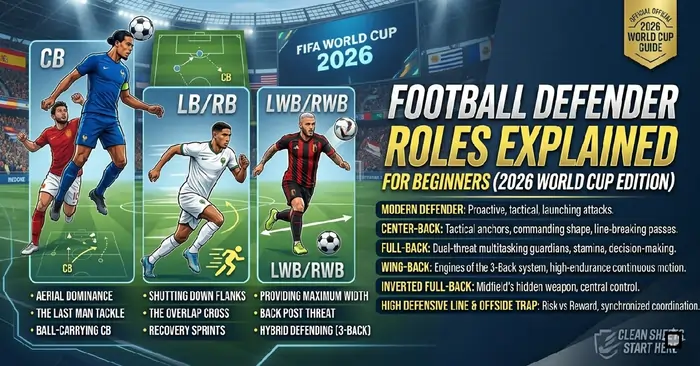
As we enter the 2026 FIFA World Cup cycle, the art of defending has reached a new peak of complexity. Gone are the days when defenders were simply “stoppers” who cleared the ball and waited for the next wave of attack. In today’s international game, every defender is expected to be a master of positioning, a high-speed runner, and a tactical general capable of launching attacks from the back.
Whether you’re watching Spain’s disciplined structure, Uruguay’s physical intensity, or the United States’ daring high-line defense, understanding these roles is key to appreciating the “chess match” on the pitch. The 2026 World Cup promises to showcase defenders who don’t just protect the goal—they define how modern football is played. Here are the Football Defender Roles Explained for Beginners.
The Foundation: The Modern Football Defender Roles Explained
The evolution of the defender role is one of football’s most dramatic tactical transformations. In 2026, defensive lines are no longer passive walls—they are launching pads for quick transitions and intelligent ball circulation. International managers now prioritize proactive defending: intercepting the ball higher up the pitch instead of waiting deep inside their own box.
A modern defender’s checklist looks very different than it did a decade ago. They must possess:
- The technique and passing range of a midfielder.
- Explosive acceleration and recovery speed.
- Tactical awareness to read pressing triggers.
- Communication to organize defensive shape.
In essence, defenders are both architects and enforcers: building play before it begins and destroying attacks before they mature.
The likes of Virgil van Dijk, Ruben Dias, and Jules Koundé demonstrate this perfectly. Each has redefined defensive intelligence for their national teams—balancing strong physical duels with pinpoint long passes that open up attacks.
The Center-Back (CB): The Tactical Anchors
Center-backs are the beating heart of the defensive line—the players who bind order and courage into one role. In knockout World Cup matches, they stand face-to-face with elite strikers like Kylian Mbappé or Erling Haaland, where one mistake can decide an entire nation’s fate.
Key Responsibilities:
- Aerial Dominance: Winning duels from long balls and set-pieces to prevent easy headers.
- The “Last Man” Tackle: Performing decisive, goal-saving interventions when the defensive line is breached.
- Organizing the Shape: Commanding the back line’s positioning to maintain compactness and structure.
- Composure Under Pressure: Playing out from the back during aggressive pressing phases.
In the 2026 World Cup, center-backs do much more than defend—they initiate attacks. This is where the “Ball-Carrying CB” comes in.
The 2026 Evolution: The Ball-Carrying Center-Back
No longer confined to sideways passes, modern center-backs frequently step into midfield with the ball. This creates numerical superiority—an extra man in build-up. Players such as William Saliba (France) and Alessandro Bastoni (Italy) exemplify this transformation.
Rather than launching long clearances, they “break the lines” by dribbling directly into open space. This forces opposing forwards to abandon their marking duties, opening huge pockets for attacking midfielders to exploit.
Example:
When France builds up from the back, Saliba will often carry the ball 15–20 yards into midfield before releasing it to Aurélien Tchouaméni or Antoine Griezmann. That single act destabilizes the press, converting defense into controlled offense.
The Ball-Carrying CB is also vital in pressing-resistance tactics. By using controlled dribbling, defenders can brave opposition pressure, draw attackers out of position, and then distribute passes behind the first line—an essential technique for nations adopting possession-based football like Spain, Japan, and England.
Tactical Partnerships: Dual and Sweeper Center-Back Roles
In some 2026 setups, teams employ asymmetric center-back duos—one serves as the aggressor, stepping out to challenge forwards, while the other acts as a covering defender, sweeping behind.
- Aggressive CB (Front-foot defender): Tackles early, tries to win possession.
- Cover CB: Stays deeper, anticipates rebounds, and blocks passing lanes.
This yin-yang relationship is seen in pairs like Ruben Dias and Antonio Silva for Portugal, or Marquinhos and Militão for Brazil. The synergy between these types is vital: if one commits to the press, the other reads the fallout.
The Full-Back (LB/RB): The Dual-Threat Guardians
Full-backs operate on the edges of the defensive unit. They are football’s unsung multitaskers—often the most hardworking players on the pitch, covering 10–12 kilometers per game.
Their job is deceptively complex: defend one moment, create chances the next.
Key Responsibilities:
- Shutting Down the Flanks: Resisting speedsters like Vinícius Jr. or Bukayo Saka in 1v1 duels.
- The Overlap: Sprinting beyond their winger to deliver crosses or cutbacks.
- Recovery Sprints: Racing back during counterattacks to restore defensive balance.
- Support in Build-Up: Providing passing outlets during midfield congestion.
At the World Cup level, stamina and decision-making are everything. Teams such as England and Morocco rely on full-backs to transition between defense and attack seamlessly. This constant switching demands extraordinary physical and mental endurance.
The Inverted Full-Back (IFB): Midfield’s Hidden Weapon
Tactically speaking, one of football’s most important innovations since 2022 has been the rise of the Inverted Full-Back. Look closely at teams like Portugal or England, and you’ll often see their full-backs drift infield—away from the touchline—when the team has possession.
Why? Because this role bridges defense and midfield. When the full-back moves centrally, they help form a compact triangle with the holding midfielder and center-backs. This makes it nearly impossible for opponents to counter through the center.
Benefits of the Inverted Full-Back System:
- Ball Retention: More midfielders available for short passes and recycling possession.
- Defensive Security: Quick transition into shape when losing possession.
- Control Through Numbers: Closer player spacing inhibits opposition pressing triggers.
Player Example:
Trent Alexander-Arnold’s transformation under England’s 2026 setup demonstrates this to perfection. While officially still a right-back, his average position during possession phases often places him beside midfielder Declan Rice. From there, he orchestrates play using diagonal passes and quick switches, effectively acting as a quarterback rather than a pure defender.
The Wing-Back (LWB/RWB): The Engines of the 3-Back System
In three-at-the-back systems—favored by nations like Germany, Morocco, and Croatia—the Wing-Back role becomes essential. They are the engines that power both the defensive and offensive transitions.
Positioned higher up than traditional full-backs, wing-backs combine the responsibilities of a defender and a winger. Their presence provides maximum width in attack while ensuring defensive cover on the flanks.
Key Responsibilities:
- Providing Maximum Width: Staying pinned to the touchline to stretch the opponent’s formation.
- The “Back Post” Threat: Arriving late in the box to finish crosses from the opposite side.
- Hybrid Defending: Shifting between wide midfielder and fifth defender based on the team’s in-possession state.
- Overlapping and Underlapping: Varying runs to confuse markers and open crossing lanes.
Modern wing-backs must be high-endurance players—running relentlessly for 90 minutes. Federico Dimarco with Italy and Achraf Hakimi with Morocco exemplify how offensive and defensive transitions can coexist fluidly within one player.
Example in Practice:
During Morocco’s counterattacks, Hakimi’s ability to surge forward from deep creates immediate overloads on the right wing. His pace turns defensive recoveries into attacking moments, reflecting why wing-backs are often described as “continuous motion.”
International Tactics: The High Defensive Line
At the 2026 World Cup, many elite nations rely on a High Defensive Line—a calculated risk where defenders hold positions near the halfway mark, even when the opponent has the ball.
The Risk:
One well-timed run or long pass can exploit the space behind the defense, leaving a fast striker with 40 yards of freedom to charge toward goal.
The Reward:
It compresses the effective playing area, forcing opponents to play under constant pressure and denying them room to build attacks comfortably.
To mitigate risk, defenders rely on precise timing and communication—traits perfected in European leagues before international tournaments. The Offside Trap is critical in this system: defenders step forward simultaneously the moment the ball is played to catch attackers offside.
A mistimed step can ruin this mechanism. If one defender lingers behind while others step up, the trap collapses, often leading to a one-on-one scenario. Nations like England and Portugal have refined this art through synchronized defensive coordination and advanced data tracking, using real-time positional feedback to maintain line integrity.
Discipline and Defensive Chemistry
Modern defenses thrive on chemistry as much as on skill. The back four (or five) functions as a unit—a synchronized web of communication, positioning, and anticipation.
Defensive chemistry is built through:
- Consistent pairing across matches, developing instinctive understanding.
- Drilled transitions between attack and defense phases.
- Voice leadership—the constant verbal exchange among players to adjust position or call a press.
- Trust levels cultivated in training, where defenders learn each other’s timing tendencies.
A great historical parallel is Italy’s defensive line in Euro 2020, where Leonardo Bonucci and Giorgio Chiellini operated almost telepathically. In 2026, this philosophy continues through Bastoni and Dimarco for the Azzurri—modernized through ball control but grounded in discipline.
Aerial Mastery and Set-Piece Dynamics
No matter how modern defense becomes, aerial duels remain decisive. Many World Cup goals come from set pieces—corners, free kicks, or indirect crosses—where defenders either rise as guardians or goalscoring threats.
Aerial Priorities for Defenders:
- Intelligent positioning: Mark zones aggressively to prevent free headers.
- Physical timing: Jump at the right split-second to clear, not just challenge.
- Second-ball anticipation: React to rebounds and loose scraps inside the box.
Elite defenders like Virgil van Dijk, Cristian Romero, and Ruben Dias blend power and anticipation, turning set pieces from chaos into calculable outcomes. Expect the 2026 tournament to showcase aerial duels as decisive moments in tight matches.
Analyzing the Tactical Spectrum: Defender Comparison (2026 Edition)
| Role | World Cup Icon | Core Skill | Tactical Intent |
| Center-Back | Ruben Dias (POR) | Reading the Game | Neutralizing the “9” |
| Full-Back | Achraf Hakimi (MAR) | 1v1 Defending, Pace | Controlling the touchline |
| Wing-Back | Federico Dimarco (ITA) | Elite Crossing | Creating chances from width |
| Inverted FB | Trent Alexander-Arnold (ENG) | Passing Range | Midfield domination |
These players exemplify how versatile defending has become. The transition between these archetypes defines the fluid tactical identity of their national teams—adaptability now trumps rigidity.
2026 Case Studies: National Team Defensive Styles
- Spain: Uses ball-dominant center-backs and inverted full-backs to strangle midfield spaces.
- Uruguay: Deploys compact, physical press with aggressive duels and minimal space surrender.
- United States: Experiments with a dangerously high line, banking on athletic recovery runs.
- France: Blends aggressive ball progression with positional discipline, making transitions lethal.
- England: Focuses on controlled possession from defense, where inverted full-backs act as playmakers.
Understanding these contrasts will help viewers appreciate why some nations seem “riskier” at the back—they’re not reckless; they’re strategically expansive.
Mental Fortitude: The Defender’s Psychology
Defending is as psychological as it is physical. A defender must make split-second decisions—whether to tackle, contain, or track. Confidence and composure under pressure are priceless.
In knockout stages, every small lapse can cost millions of fans their dream moment. That pressure breeds leaders. Center-backs like John Stones or José Giménez embody this rare steel—calm yet commanding when chaos unfolds.
Defenders also shoulder immense invisible work: guiding teammates, adjusting shape mid-game, and handling frustration when their side concedes despite perfect marking. This mental dimension defines “world-class” more than raw defensive stats ever could.
Conclusion: Defense Wins World Cups
History doesn’t lie—while strikers sell tickets, defenders lift trophies. Italy’s Euro triumph in 2020, France’s balance in 2018, and Argentina’s resilience in 2022 all underline this truth. In every era, champions are born from defensive unity.
As you watch the 2026 FIFA World Cup, pay attention not only to goals but to movements without the ball. Notice how defenders glide laterally as one organism, how they signal to midfielders to step or hold, and how they initiate attacks with composure and timing.
They aren’t merely protecting the goal—they’re the foundation of global victory. The defenders of 2026 embody football’s evolution: fast, intelligent, and indispensable to every strategy that unfolds across the world’s grandest stage.