
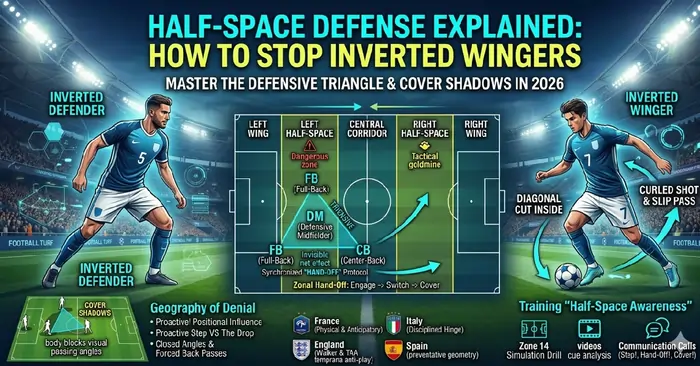
In the tactical landscape of the 2026 FIFA World Cup, the deadliest area on the pitch isn’t always the penalty box or even the wings — it’s the Half-Space.
This narrow vertical corridor, stretching between the central channel and the touchline, has become the favorite battlefield of the modern attacker. It’s where creative chaos meets positional precision — and where some of the world’s most electrifying wingers and playmakers carve open defenses with surgical precision.
Players like Vinícius Júnior, Bukayo Saka, and Mohamed Salah are redefining how we view wide forwards. They start wide, drift inside, and attack not down the flank, but into the narrow seam where defenders hesitate, unsure whether to step up or stay back.
For defenders, the half-space is a nightmare — a twilight zone that exposes the gaps between defensive logic and timing. And at this level, a moment’s indecision means a goal.
To survive the modern game, every elite national team entering the 2026 tournament must master one essential art: Half-Space Defense.
What Is the Half-Space?
To understand how to defend it, you must first understand its geography. When coaches divide the football pitch into vertical zones, there are typically five lanes:
- The left wing
- The left half-space
- The central corridor
- The right half-space
- The right wing
The half-spaces—those narrow vertical strips nestled between the central lane and the wide channels—have become tactical goldmines for attackers.
Why? Because they sit in the blind spot of most defensive systems.
In a typical 4-4-2 shape:
- The Full-Back (FB) is drawn wide to track the opposition winger.
- The Center-Back (CB) stays narrow to mark the striker.
- The gap between them becomes open territory — the half-space— ripe for exploitation.
Enter the Inverted Winger — a modern attacker who thrives precisely in this gap. Positioned in neither the winger’s lane nor the striker’s slot, they confuse defenders into hesitation. It’s not always clear who should engage: the full-back, the center-back, or the defensive midfielder?
The answer must be collective — not individual.
The Threat of the Inverted Winger
In 2026, the traditional winger — the one who hugs the touchline and delivers crosses — is nearly extinct. The modern game belongs to the Inverted Winger:
- Right-footed on the left (Vinícius Júnior, Gakpo)
- Left-footed on the right (Salah, Saka, Messi’s late evolution)
This inversion allows attackers to open up their stronger foot toward goal rather than the corner flag.
When an inverted winger moves into the half-space, they gain diagonal perspective — seeing the penalty area, the far post, and the onrushing striker all at once.
The Triad of Threats
When they receive the ball between the lines, they can instantly choose from three lethal options:
- The Curled Shot: The signature move — angling toward the top corner with that inside foot.
- The Slip Pass: Threading a through-ball between the CB and FB for a diagonal runner.
- The Switch: Sending a lofted cross-field pass to the far winger, exploiting defensive collapse.
This triple-choice attack transforms the half-space into the most unpredictable region of modern football. Defenders who treat it like a standard wing battle often find themselves reacting half a beat too late.
Structural Solution: The “Defensive Triangle”
No single defender can neutralize the half-space alone. The moment a winger cuts inside, traditional 1v1 discipline collapses. What works instead is geometry — specifically, a three-man defensive structure known as the Defensive Triangle.
This triangle connects three players:
- The Full-Back (FB) marking the wide zone
- The Center-Back (CB) providing cover
- The Defensive Midfielder (DM) shielding from above
Together, they synchronize their movement to create an invisible net around the half-space.
The “Hand-Off” Protocol
At the professional level, this coordination happens through Zonal Hand-Offs — seamless transitions of defensive responsibility across players.
- Phase 1 – The Engage: The full-back tracks the winger as they receive the ball near the touchline.
- Phase 2 – The Cut: As the winger drives diagonally inward, the full-back “hands off” defensive control to the defensive midfielder stepping across.
- Phase 3 – The Cover: Meanwhile, the center-back adjusts slightly to block vertical passing lanes and prevent through-balls behind the line.
A momentary lapse in this triangle — a mistimed step, a late rotation — creates catastrophe.
- If the DM is slow to engage, the winger gets space for a free shot.
- If the CB steps too early, they leave space for a striker’s diagonal run.
The strongest defenses at the 2026 World Cup — such as France, Argentina, and Italy — will rely on this triangular synchronization to neutralize attackers’ rhythm.
Tactical Counter: The “Inverted Defender”
To counter the inverted winger, modern coaches now deploy the logical inverse: the Inverted Defender.
The Concept
Imagine facing a left-footed winger cutting inside from the right (say, Bukayo Saka). Instead of matching him with a right-footed right-back, a manager might choose a left-footed defender for that role.
The result is a “mirror matchup.”
When Saka cuts inward on his strong foot, he runs straight into the defender’s tackling foot.
This orientation forces attacking wingers to reconsider their angles, reducing shooting and passing windows.
By shutting down the dominant-foot angle, inverted defenders flip the script on inverted wingers.
The Shield Effect
This approach also improves passing interception rates. Since the defender’s body is already turned toward the inside channel, they naturally block many common passing lanes before challenges even occur.
It’s subtle, but in world-class football, orientation is everything. The outcome of a one-second duel between inverted forces often decides matches.
Closing the “Passing Lane” with Cover Shadows
Not every battle in the half-space ends with a tackle. In fact, elite defenders often win by invisibility — by removing options before they even exist.
This is where the concept of the Cover Shadow dominates modern training.
Defining the Cover Shadow
A defender’s shadow isn’t literal — it’s positional influence. It’s the triangle-shaped area behind them where their body blocks potential passing angles from the ball-carrier.
When a midfielder — say, Pedri — has the ball for Spain, defenders must position themselves not just to protect zones but to cut sightlines toward half-space receivers like Nico Williams or Olmo.
In other words, a defender can neutralize a winger without touching them.
The Geometry of Denial
The rule is simple:
- Always position yourself between the ball and the half-space receiver.
- Tilt your hips toward both the ball and your mark.
- Force backward or horizontal passes — never forward diagonals.
Players like Virgil van Dijk or Ruben Dias embody this discipline. They rarely lunge because their shape “deletes” high-risk spaces. In the data-driven era, preventing the ball from reaching an inverted winger is as valuable as tackling them once they get it.
The “Aggressive Step” vs. “The Drop”
Defensive excellence in 2026 is not static; it’s dynamic decision-making. Every defender now faces a recurring dilemma:
Should I step forward to close space, or drop back to contain danger?
Both options can succeed — or fail — depending on context.
The Aggressive Step
Used against technically gifted but slower wingers. When facing players like Riyad Mahrez or Bernardo Silva, defenders must tighten space instantly, suffocating the half-space before creativity blooms.
The Defensive Midfielder becomes key here. By stepping forward at high speed, they force the inverted winger to release early, often sideways, disrupting rhythm and shot creation.
The Drop
Against sprinters like Kylian Mbappé or Vinícius Jr., stepping up is suicide. The solution is depth control: the back line must drop toward the penalty edge, closing off runs behind and forcing the attacker to stay in front.
Dropping converts a vertical duel into a horizontal one, containing the danger within predictable lines. The team sacrifices pressing height for structural stability — a choice that often determines knockout match survival.
Half-Space Defense vs. Traditional Defense
| Feature | Traditional Defense | Modern Half-Space Defense |
| Focus | Man-marking assignments | Zonal awareness & pattern reading |
| Full-Back Role | Stays wide, blocks crosses | Tucks inside, supports DM |
| Communication Code | “Stay with your runner” | “Switch and cover” (hand-off protocol) |
| Shape Transition | 4-4-2 / flat lines | 4-3-3 or 5-2-3 rotations |
| Primary Goal | Prevent the cross | Deny diagonal shots and passes |
| Defensive Reaction | Reactive, individual | Anticipatory, collective |
The evolution toward half-space awareness signifies football’s future — where defense transforms from reaction to prediction.
Training the “Half-Space Awareness”
Mastering half-space defense isn’t learned through chalkboard diagrams alone. It’s a cognitive habit — trained through repetition, visualization, and communication.
Here are core drills and exercises professional teams use preparing for 2026:
The “Zone 14” Simulation Drill
- Divide the pitch into five lanes: two wings, two half-spaces, and the center.
- Conduct 3v3 mini-games specifically within half-space zones.
- Objective: Defenders must communicate transitions, executing correct hand-offs when attackers switch zones.
This forces automatic pattern recognition between defenders and midfielders.
Body Orientation Practice
Half-space defenders must stand in “half-open” stances — hips turned 45 degrees. This angle lets them monitor both an inside attacker and a wide runner.
Training players to adopt this stance instinctively reduces blind spots during transitions.
Cover Shadow Awareness
Defenders conduct line drills where they must block visual passing lanes rather than intercept balls directly. The focus is shape discipline — learning how to influence pass direction without active challenges.
Video Cue Analysis
Teams analyze how elite wingers behave before cutting inside. Some players reveal predictable cues — a drag-back touch, a shoulder feint, or a specific stance before switching angles.
By recognizing these micro-triggers early, defenders shave milliseconds off their reaction time — often the difference between containment and collapse.
Communication Drills
Assign calls for every action within the triangle:
- “Step!” signals the DM to press.
- “Hand-Off!” indicates overlap of responsibility.
- “Cover!” alerts the CB to adjust position.
Silent understanding, built through repetition, creates defensive instincts that no attacking choreography can outthink.
Tactical Variations in 2026
Different nations employ nuanced versions of half-space defense, shaped by style and personnel.
France:
Relies on the physicality of Saliba and Varane combined with Tchouaméni’s anticipatory midfield coverage. Their triangle is compact but aggressive, built to counter fast dribblers.
Italy:
Employs a disciplined “hinge” system. Bastoni tucks toward midfield while Barella acts as the switch point — pressing or dropping based on the winger’s cut direction.
England:
Uses hybrid full-backs like Walker and Alexander-Arnold to anticipate diagonal plays early. Their half-space defense doubles as a counterattack launch pad through interceptions.
Brazil:
Focuses on athletic closing — using Casemiro or Bruno Guimarães as the pivot point for defensive collapses. Their half-space defense emphasizes muscular pressure and recovery speed.
Spain:
Opt for preventive geometry through possession. Rather than defend the half-space reactively, they deny it ever forming by keeping the ball — turning defense into control.
Mistakes That Break the System
Defending half-spaces demands near-perfect timing. Here are common failures that elite analysts watch for in 2026:
- Late DM Rotation: The holding midfielder fails to arrive in time for the hand-off, leaving the winger free to shoot.
- Overstepping CB: The center-back commits early, opening horizontal seams for a striker’s run.
- Ball-Watching FB: Full-backs focus on the ball instead of tracking underlaps from opposite wingers.
- Poor Body Angling: Defenders stand square to the play, unable to pivot quickly.
- Silence in the Triangle: Lack of verbal cues causes simultaneous commitment — two defenders press, none cover.
Each failure unravels layer by layer until one cutback pass finds the net.
The Philosophy Behind Great Half-Space Defending
Half-space defending isn’t just physical strategy — it’s philosophical balance. Successful teams view it as a shared consciousness built on three principles:
- Proactive Mindset: Anticipate before reacting. Every defender should think one passing lane ahead.
- Visual Connection: Maintain triangular sightlines — never turn your back on space.
- Zonal Brotherhood: Defending isn’t heroism; it’s handoffs and harmony.
Great half-space defense isn’t about containing one attacker — it’s about taming the rhythm of attack itself.
Conclusion: Winning the Twilight Zone
The half-space is football’s twilight zone — the gap between logic and instinct, order and improvisation. It’s the channel where the best wingers in the world — Vinícius, Saka, Salah — transform finite room into infinite creativity.
Yet, for defenders who master its mysteries, it can also become a dead zone — a space closed off not by tackles, but by intelligence.
The key lies in mastering the geometry of resistance:
- The Defensive Triangle, synchronized in real time.
- The guiding Cover Shadows, cutting off sightlines before danger brews.
- The disciplined Hand-Offs that prevent hesitation in the twilight.
At the 2026 FIFA World Cup, the trophy may not belong to the most flamboyant attack, but to the nation whose defenders turn complexity into calmness — who silence chaos in football’s most chaotic zone.
Because in the half-space, victory belongs not to speed, but to understanding.