
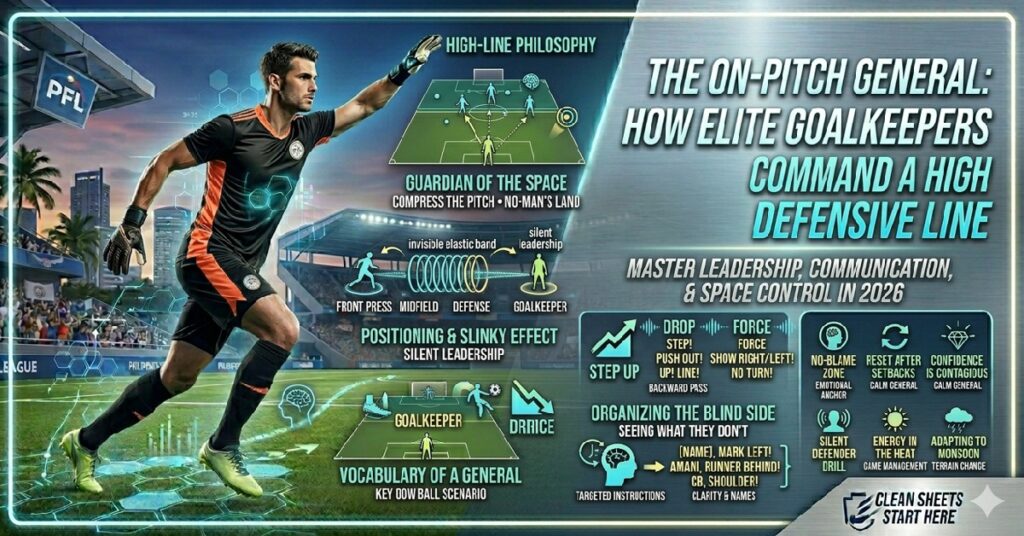
In the modern tactical landscape of 2026, the image of a goalkeeper quietly standing on their line is a relic of the past. Today’s Elite Goalkeepers Command, from the tactical masters in the European Champions League to the top-tier shot-stoppers in the Philippines Football League (PFL)—have a new job title: The On-Pitch General.
As teams increasingly adopt a high defensive line to compress the pitch and dominate possession, like in FIFA World Cup teams, the goalkeeper’s role as communicator, organizer, and emotional anchor has become the most critical factor in a team’s defensive success. When your defenders are pushed up to the halfway line, the space behind them becomes a danger zone. To survive, a goalkeeper must lead—not just with saves, but with voice, positioning, and personality.
In this finale to our goalkeeping cluster, we explore the psychology of leadership, the mechanics of organizing a high line, and the vocal commands that keep a clean sheet. By the end, you’ll see why the best keepers are not only the last line of defense, but the first line of organization.
The High-Line Philosophy: Why Goalkeepers Must Lead
A high defensive line is a high-risk, high-reward strategy. When it works, it strangles the opponent’s attack and keeps your team playing in the attacking half. When it fails, it gifts opponents clean 1v1s and breakaways.
Why Teams Use a High Line
By pushing the back four (or back three) up the pitch, a team:
- Compresses the space the opponent has to play in.
- Makes pressing easier, because lines are closer together.
- Keeps the team connected, so losing the ball doesn’t immediately expose huge gaps.
But there is a cost. Every step your defenders take forward expands the space in behind. That “green ocean” between the last defender and the goalkeeper becomes the most valuable real estate on the pitch for quick strikers and accurate passers.
The Guardian of the Space
The goalkeeper is the only player who truly sees all of it.
A center-back like Jefferson Tabinas might be locked in a duel with the striker directly in front of him. Full-backs may be focused on their winger. Midfielders are often chasing second balls or marking runners. Only you, the goalkeeper, have the panoramic view:
- You see the winger on the far side starting a sneaky run.
- You see the #10 drifting between lines.
- You see the defensive line slowly, almost unconsciously, dropping deeper or shifting out of shape.
Your mission: you are not just defending the goal; you are defending the space behind your line.
Your strategy: act as the “connective tissue” between defense and midfield. You keep the gap between them compact enough that no opponent can simply drop a ball into the void and watch a striker race through.
This is why a high-line system without an active, vocal goalkeeper often crumbles. The system itself demands a general at the back, not a spectator.
Positioning as Leadership: The Slinky Effect
Before you even open your mouth, your positioning sends a message. This is silent leadership—the way you stand tells your defenders how brave they can be.
The Team as a Slinky
Imagine your team as a slinky toy stretched across the field:
- When the front players press forward, the midfield has to move up behind them.
- When the midfield steps up, the defenders must follow.
- When the defenders push, you must move with them.
If one part stays still while the rest moves, the slinky breaks. The shape disconnects. For a high line to work, all parts have to move in sync—and you are the last coil in that slinky.
Zone of Control
When the ball is in the opponent’s half and your team is in a high press, an elite “General” does not sit on the six-yard line. Instead:
- You stand around the edge of the 18-yard box, sometimes even a few steps beyond it if your line is very high.
- You constantly adjust—two steps up, one step back, mirroring the ball’s position and your defenders’ line.
From there, you can:
- Sweep up long balls over the top.
- Offer yourself as a passing option for recycled possession.
- Stay close enough to your line to recover if the opponent breaks quickly.
The Message Your Positioning Sends
By standing high, you signal to your defenders:
“I’ve got the space behind you. You are safe to press high and stay tight to your man.”
If you quietly drift back toward your goal line:
- Your defenders feel exposed and will instinctively drop deeper.
- The back line sinks, the midfield gets stretched, and the high press breaks.
- Suddenly your team is defending deep again—even if the coach’s plan was to stay high.
In other words, your starting position is not just tactical; it is psychological. You either give your defenders courage or invite their fear.
The Vocabulary of a General: Vocal Commands That Work
On a noisy night at Panaad or during a heated 7-a-side match at Turf BGC, random shouting is background noise. To cut through that chaos, you need a clear, rehearsed vocabulary—short words that carry meaning instantly.
Your commands must be:
- Loud.
- Simple.
- Specific.
- Repeated at the right moments.
A. The “Step Up” Command
Used when:
- The opponent plays a back-pass or sideways pass.
- A long ball is cleared out of their defensive third.
- You see the chance to move your line higher and trap strikers offside.
Goal: Shift the whole line up quickly to compress space and catch opponents who are slow to retreat.
Typical shouts:
- “STEP! STEP! STEP!”
- “PUSH OUT!”
- “UP! LINE!”
Timing matters. You want to shout as the pass is moving backwards or sideways, not after the opponent has already turned and played a long ball.
B. The “Drop” Command
Used the moment:
- An opponent has “open ball”—time and space to look up and play long.
- A midfielder receives the ball facing forward with no pressure.
- A fast winger starts a sprint in behind.
Goal: Prevent your defenders from getting caught high and flat-footed.
Typical shouts:
- “DROP! DROP!”
- “AWAY! AWAY!”
- “BACK FIVE! BACK!”
The drop does not need to be huge—sometimes 3–5 yards is enough to buy you a fraction more time to read and deal with the pass.
C. The “Force” Command
Defending is not just about distance; it’s about angles. Modern keepers help defenders decide where to send the attacker:
- Toward the touchline (outside) where space is limited.
- Onto their weaker foot, where their shot or cross is less dangerous.
- Away from the center, where runners and second balls are more threatening.
Typical shouts:
- “FORCE OUTSIDE!”
- “SHOW RIGHT!” / “SHOW LEFT!”
- “NO TURN!” (if you want the attacker to play backwards)
Over time, your defenders will react automatically to these cues. You are essentially “coaching live” every 2–3 seconds.
Organizing the Blind Side: Seeing What They Don’t
Defenders, especially in a high line, often become ball-watchers. Their eyes lock onto the player with the ball, and they lose track of runners drifting behind them or to their far side. That is where you come in.
Constant Scanning
Your head should be on a swivel:
- Check the ball.
- Check the line of defenders.
- Check the far side and central runners.
- Repeat every few seconds.
Key questions you ask yourself:
- Is a winger ghosting in at the far post?
- Is a midfielder making a late run into the box?
- Is there a striker standing offside, waiting to time his run?
You are looking not just at where players are, but at where they are about to be.
Specific, Targeted Instructions
Vague instructions create chaos. Shouting “Someone mark him!” is nearly useless—no one knows if you’re talking to them or someone else.
Instead, use:
- Names or positions.
- Clear directions.
Examples:
- “Santi, check your left!”
- “Amani, runner behind!”
- “Center-back, shoulder! Shoulder!”
- “Full-back, far post, mark tight!”
By attaching a name (or role) and a direction, you remove ambiguity. The defender knows:
- This is for me.
- This is where I need to look.
- This is what I’m supposed to do.
In a high line, that clarity buys you critical seconds.
The Mental Burden: Managing Morale and Emotion
Being the General is not only tactical—it is emotional. When you play with a high line, mistakes are punished harshly. One mistimed step, one misread bounce, and the opponent is through.
The “No-Blame” Zone
In many older dressing rooms, goalkeepers and defenders might scream at each other after a goal. Modern keepers at the highest level are moving away from that approach.
Why blaming is counter-productive:
- It erodes trust between you and your backline.
- It makes defenders play more cautiously, scared to make decisions.
- It turns one mistake into a mental spiral.
The better approach is to treat the pitch as a no-blame zone and the locker room or video room as the place for detailed feedback.
Resetting After Setbacks
When a goal goes in from a high line:
- The temptation is to rage, throw your arms up, or blame the last player to touch the ball.
- The leadership choice is to reset the team’s mentality immediately.
The first words you say matter. Strong options:
- “Next one. Keep the line high—we go again.”
- “We stay brave. Same plan.”
- “Forget it, focus. Reset shape.”
You want your defenders to feel:
- The system itself is still trusted.
- They are allowed to keep playing courageously.
- One mistake does not define the game.
Confidence Is Contagious
Your body language is a message that spreads through the team:
- If you look panicked, your defenders will panic.
- If you look flat and defeated, their energy drops.
- If you stay upright, composed, and decisive, they are more likely to play with “ice in their veins.”
The On-Pitch General must be the calmest person on the field when chaos hits.
Training the General: Communication as a Skill
Communication and leadership are trainable, just like diving, handling, or distribution. You don’t become vocal by accident you build it through intentional practice.
The “Silent Defender” Drill
Setup:
- Small-sided game (e.g., 7v7 or 8v8).
- Defenders are not allowed to speak during the game.
- Only the goalkeeper is permitted to give verbal instructions.
Outcome:
- You quickly realize how much you need to talk.
- You learn to anticipate problems instead of reacting late.
- You practice giving clear, concise commands rather than constant noise.
This drill forces you to become the conductor, not just another instrument.
The “Back-to-Goal” Drill
Setup:
- You face the field as normal.
- A coach or assistant stands behind you, outside your line of sight.
- The coach gives silent signals—e.g., a tap on one shoulder for “Step,” a tap on the other for “Drop.”
- You must relay these cues instantly to your defenders with loud verbal commands.
Outcome:
- You build reflexive communication: as soon as you sense danger, you speak.
- You train yourself to react fast and transmit information clearly.
- You practice the vocabulary you’ll use in real games.
Using Video and Audio Analysis
Modern academies and professional clubs increasingly record matches and training from behind the goal, sometimes even with a mic near the keeper.
Watching yourself back, ask:
- Am I pointing and using body language, or just shouting?
- Do I speak before danger develops, or only after something goes wrong?
- Are my commands clear and consistent? Or vague and emotional?
Self-review turns your instincts into refined habits.
The Philippine Context: Leading in the Heat and Rain
Commanding a high line in the Philippines carries additional challenges: intense heat, humidity, and monsoon weather all affect how loudly you can speak, how quickly your teammates tire, and how risky a high line can be.
Managing Energy in the Heat
Under the blazing sun in Manila, Cebu, or Bacolod:
- Players tire faster, mentally and physically.
- Concentration levels drop late in each half.
- Sprinting back to cover long balls becomes harder.
As the General, part of your leadership is game management:
- Notice when your defenders’ legs are getting heavy.
- If you see them struggling to recover, you might decide to drop the line 5–10 yards deeper for a period.
- Communicate this clearly: “Drop ten! Rest shape!” or “Deeper line, recover!”
This is not abandoning the philosophy; it’s adapting it to the real conditions in front of you.
Leadership in the Monsoon
On a wet pitch:
- The ball skids faster behind the line.
- Misjudged bounces can turn safe balls into dangerous ones.
- Risky short passes in your own third become more hazardous.
In heavy rain, you must:
- Be louder and more decisive—rain and crowd noise can swallow weaker voices.
- Emphasize “safety first” when appropriate:
- “Clear wide!”
- “No risk!”
- “Out! Out!”
You still want to play a brave high line when possible, but you adjust the risk level:
- Long, skidding balls behind you mean your starting position may drop a few yards.
- You tell defenders to clear under pressure rather than try risky turns in puddles.
Good generals change tactics with the terrain.
Summary Checklist for the On-Pitch General
Use this quick reference as your mental checklist on match day:
Scenario: Opponent plays a back-pass
- Your action: Step forward 3–5 yards, raise your voice.
- Command: “STEP UP!” / “LINE!”
Scenario: Attacker looks ready to play long or a winger starts a deep run
- Your action: Direct defenders to retreat as you adjust your position.
- Command: “DROP! DROP!” / “AWAY!”
Scenario: Defensive confusion, free runner appearing
- Your action: Point clearly at the unmarked player, call out a name.
- Command: “[Name], MARK LEFT!” / “[Name], far post!”
Scenario: Corner kick against you
- Your action: Assign match-ups, place tallest players centrally, call zonal/marking roles.
- Command: “Tallest center!” / “Near post!” / “Mark tight!”
Scenario: Free kick against you
- Your action: Set the wall from the post, count steps, adjust left/right.
- Command: “Two left! Hold!” / “No jump!” if needed.
Over time, these become automatic responses instead of conscious decisions.
Conclusion: Elite Goalkeepers Command
Across this goalkeeping cluster, we’ve looked at the physics of shot-stopping, the geometry of positioning, the speed of the 8-second rule, and the craft of distribution. Commanding a high defensive line is the glue that holds all of those skills together.
A goalkeeper who truly leads:
- Keeps the defensive line synchronized.
- Turns complex tactics into simple, repeatable commands.
- Manages the emotional temperature of the team under pressure.
- Adapts the high-line philosophy to the realities of heat, rain, and fatigue.
In 2026, the greatest keepers are not just those with the most spectacular saves or the cleanest jerseys. They are the ones whose voices shape the entire game, whose positioning gives courage to their defenders, and whose decisions allow the high line to function without fear.
When you step onto the pitch, you are not just wearing the #1 shirt—you are stepping into the role of the On-Pitch General. Embrace it, and you don’t just protect your goal; you elevate everyone in front of you.